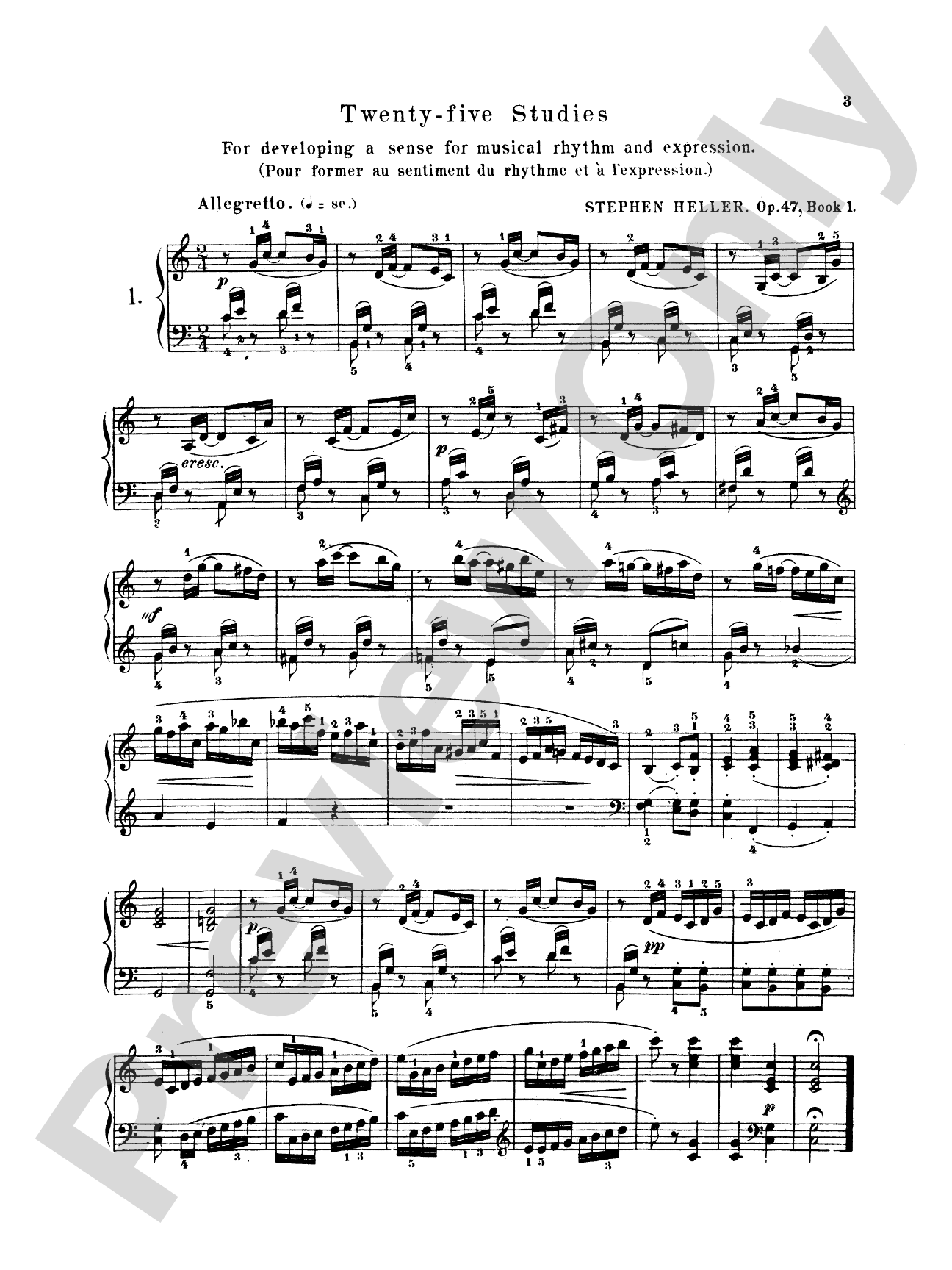
Heller: Twenty-five Studies, Op. 47 Sheet Music Preview

Heller: Twenty-five Studies, Op. 47

By Stephen Heller

Item: 00-PC-0007708

Digital Download
$0.99
Description
A collection of exercises for piano, composed by Stephen Heller.

Don't just read it, hear it, play along with it, and watch your students grow with it. In MakeMusic Cloud, Heller: Twenty-five Studies, Op. 47 comes alive with professional accompaniment, adjustable tempo, and built-in practice tools that turn solo practice into real progress.

Sample Audio
No sample audio found.
Sample Video
Additional Details
Series: Kalmus Edition
Publisher: Alfred Music
Page Count: 36
SKU: 00-PC-0007708

More about this title

About the Composer: Stephen Heller

Stephen Heller (1813-1888) was an Austrian pianist and composer whose prolific output of studies and character pieces shaped 19th-century piano pedagogy. A virtuoso performer who studied with Carl Czerny, Heller brought musical sophistication to technical training, composing studies that developed facility without sacrificing artistic merit.

Heller's legacy rests on his ability to marry mechanical drill with genuine musical substance. His etudes remain standard repertoire in conservatories worldwide because they treat the piano student as a musician first, not merely a technician.

Why we love this

Heller's Op. 47 studies deserve a permanent place in the intermediate pianist's library because they accomplish what few collections do: they solve specific technical problems while remaining genuinely musical to perform and hear. Each study isolates one or two challenges (hand independence, scale work, arpeggiation, rhythmic clarity) without reducing the piece to mere finger gymnastics. Teachers return to these again and again because students actually want to practice them.

What to expect

These studies occupy the spacious, lyrical world of 19th-century salon music. You'll encounter elegant melodic lines over flowing accompaniment patterns, clear harmonic progressions, and moments of genuine beauty emerging from technical work. The writing feels accessible yet never condescending, inviting performers into the world of Romantic pianism at a pace that builds both capability and confidence.

Who it's for

Intermediate pianists (roughly grades 4-6 level) benefit most from this collection, particularly students ready to tackle more refined technical challenges in a Romantic aesthetic. These studies fit naturally into a progression from Czerny or Hanon toward more substantial repertoire, offering musicality that basic technique books lack. Teachers seeking studies that develop independence between the hands while maintaining artistic integrity will find this essential.

How to get the most out of it

  • Identify the primary technical focus of each study before you begin; treating it as a complete musical thought rather than an exercise changes how you approach tone and phrasing.
  • Work for even passage work by isolating hands separately first, then gradually bring them together at a slow enough tempo to maintain clarity in both parts.
  • Shape phrases with gentle rubato and dynamic contour; Romantic-era studies respond well to expressive playing and reward attention to voice leading within the figuration.
  • Record yourself periodically to hear whether technical patterns are becoming automatic, freeing your attention for musical interpretation.

How to use it

Assign these studies as foundational technical material across an entire season rather than as standalone recital pieces. Their 36 pages allow you to introduce one or two studies every few weeks, rotating focuses to address the specific challenges your students face. A student performing a Chopin Prelude or a Schumann Album for the Young benefits tremendously from concurrent work in Heller, where similar technical patterns appear in isolation.

Skills your students will build

  • Independence between right and left hands
  • Evenness and clarity in rapid scalar and arpeggio passages
  • Control of Romantic-era accompaniment patterns (broken chords, alberti figures)
  • Phrasing and tone production within etude contexts
  • Hand position stability across extended technical passages
  • Reading and executing dynamic and expressive markings in period style

You May Also Like