
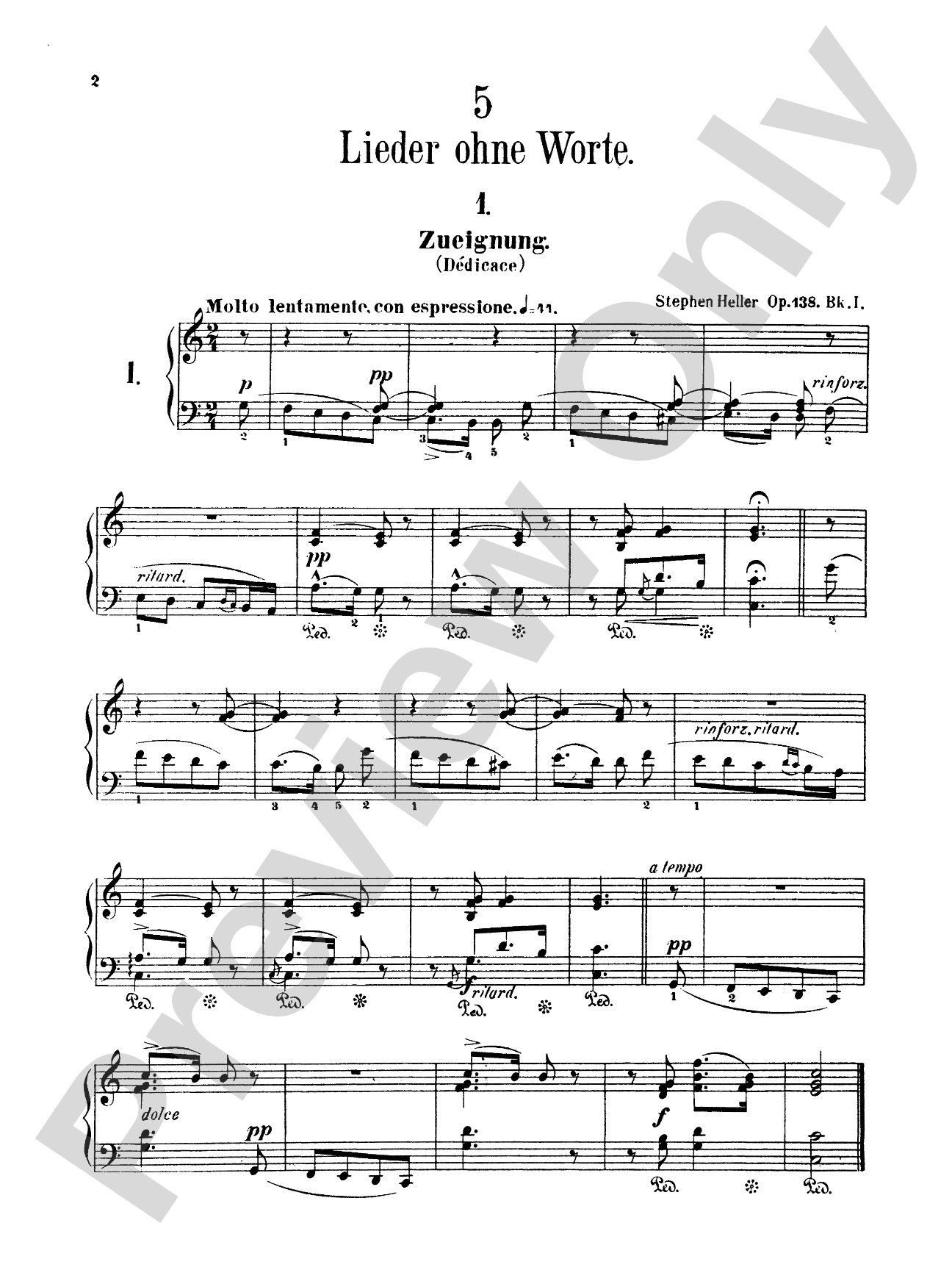

Heller: Album for the Young, Op. 138: Piano Book
By Stephen Heller
Level: Intermediate / Advanced
Item: 00-PK-0003144

$9.99
Pickup currently not available
Buy Extra Parts (Digital PDF Download)
Parts Added to Cart!
Related Items
Album for the Young, Opus 138: Piano Book |
$9.95
|
View |
Description
An Intermediate / AdvancedPiano Solo, composed by Stephen Heller.


Don't just read it, hear it, play along with it, and watch your students grow with it. In MakeMusic Cloud, Heller: Album for the Young, Op. 138: Piano Book comes alive with professional accompaniment, adjustable tempo, and built-in practice tools that turn solo practice into real progress.
Open in the Player
Jump straight in and assign it today.
Start Your Free Trial
Open this title and explore the full library in minutes.
Sample Audio
No sample audio found.
Sample Video
No sample videos found.
Additional Details
Series:
Kalmus Edition
Publisher:
Alfred Music
Page Count:
40
SKU:
00-PK-0003144
More about this title
About the Composer: Stephen Heller
Stephen Heller (1813, 1888) was a Hungarian pianist and composer whose prolific output shaped 19th-century piano pedagogy. Though less celebrated today than his contemporaries Chopin and Liszt, Heller was a serious musician whose technical and musical demands pushed students beyond mechanical exercises into genuine artistry.
Heller's teaching collections remain essential because they strike a rare balance: pieces that sound elegant and musical while systematically developing pianistic maturity. His Album for the Young represents the culmination of his pedagogical philosophy, offering intermediate and advanced students a pathway into romantic repertoire that respects both their developing technique and their musical intelligence.
Why we love this
Heller understood the intermediate to advanced student's moment of transition—when technical facility must meet artistic intention. This collection offers genuine Romantic miniatures with structural clarity and emotional range, avoiding both the overly scholastic and the gratuitously difficult. Each piece feels composed rather than assembled, which means students spend practice time becoming musicians, not merely solving technical puzzles.
What to expect
These pieces inhabit a world of Romantic intimacy and refinement. You'll encounter lyrical melodies that unfold with restraint, harmonic language that shifts color without dramatic gesture, and a kind of narrative economy where small musical ideas generate complete emotional arcs. The writing feels conversational rather than declamatory, inviting the listener into private musical thought.
Who it's for
Piano students at the intermediate to advanced level who have moved beyond strictly pedagogical etudes and can handle layered textures, mixed meters, and longer formal structures. This collection suits serious students preparing for conservatory entrance, high school pianists building a substantial repertoire, and adult learners ready for substantial Romantic miniatures.
How to get the most out of it
- Identify the harmonic rhythm within each piece before diving into passage work; Heller's voice leading repays close attention and will guide phrasing naturally.
- Attend to the relationship between melody and accompaniment in different registers; resist the habit of letting the left hand recede when exploring what the right hand needs.
- Use sectional practice to lock down form and pacing; knowing where you are architecturally helps tempo remain steady under the weight of interpretive choices.
- Approach dynamic markings as information about structural weight rather than surface effect; Heller uses them to clarify phrase relationships and harmonic movement.
How to use it
Heller's Album works beautifully in a student recital program, either as standalone pieces between larger works or as a themed set that demonstrates musical growth across the collection. The pieces are compact enough to allow for variety within a single program, making this source invaluable for pianists building 20-minute to 30-minute recital sets.
Skills your students will build
- Pedaling for color and resonance in Romantic harmony
- Balancing melodic line with accompanimental texture across hand independence
- Sustaining phrasing across key areas and modulations
- Managing mixed articulation (legato, staccato, and semi-staccato) within single pieces
- Reading nineteenth-century Romantic score conventions and performance markings
- Building interpretive choices from structural and harmonic analysis