
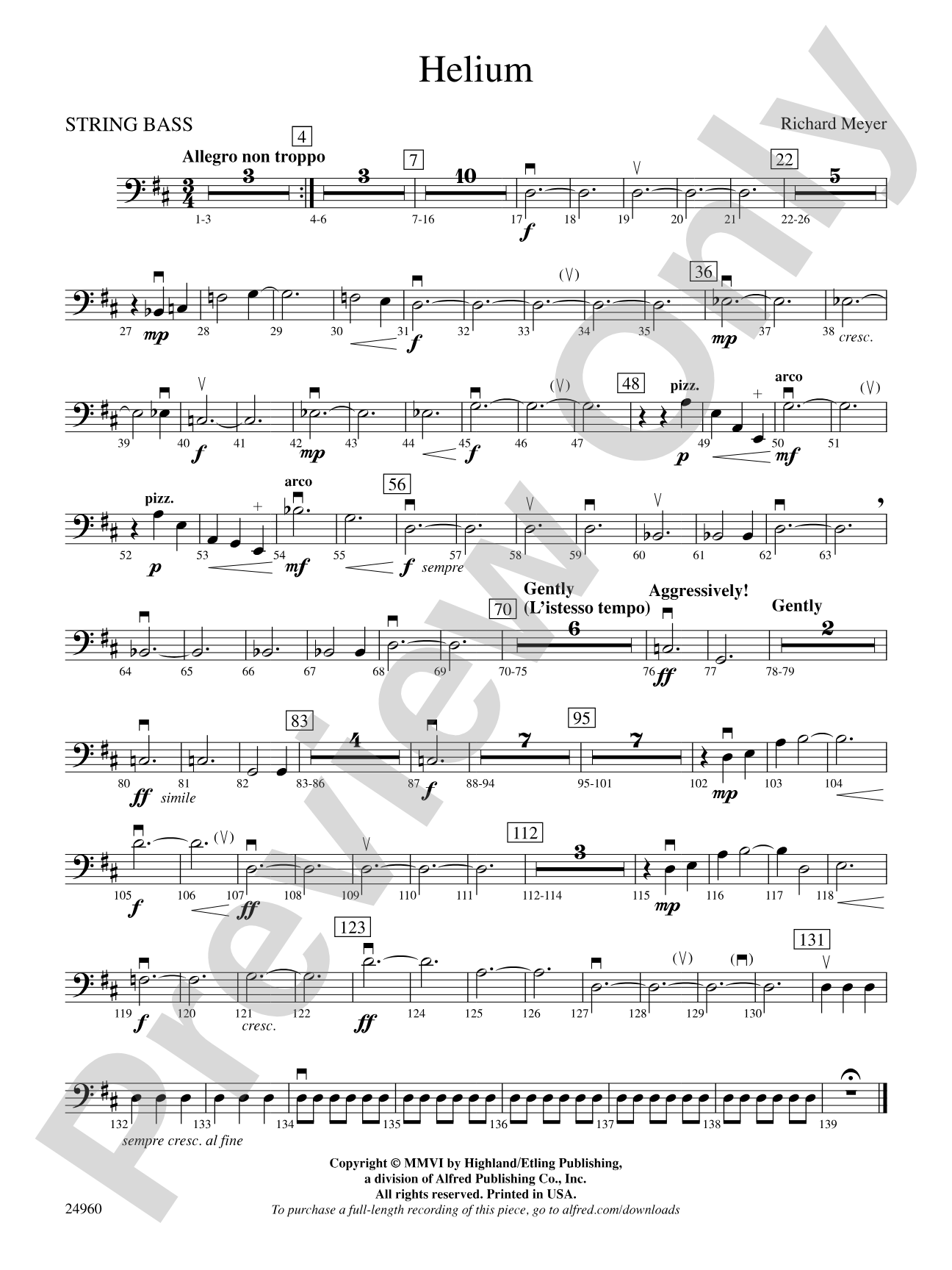

Helium: String Bass
By Richard Meyer
Grade: 3
Item: 00-PC-0000952_SB
$5.99
Pickup currently not available
Description
Using compositional techniques pioneered by modernists such as Philip Glass and Steve Reich, Richard Meyer has created a hypnotic and fascinating journey into the world of minimalism for the student orchestra. The interesting textures, unrelenting rhythms and hauntingly beautiful harmonies found within this piece are sure to grab the attention of any audience while educating your students, giving them a chance to express themselves in a refreshingly modern vein not usually found in works for younger orchestras. This title is available in MakeMusic Cloud.


Don't just read it, hear it, play along with it, and watch your students grow with it. In MakeMusic Cloud, Helium: String Bass comes alive with professional accompaniment, adjustable tempo, and built-in practice tools that turn solo practice into real progress.
Open in the Player
Jump straight in and assign it today.
Start Your Free Trial
Open this title and explore the full library in minutes.
Sample Audio
1
Audio File
--:--
0:00
0:00
Sample Video
No sample videos found.
Additional Details
Series:
Highland/Etling String Orchestra
Publisher:
Alfred Music
Page Count:
114
SKU:
00-PC-0000952_SB
More about this title
About the Composer: Richard Meyer

Richard Meyer brings three decades of classroom experience to his compositions, having built one of Southern California's largest school orchestra programs from the ground up. At Oak Avenue Intermediate School in Temple City, he expanded enrollment from 29 to 200 string students over 22 years while directing the city's elementary string program. Beyond the classroom, Meyer served as music director of the Pasadena Youth Symphony Orchestra for 16 years, conducting students in venues across New York, Washington D.C., Vienna, Australia, and Canada.
Meyer's work extends across multiple roles in music education. He served as string editor for Alfred Publishing Company for 16 years and co-authored several string method series, including the widely used String Explorer Series and Sight-read It for Strings. In 2009, he created the "Giving Bach" program at his school, an innovative concert initiative that has gained national recognition for bringing live orchestral music to students with special needs and those in underserved communities throughout Southern California. As a clinician, he has been featured at the A.S.T.A. National Conference, the Texas Orchestra Directors' Association Conference, and multiple state All-State and Honor Orchestra rehearsals. With nearly 200 published compositions and arrangements, Meyer remains an active guest conductor while living in Sierra Madre, California with his wife Rose and their three daughters and two grandsons.
Why we love this
Meyer pulls minimalist techniques directly into the student orchestra repertoire without sacrificing musical substance or ensemble development. Rather than treating minimalism as a novelty, he builds it into a work that teaches texture, rhythmic precision, and harmonic awareness simultaneously, giving your students genuine exposure to how 20th-century composers think about sound. The hypnotic quality keeps audiences engaged while the unrelenting rhythms demand the focus and consistency that make ensembles stronger.
What to expect
Helium creates an almost trance-like environment through layered, shimmering textures and driving rhythmic patterns that pulse beneath haunting harmonic shifts. The piece invites listeners into a modern soundscape where traditional melody takes a back seat to the hypnotic interaction of interlocking lines and atmospheric density.
Who it's for
Grade 3 string orchestras ready to explore sound in ways that move beyond traditional harmonic progressions and phrasing. This score works best with ensembles that have developed reliable rhythmic discipline and can sustain focus through extended repeated figures without losing intonation.
How to get the most out of it
- Establish a metronomic pulse early in rehearsal and maintain it relentlessly; minimalist textures depend on absolute rhythmic stability from every stand, not just the section leaders.
- Layer the parts gradually in sectional rehearsals rather than running the full texture from day one; students need to hear how their line interlocks with others before experiencing the collective effect.
- Emphasize tone consistency across repeated figures; repetition in minimalist writing exposes any tonal unevenness or dynamic drift that might go unnoticed in traditional repertoire.
- Conduct with clarity and minimal gesture; the harmonic and textural shifts happen subtly, and your baton work should let the music speak rather than override it.
How to use it
Program this as a festival or contest entry where judges expect to hear musical sophistication beyond conventional repertoire; the minimalist idiom reads as contemporary artistic choice rather than novelty. It also pairs effectively on concert programs with Romantic-era works, providing stark contrast that highlights the distinct character of both eras.
Skills your students will build
- Maintaining steady rhythmic precision in minimalist textures with repeating patterns
- Listening for subtle harmonic shifts and timbral changes within a controlled harmonic language
- Balancing individual melodic lines within a dense, layered ensemble texture
- Interpreting 20th-century compositional techniques and understanding minimalism as a deliberate artistic approach
- Sustaining focused tone quality and intonation over extended repeated figures