
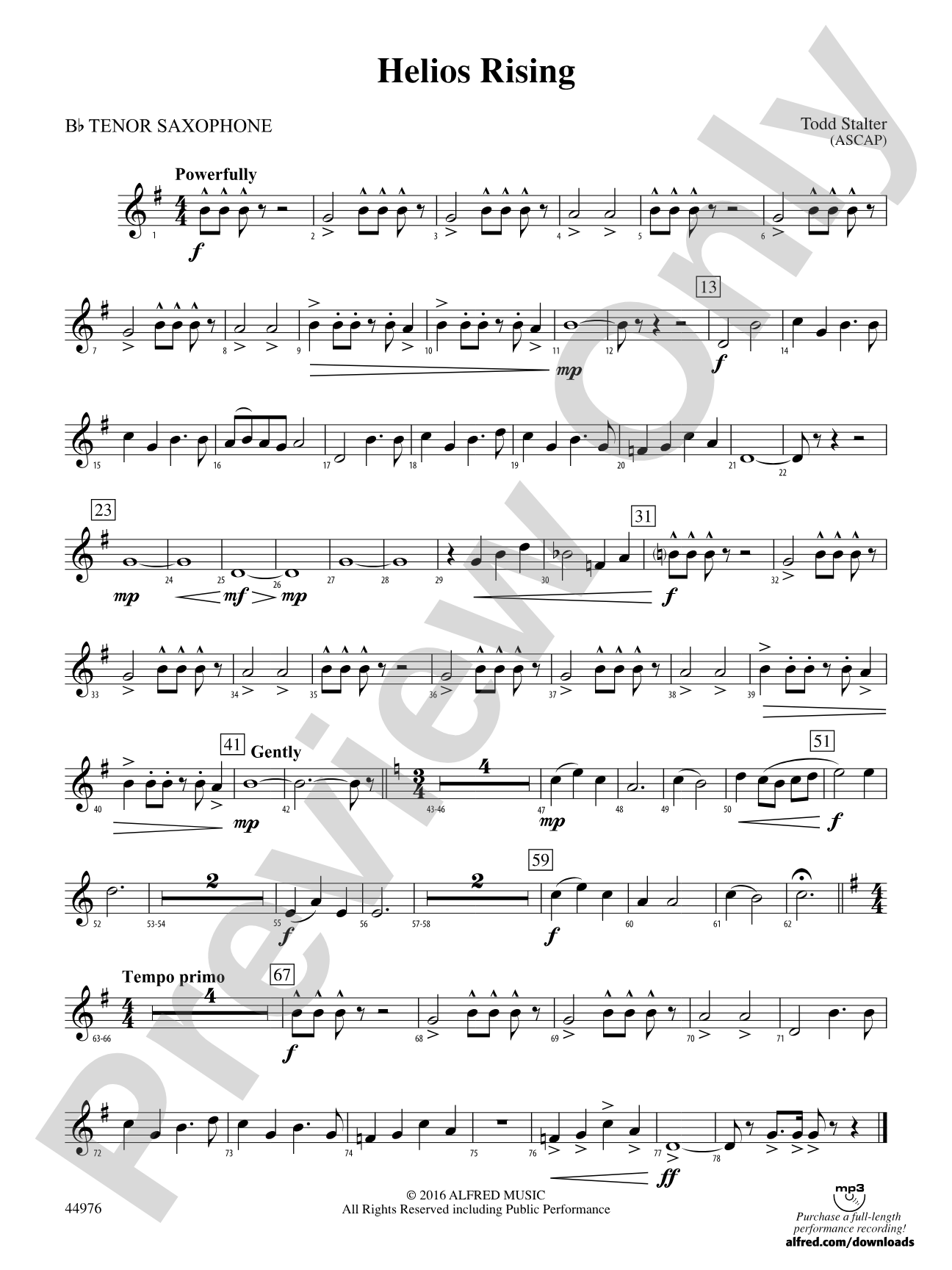

Helios Rising: B-flat Tenor Saxophone
By Todd Stalter
Grade: 2 (Medium Easy)
Item: 00-PC-0017441_TX1
$3.00
Pickup currently not available
Description
In Greek mythology, Helios is a Titan who faithfully drove the Sun's chariot across the sky each day, disappearing in the west into Oceanus (the ocean, which the Greeks believed encircled the Earth), and rising out of it again in the east the next morning. Helios' journey at sunrise is referenced musically by the ascending leap in the main theme and the strong driving rhythms of the low winds and percussion. The contrasting light and dark textures in the slow section depict twilight inevitably giving way to the darkness of night. (2:45)


Don't just read it, hear it, play along with it, and watch your students grow with it. In MakeMusic Cloud, Helios Rising: B-flat Tenor Saxophone comes alive with professional accompaniment, adjustable tempo, and built-in practice tools that turn solo practice into real progress.
Open in the Player
Jump straight in and assign it today.
Start Your Free Trial
Open this title and explore the full library in minutes.
Sample Audio
1
Audio File
--:--
0:00
0:00
Sample Video
Additional Details
Series:
Challenger Band Series
Publisher:
Alfred Music
Page Count:
202
SKU:
00-PC-0017441_TX1
More about this title
About the Composer: Todd Stalter

Todd Stalter built a legendary band program at Eureka High School in Illinois, where he directed for 34 years and established a tradition of consistent excellence. His ensembles earned 16 state marching championships, superior ratings at contest after contest, and invitations to perform at Orchestra Hall in Chicago and Walt Disney World. Beyond the classroom, he has conducted All-State bands in Georgia and Delaware, adjudicated extensively across the Midwest, and presented clinics on composition and music education at major state conferences.
As a composer, Stalter's works for band and string orchestra are performed nationwide and appear regularly on state festival and contest lists. Several of his pieces are featured in the "Teaching Music Through Performance in Band" series published by GIA. He holds degrees in music education and trumpet performance from Illinois State University, where he studied conducting with Dr. Stephen K. Steele and trumpet with some of the nation's finest musicians.
Why we love this
Stalter's setting of the Helios myth gives young bands a piece with genuine musical storytelling. The ascending melodic leap paired with driving low-end rhythms creates an immediate and tangible musical image, while the contrasting slow section teaches dynamic shaping and textural balance without requiring advanced technical demands. Grade 2 bands will find material that sounds substantial and concert-ready, not simplified.
What to expect
Helios Rising opens with urgent energy and classical imagery: a sun chariot ascending the eastern sky, propelled by insistent rhythms from the low end. The music shifts partway through into softer, cooler terrain, painting the inevitable descent toward dusk and the ocean that surrounds the world. The piece captures both the triumph of daylight and the quiet mystery of approaching night.
Who it's for
Grade 2 concert bands with balanced instrumentation and a desire for repertoire that combines musical substance with accessible technical demands. Directors preparing for contest or festival performances will find a work that develops ensemble musicianship while remaining within reach of developing musicians.
How to get the most out of it
- Shape the ascending leap in the main theme with a clear crescendo; this is the moment of sunrise, and it needs weight and forward motion from your entire ensemble.
- Lock the low winds and percussion into a unified, rhythmic pulse during the driving sections. This foundation makes everything else sit properly in the band.
- Contrast the slow section deliberately. Move the dynamic and tempo relationships so that twilight actually feels like a shift in landscape, not just a tempo change.
- Use the full duration of the piece (2:45) to your advantage. Don't rush the structural moments; let the mythology unfold naturally.
How to use it
This works beautifully in a fall contest or festival program where you want a contrasting piece alongside faster, lighter works. Its 2:45 duration makes it ideal for a middle-of-the-set moment that resets the energy without derailing the overall arc. The mythological context also pairs well with programs built around storytelling or classical themes.
Skills your students will build
- Dynamic control across sustained passages and sectional contrasts
- Rhythmic precision in driving low wind and percussion lines
- Listening for ensemble balance between melody and accompaniment
- Shaping long melodic lines with clear, intentional phrasing
- Interpreting musical imagery through tempo and textural choices