
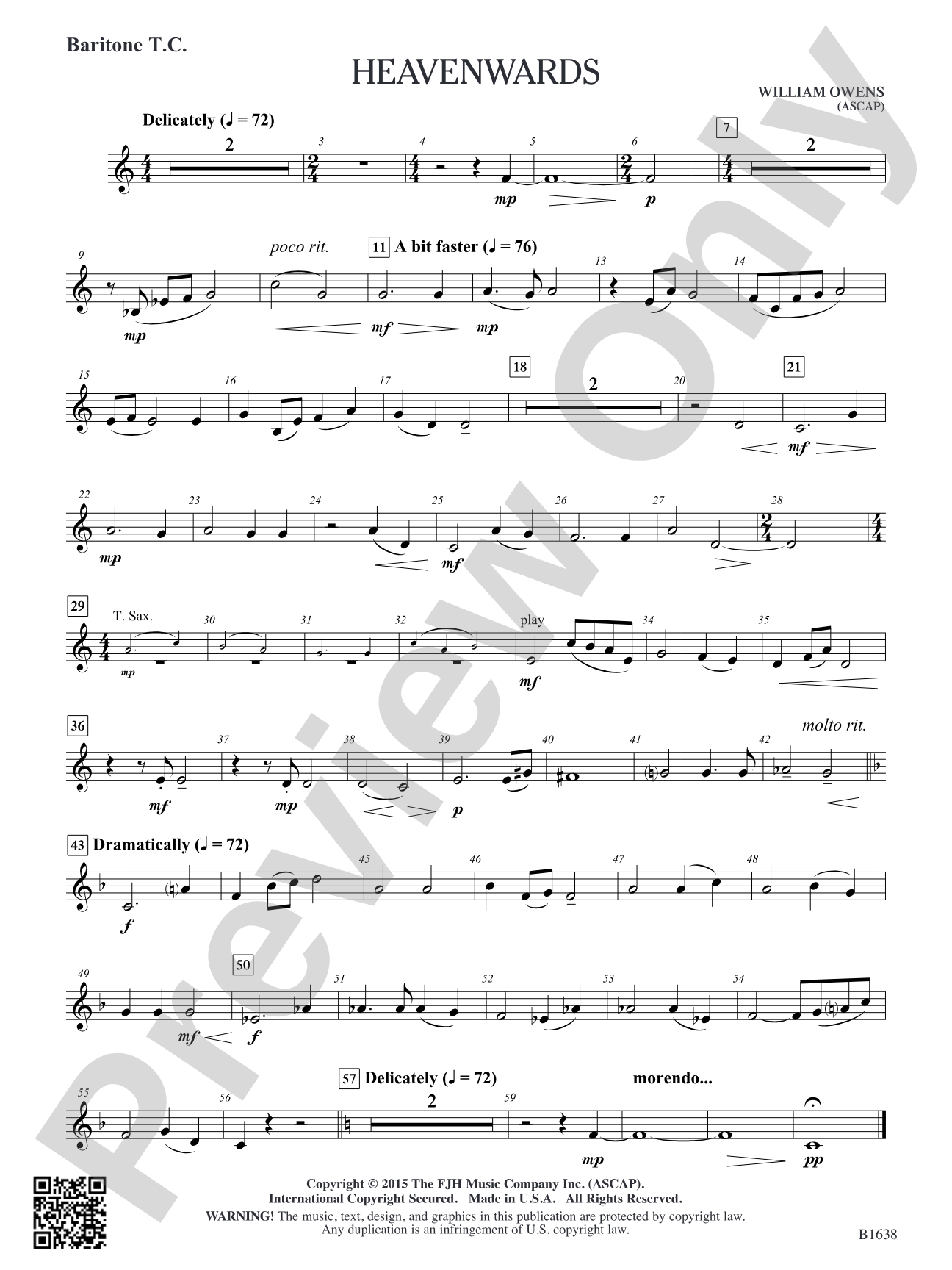

Heavenwards: Baritone T.C.
By William Owens
Grade: 2.5
Item: 98-PC-DB1638_BTC1
$7.00
Pickup currently not available
Description
As the loss of a loved one is always hard to face, this sensitive lyrical work strives to offer a measure of comfort during this most difficult time. Solemn at moments and uplifting at others, the music explores the full range of emotions when life finds us all at our most vulnerable.


Heavenwards: Baritone T.C. isn't in MakeMusic Cloud just yet...but it could be. Let us know you'd like to see it, and you'll help shape what comes next. In the meantime, start a free trial and dive into thousands of interactive titles your students can play along with today.
Request This Title
Tell us you want it.
Start Your Free Trial
Explore everything that's ready to play right now.
Sample Audio
1
Audio File
--:--
0:00
0:00
Sample Video
No sample videos found.
Additional Details
Series:
FJH Young Band
Publisher:
The FJH Music Company, Inc.
SKU:
98-PC-DB1638_BTC1
More about this title
About the Composer: William Owens

William Owens brings three decades of classroom experience to his compositional work. A 1985 graduate of VanderCook College of Music, he spent 30 years directing bands in Texas before retiring in 2014, giving him deep insight into what young ensembles need musically and pedagogically. His catalog exceeds 300 works across concert band, string orchestra, and chamber settings, many of which have become curricular staples and appear in educational texts nationwide.
Owens has established himself as a clinician and conductor throughout North America, earning recognition from the Texas Bandmasters Association, his alma mater, and multiple commissioning bodies including the American Bandmasters Association and Phi Beta Mu International. His membership in ASCAP and various music educators' organizations reflects his dual commitment to composition and the profession. He currently resides in Fort Worth, Texas.
Why we love this
Owens writes with genuine restraint and emotional authenticity. Rather than relying on sentimental gestures, he constructs moments of real lyrical beauty that feel earned, allowing young musicians to engage thoughtfully with grief and comfort without embarrassment. A director looking for repertoire that meets students where they are emotionally will find the balance here rare at this grade level.
What to expect
The music inhabits a contemplative space, moving through moments of quiet sorrow and unexpected uplift without settling into despair. Textures shift between intimate transparency and fuller sonorities, creating a sense of gradual emotional movement. The overall arc suggests not an ending but a gentle reorientation, as if the ensemble is exploring both the heaviness of loss and the possibility of peace.
Who it's for
High school and strong middle school band programs seeking meaningful concert repertoire that addresses difficult emotional terrain. Directors who value repertoire that allows musicians to grow as listeners and communicators, not just technical players, will find this work particularly valuable. The Grade 2.5 difficulty keeps the musical challenges accessible so students can focus on interpretation and ensemble cohesion.
How to get the most out of it
- Shape the phrasing across full phrases rather than within individual measures; this piece rewards breathing space and long musical lines over rhythmic precision.
- Let the dynamics speak the emotional content. Resist over-conducting; transparent leadership allows the solemn sections to land with genuine weight.
- Balance the full band sound during uplifting passages by listening for inner voices rather than driving the tutti forward with increased volume.
- Mark breath points carefully in the parts so that the ensemble breathes together during lyrical sections, which strengthens the sense of collective reflection.
How to use it
Program this on a concert dedicated to meaningful themes or as a standalone piece that allows your audience genuine emotional experience. It serves well as a concert closer or companion to other reflective works, and works particularly thoughtfully on memorial events or programs addressing community experiences. The piece also functions excellently as a vehicle for helping students understand interpretation and emotional communication without requiring advanced technical facility.
Skills your students will build
- sustaining long lyrical phrases with consistent tone and phrasing
- responding to subtle dynamic shadings and their emotional effect
- balancing individual parts within an ensemble texture without doubling sound
- maintaining ensemble cohesion during reflective tempos
- understanding how musical choices communicate emotional content