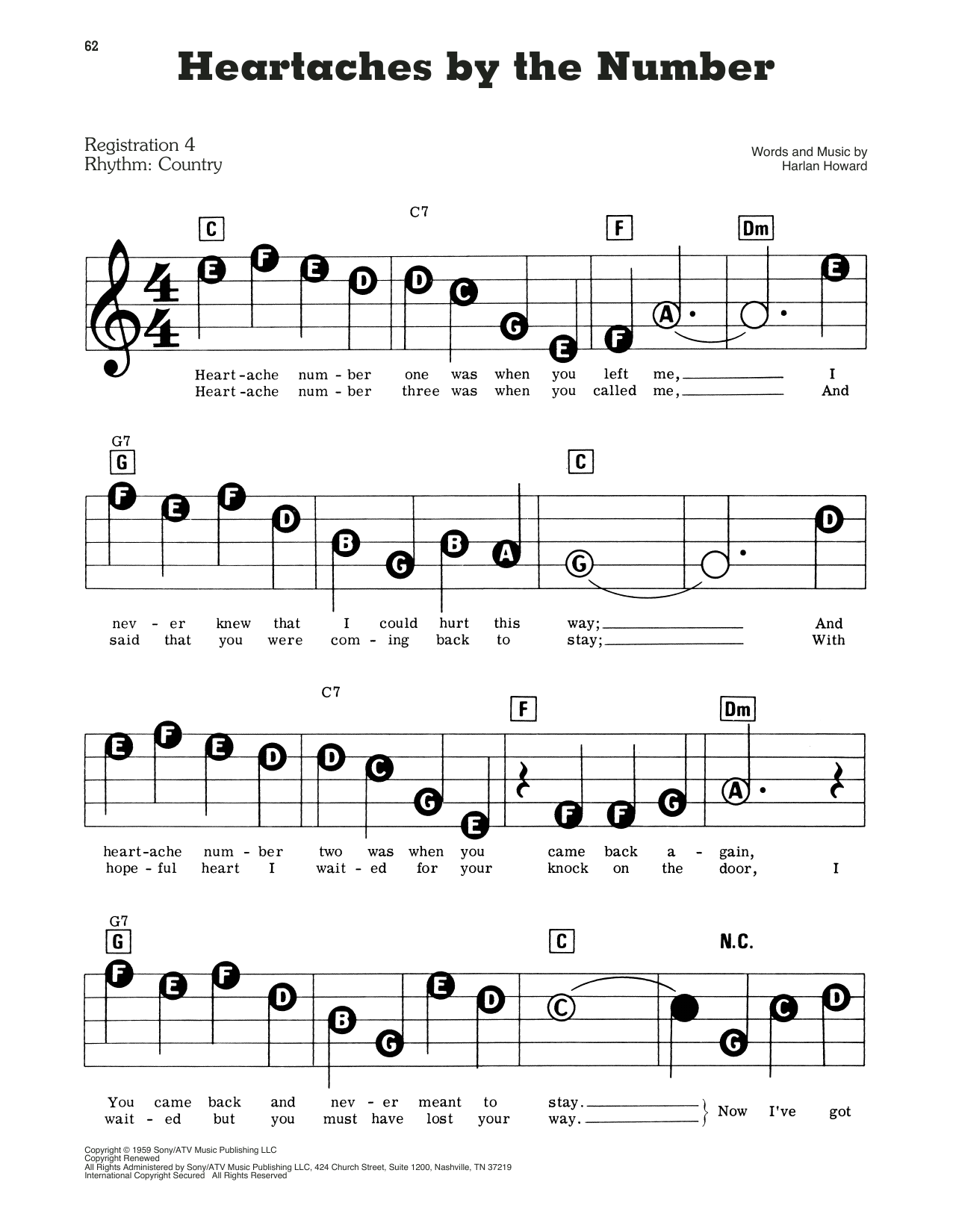
Heartaches By The Number Sheet Music Preview

Heartaches By The Number: E-Z Play Today

As performed by Guy Mitchell

Item: 35-DS00456517

Digital Download
$4.99
Description

Heartaches By The Number: E-Z Play Today isn't in MakeMusic Cloud just yet...but it could be. Let us know you'd like to see it, and you'll help shape what comes next. In the meantime, start a free trial and dive into thousands of interactive titles your students can play along with today.

Sample Audio
No sample audio found.
Sample Video
Additional Details
Publisher: Hal Leonard
Page Count: 2
SKU: 35-DS00456517

More about this title

About the Artist: Guy Mitchell

Guy Mitchell was a singer and actor who rose to prominence in the 1950s, delivering hits across pop, country, and novelty genres with equal ease. His smooth baritone and charismatic stage presence made him a fixture on radio, television, and in film during the golden age of American popular music.

Why we love this

The E-Z Play arrangement strips this 1959 standard down to its essential melody and harmony, making it accessible for pianists still building fluency while preserving the song's wry emotional core. It's a perfect vehicle for exploring how a strong melody can carry a song, and students will recognize the tune immediately.

What to expect

Wistful and slightly self-deprecating, the song captures the resigned humor of counting up romantic failures. The melody has a conversational lilt that invites rubato and expressive playing despite its straightforward notation.

Who it's for

Pianists in early intermediate stages who want to explore country and pop standards beyond classical repertoire. This works equally well for students building sight-reading skills or for anyone interested in the American songbook of the 1950s.

How to get the most out of it

  • Keep the tempo steady and conversational; this song works best when it feels like someone telling a story rather than racing through it.
  • Pay attention to the lyrical phrasing in the melody line, letting natural speech rhythm guide your phrasing even though it's written notation.
  • Balance the accompaniment so the right hand melody sings out clearly without the left hand becoming an afterthought.

How to use it

Include this in a concert exploring American song standards, or pair it with other 1950s hits to create a retrospective program that appeals to general audiences. It also works nicely as a lighter moment in a recital that leans toward classical repertoire.

Skills your students will build

  • Reading lead sheet notation and chord symbols
  • Accompanying a melody with simple harmonic progressions
  • Shaping phrasing in popular song style
  • Balancing melody and accompaniment in two hands

You May Also Like