
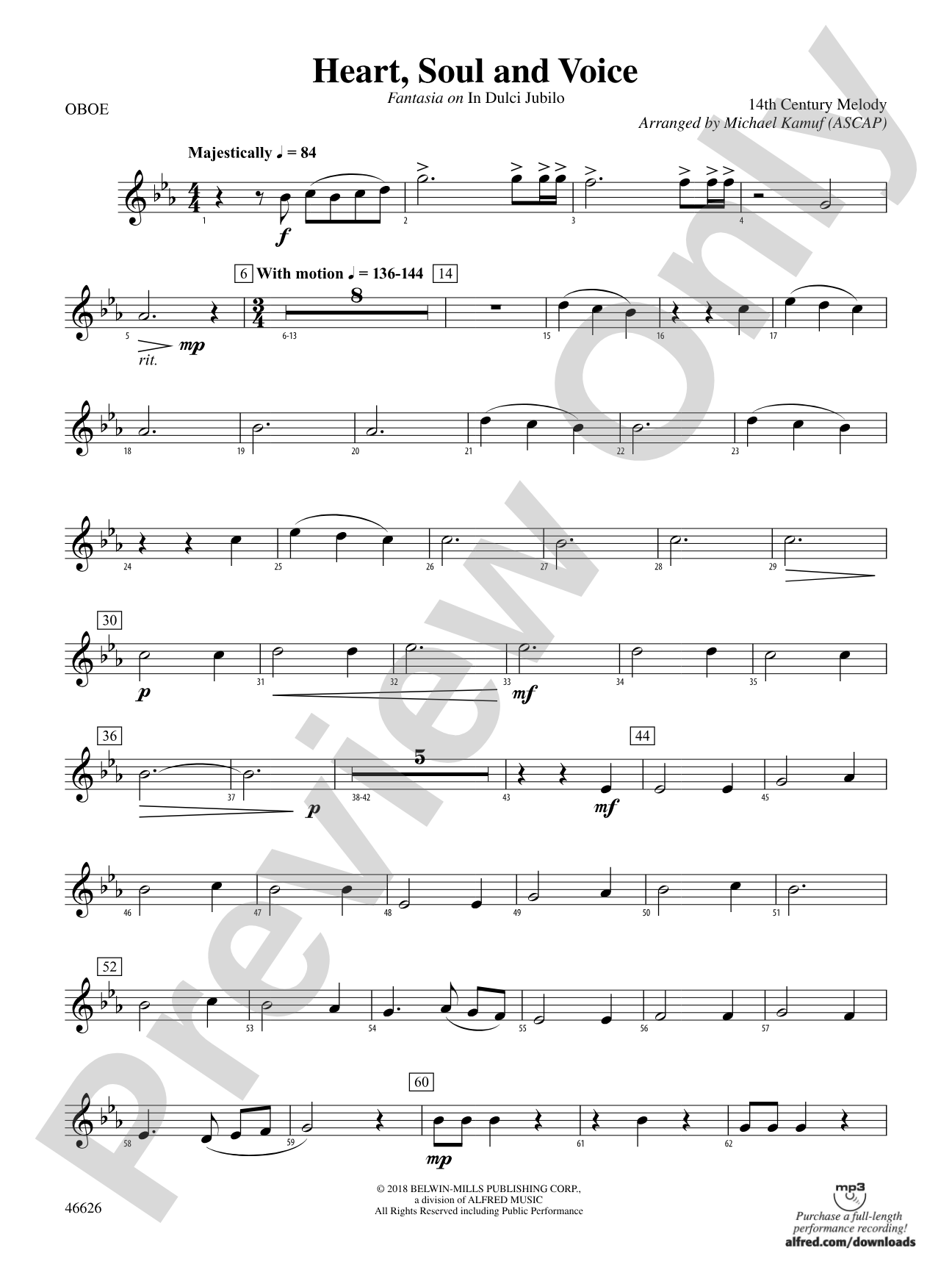

Heart, Soul, and Voice: Oboe
Fantasia on "In Dulci Jubilo"
14th Century Melody / arr. Michael Kamuf
Grade: 2 (Easy)
Item: 00-PC-0018060_O1
$3.00
Pickup currently not available
Description
A fantasia on In Dulci Jubilo, this setting includes each of the three melodic statements building in orchestration and intensity, taking both the musicians and audiences on a musical expedition. With both expressive and energetic elements, this piece is a solid musical choice for both holiday concerts and festival programs! (2:45)


Don't just read it, hear it, play along with it, and watch your students grow with it. In MakeMusic Cloud, Heart, Soul, and Voice: Oboe comes alive with professional accompaniment, adjustable tempo, and built-in practice tools that turn solo practice into real progress.
Open in the Player
Jump straight in and assign it today.
Start Your Free Trial
Open this title and explore the full library in minutes.
Sample Audio
1
Audio File
--:--
0:00
0:00
Sample Video
Additional Details
Series:
Belwin Young Band
Publisher:
Alfred Music
Page Count:
254
SKU:
00-PC-0018060_O1
More about this title
About the Arranger: Michael Kamuf

Michael Kamuf earned degrees in Jazz Performance and Music Education from Youngstown State University's Dana School of Music, followed by a Master of Arts in Instrumental Conducting from George Mason University. His compositions and arrangements have been performed by major jazz ensembles including the Woody Herman and Glenn Miller Orchestras, the USAF Airmen of Note, and the US Navy Commodores, as well as by accomplished soloists such as James Moody, Eddie Daniels, and Sean Jones.
Kamuf spent three decades teaching instrumental music in Montgomery County Public Schools, where he served as Director of Bands and Orchestras and Music Department Chairperson at John T. Baker Middle School for twenty-seven years. Under his leadership, the Baker ensembles earned consistent high ratings at festivals and commissioned multiple works for young concert bands. He is an exclusive writer for the Belwin Division of Alfred Music Publishing and maintains over 100 published titles across jazz, orchestra, and concert band catalogs. Currently, he leads the Mike Kamuf Little Big Band, a jazz octet based in the Baltimore and Washington, DC region.
Why we love this
This arrangement captures what makes In Dulci Jubilo enduring: three distinct melodic presentations that give your band genuine room to grow within a single performance. Kamuf builds the orchestration thoughtfully across each statement, so your musicians experience real musical architecture rather than simple repetition. It fits seamlessly into winter concerts and festival programs alike, giving emerging bands a piece that sounds substantial without demanding virtuosity.
What to expect
The piece unfolds like a musical conversation that grows more animated with each turn. Early on, the melody emerges clear and reflective, inviting singers and audiences into something familiar and warm. By the final iteration, the full band embraces an energetic, celebratory character that still honors the quiet dignity of the original tune.
Who it's for
Developing concert bands working toward festival or concert performance at the Grade 2 level will find this arrangement accessible without being oversimplified. It works well for bands with mixed instrumentation strength, since Kamuf's scoring distributes musical interest across the ensemble. Conductors seeking repertoire that builds musical maturity while remaining playable will value its straightforward demands paired with real musical substance.
How to get the most out of it
- Shape each of the three melodic statements as distinct musical ideas rather than variations. Use tempo and dynamic shaping to help your band hear where one statement ends and the next begins.
- Balance the developing orchestration carefully across the middle statement. As more voices enter, ensure that the original melody remains the focal point rather than disappearing into fuller scoring.
- Approach the transition into the most energetic final statement with intention. This progression should feel earned, not abrupt, so attend to the exact tempo relationship and articulation choices that lead into it.
- Use the 2:45 duration as a guide for overall pacing. Resist the urge to rush the expressive moments early on; they give weight to the energy that follows.
How to use it
This arrangement serves as an excellent centerpiece for a winter or holiday concert, offering contrast between more serious seasonal literature and purely festive selections. Consider pairing it with other Grade 2 repertoire to show your band's range in a single concert arc. Its festival designation makes it a logical choice for adjudicated competition programs where you want a well-crafted, satisfying piece that showcases developing musicianship.
Skills your students will build
- Recognizing and emphasizing melodic continuity across changing orchestration
- Executing dynamic control from soft, expressive passages to energetic, full-band statements
- Listening for balance when instrumental doublings increase the texture
- Understanding how a single melody can take on different character through arrangement choices