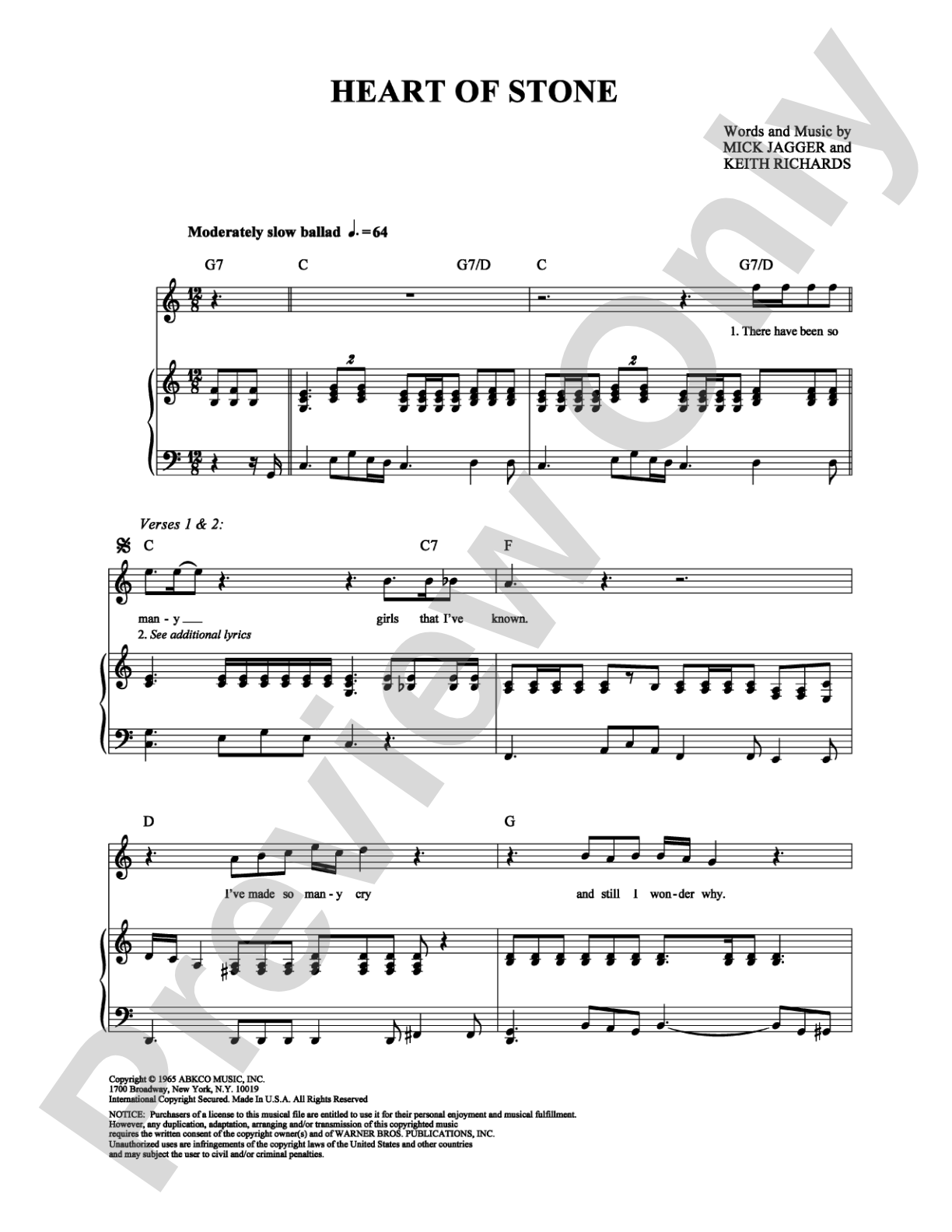
Heart of Stone: Piano/Vocal/Chords Digital Sheet Music

Heart of Stone: Piano/Vocal/Chords Digital Sheet Music

The Rolling Stones, Keith Richards, Mick Jagger

Item: 00-PS-0000810

Digital Download
$3.99
Description

Heart of Stone: Piano/Vocal/Chords Digital Sheet Music isn't in MakeMusic Cloud just yet...but it could be. Let us know you'd like to see it, and you'll help shape what comes next. In the meantime, start a free trial and dive into thousands of interactive titles your students can play along with today.

Sample Audio
No sample audio found.
Sample Video
Additional Details
SKU: 00-PS-0000810

More about this title

About the Artist: The Rolling Stones

The Rolling Stones emerged from London in 1962 as one of the most influential rock bands in history. Their catalog spans six decades of blues-influenced rock, with songwriting partnerships (most notably Mick Jagger and Keith Richards) that redefined popular music through restless innovation, raw energy, and a willingness to push cultural boundaries.

In the classroom, their music offers genuine entry points into rock history, songwriting craft, and the interplay between blues tradition and contemporary form. Songs like "Heart of Stone" demonstrate how skilled musicians adapt existing idioms into something distinctly their own, making the band's work valuable for understanding both musical lineage and creative independence.

Why we love this

"Heart of Stone" sits at the intersection of accessible pop-rock energy and real harmonic interest, making it engaging for singers at multiple levels without oversimplifying the arrangement. The song's conversational lyric and straightforward song form give students room to focus on interpretation and phrasing while the chord progression offers something worth analyzing. It's a piece that feels contemporary even after decades, which tends to energize rehearsals.

What to expect

Confident and slightly defiant, with an underlying tenderness that keeps the song human. The blues-rock foundation gives it groove and swagger, while the melody carries a restrained vulnerability that rewards sensitive interpretation. It's a performance that invites you to hold two emotional truths at once.

Who it's for

Singers working at the high school or community college level who want to explore rock repertoire with substance, or vocalists preparing audition material that sits comfortably in a contemporary style. The piece also works for piano teachers seeking rock arrangements that don't condescend to their students' musicianship.

How to get the most out of it

  • Shape the vocal line conversationally rather than with big, sustained legit phrasing. The song thrives on a speaking quality that serves the lyric.
  • Lock the piano accompaniment into a steady pulse and let the chords breathe slightly on the backbeat; this props up the vocal melody rather than fighting it.
  • Pay attention to dynamics during the verse and chorus transition. A small lift in volume and energy signals the structural shift without requiring an arrangement change.
  • Experiment with minimal ornamentation in the vocal. The strength of the song lives in its simplicity, not in added runs or melismas.

How to use it

Pair this with other era-defining pop-rock standards in a concert celebrating songwriting across decades, or use it as a contemporary contrast to classical art songs in a mixed recital. For younger singers, it's an excellent anchor piece in a program exploring how blues harmonic language shaped modern song.

Skills your students will build

  • Phrasing conversational melody in a contemporary style
  • Interpreting chord symbols and realizing voice-leading at the piano
  • Understanding blues-influenced harmonic progressions in a pop context
  • Balancing rhythmic precision with lyric-driven expression
  • Analyzing song form and dramatic turning points in rock structures

You May Also Like