

Headed for the Promised Land: SSA Choral Octavo
Music by Jay Althouse
Item: 00-PO-0004497
$2.25
Minimum order quantity: 20 copies
Pickup currently not available
Description
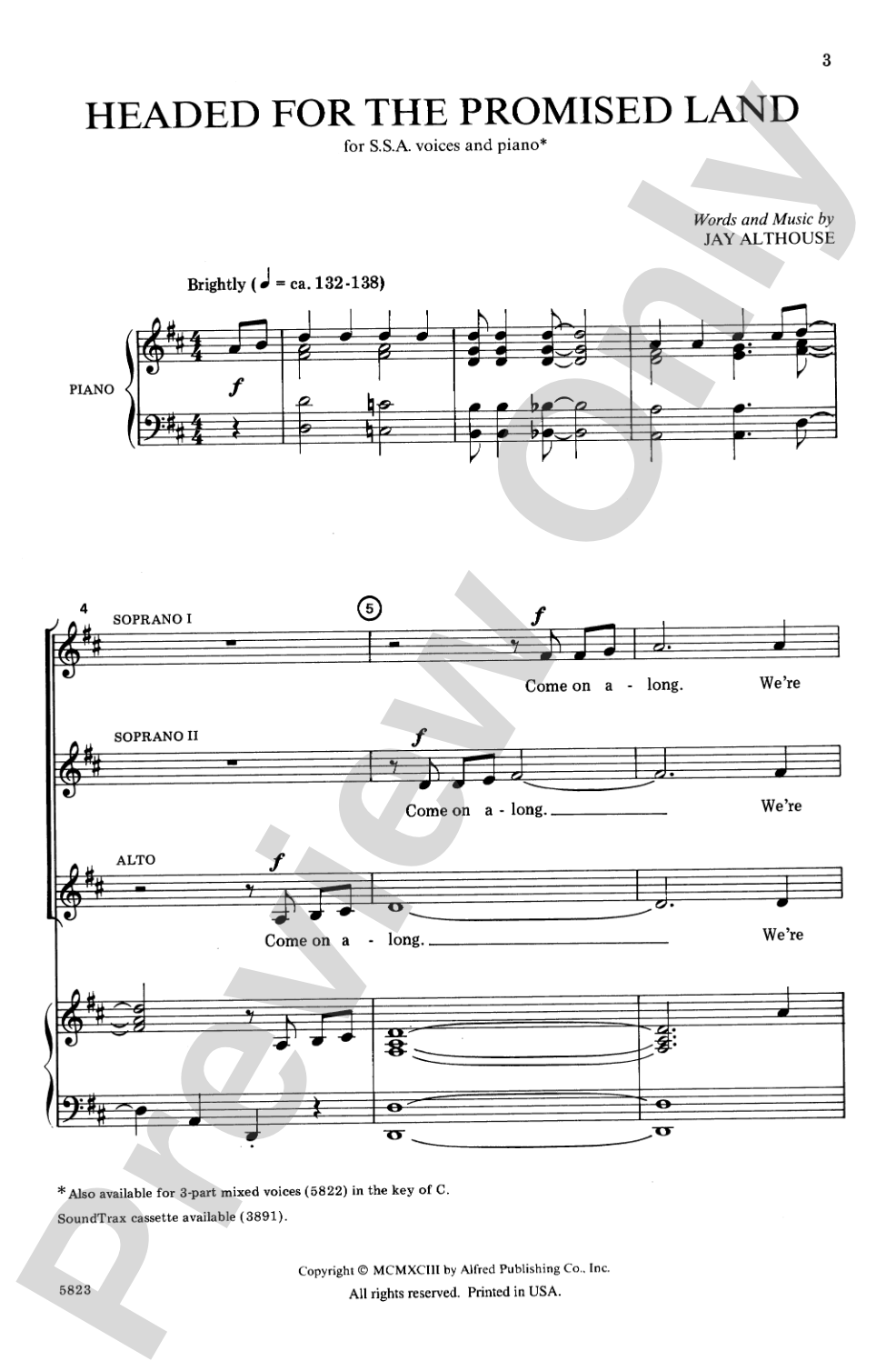
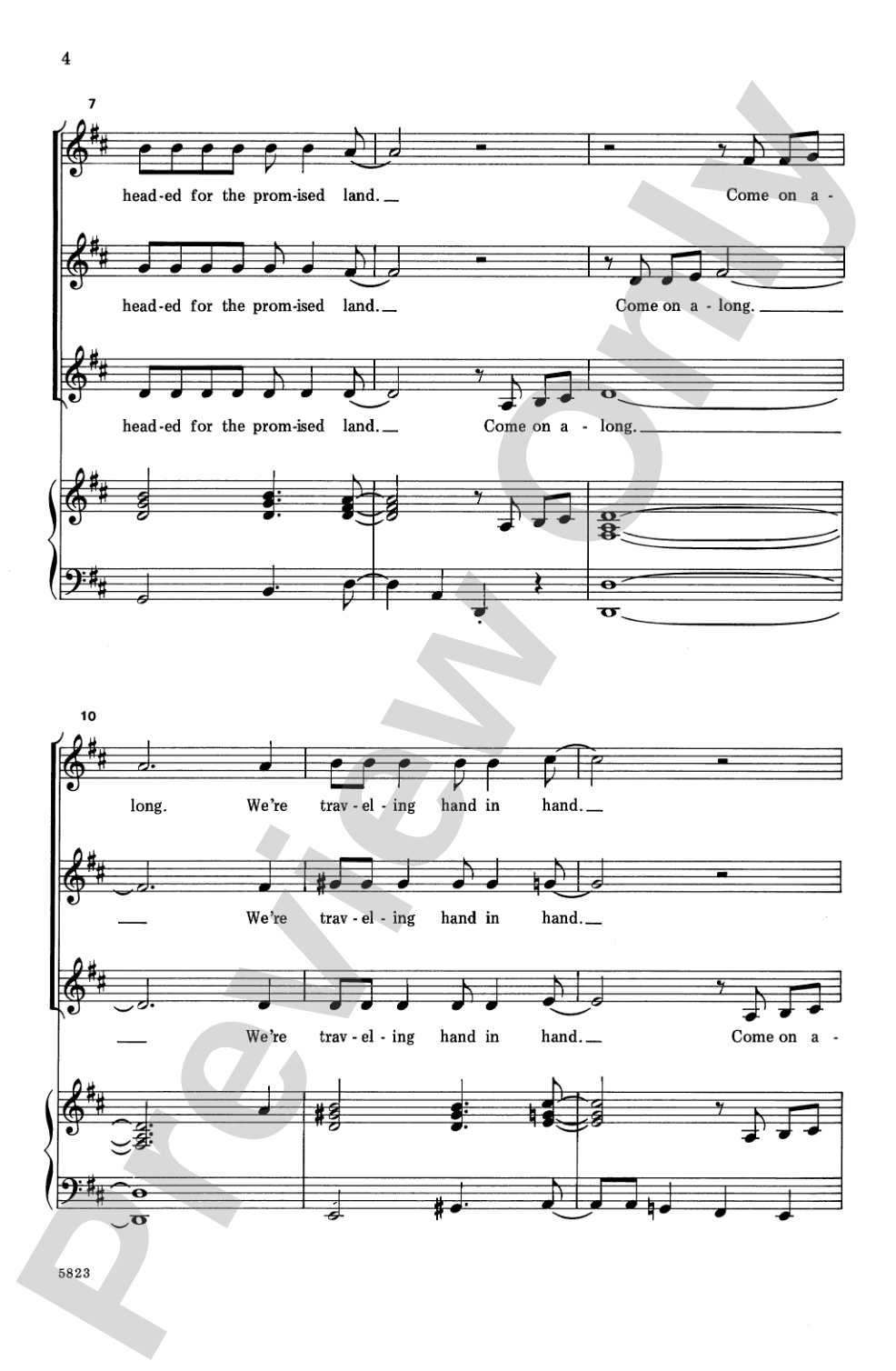
The perfect 3-part choice for middle school and junior high choirs, Headed for the Promised Land is an exciting spiritual with a limited-range men's part. The chorus opens with a pyramid of sound that leads into a homophonic verse. Your young singers-especially the men-will love it. And in just a rehearsal or two they'll sound great. Also a winner for your SSA choirs.


Headed for the Promised Land: SSA Choral Octavo isn't in MakeMusic Cloud just yet...but it could be. Let us know you'd like to see it, and you'll help shape what comes next. In the meantime, start a free trial and dive into thousands of interactive titles your students can play along with today.
Request This Title
Tell us you want it.
Start Your Free Trial
Explore everything that's ready to play right now.
Sample Audio
No sample audio found.
Sample Video
No sample videos found.
Additional Details
Series:
Alfred Archive Edition: Alfred Choral Designs
Publisher:
Alfred Music
Page Count:
12
SKU:
00-PO-0004497
More about this title
About the Composer: Jay Althouse

Jay Althouse holds degrees in Music Education and Music from Indiana University of Pennsylvania, where he was later honored with the Distinguished Alumni award. His career spans both publishing administration and composition; he spent eight years managing rights and licenses for a major educational music publisher and served on the Executive Board of the Music Publishers Association of America. As a composer, he has created more than 800 choral works performed regularly across the English-speaking world and is a ASCAP writer member with multiple Special Award recognitions.
Beyond choral composition, Althouse has co-written children's musicals with his wife Sally K. Albrecht, curated vocal solo collections including Folk Songs for Solo Singers, and co-authored widely used resources like The Complete Choral Warm-up Book and Accent on Composers. He has also written classroom materials for music teachers, among them Ready to Read Music and One-Page Composer Bios. His choral work I Hear America Singing, created with Albrecht, was performed by the San Francisco Girls and Boys Choirs at President Obama's 2009 inauguration. He serves on the National Advisory Board of the Folk Art Society of America and resides in North Carolina.
Why we love this
Althouse has built his catalog on understanding what works in the middle school rehearsal room, and this arrangement proves why. The opening pyramid voicing immediately engages young singers without overwhelming them, while the homophonic verse keeps momentum high and prevents note-learning from derailing your timeline. The accessible range and quick-learning curve mean you can program it confidently even in a season with limited rehearsal time.
What to expect
The spiritual tradition meets purposeful pedagogical design. Opening with stacked voices that gradually reveal the melody creates anticipation; when the verse resolves into straightforward harmony, there's a satisfying sense of arrival. Your singers will hear themselves as part of something bigger from the very first entrance.
Who it's for
Middle school and junior high choir directors who need repertoire that builds voice confidence without endless rehearsal time. Tenors and baritones in young ensembles will appreciate a part written specifically for their range and comfort level. SSA choirs can also perform this effectively, making it adaptable across different school configurations.
How to get the most out of it
- Build the pyramid entrance deliberately during early rehearsals. Have each voice part enter separately, listening to the voices already singing, so students experience how their line contributes to the texture rather than just reading their own notes.
- Encourage the men's section to sing with confidence despite the limited range. Their part is short by design, which means precise rhythm and full tone matter more than ever; they anchor the harmonic foundation.
- Bring out the homophonic verse with clear diction and shape each phrase with a gentle dynamic arc. This section is where your singers can finally breathe and listen to their own musicality.
How to use it
Program this in a concert that explores spirituals and American vocal traditions, or use it as an accessible entry point for choirs new to the genre. Its energy and quick-learning trajectory make it ideal for a mid-year concert when rehearsal time feels compressed, or as a closing piece that sends an audience out with warmth and momentum.
Skills your students will build
- Layering independent voice parts into unified texture
- Sustaining whole notes and long phrases with steady support
- Reading and performing homophonic (block chord) writing
- Balancing blend when parts enter at different times
- Performing with spiritual style and expressive phrasing