He Will Not Suffer Thy Foot To Be Moved (from I Will Lift Up Mine Eyes) Sheet Music Preview

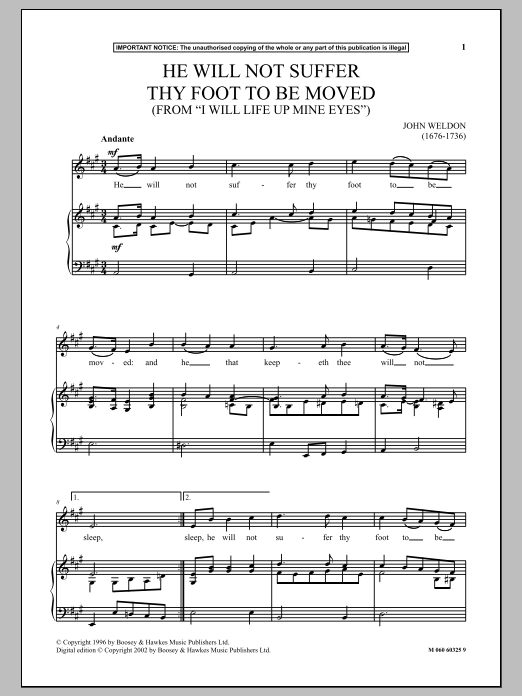
He Will Not Suffer Thy Foot To Be Moved (from I Will Lift Up Mine Eyes): Piano Vocal

As performed by John Weldon

Item: 35-DS00238078

Digital Download
$5.99
Description

He Will Not Suffer Thy Foot To Be Moved (from I Will Lift Up Mine Eyes): Piano Vocal isn't in MakeMusic Cloud just yet...but it could be. Let us know you'd like to see it, and you'll help shape what comes next. In the meantime, start a free trial and dive into thousands of interactive titles your students can play along with today.

Sample Audio
No sample audio found.
Sample Video
Additional Details
Publisher: Hal Leonard
Page Count: 2
SKU: 35-DS00238078

More about this title

About the Artist: John Weldon

John Weldon (1676-1736) was an English composer whose sacred works became staples of the Anglican liturgy. He served as organist at St Bride Church in London and later held positions at the Chapel Royal, where his understanding of the English cathedral tradition shaped his compositional voice. His anthems and vocal works demonstrate a gift for setting devotional texts with clarity and dignity, making them accessible to church choirs while maintaining musical substance.

Why we love this

Weldon's setting brings straightforward eloquence to this affirmation of faith. The part writing sits comfortably for singers while the piano reduction captures the harmonic language of the period without overwhelming either performer, making it ideal for church services, recitals, or voice studio work.

What to expect

A quiet assertion of trust. The harmonic language moves with gentle inevitability, never rushing, while the text unfolds with the assurance of a prayer spoken aloud. There's both intimacy and conviction in Weldon's approach.

Who it's for

Voice teachers, church musicians, and serious vocal students looking for substantial English sacred repertoire. This piece works equally well for soprano, alto, tenor, or bass voices with appropriate transposition.

How to get the most out of it

  • Shape the melody with gentle momentum through each phrase rather than stopping at the bar lines; the text naturally suggests where to breathe.
  • Keep the accompaniment transparent and rhythmically steady so the vocal line remains the focus.
  • Balance the text setting carefully, ensuring that the theological weight of the words comes through without forcing the vocal part.

How to use it

Pair this with other English vocal works for a themed recital, or program it as a movable part of a church service focused on Psalms. Its modest two-page length makes it useful as a character piece between larger works.

Skills your students will build

  • Sustaining legit tone across longer phrases
  • Text clarity in formal English diction
  • Coordination between voice and piano reduction accompaniment
  • Interpretation of harmonic pacing in Baroque English sacred music

You May Also Like