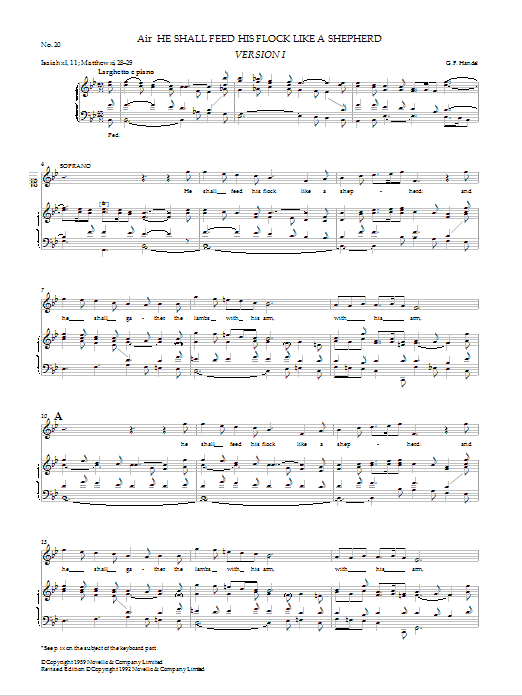
He Shall Feed His Flock Like A Shepherd Sheet Music Preview

He Shall Feed His Flock Like A Shepherd: SATB Choral Octavo

As performed by George Frideric Handel

Item: 35-DS00148086

Digital Download
$2.99
Description

He Shall Feed His Flock Like A Shepherd: SATB Choral Octavo isn't in MakeMusic Cloud just yet...but it could be. Let us know you'd like to see it, and you'll help shape what comes next. In the meantime, start a free trial and dive into thousands of interactive titles your students can play along with today.

Sample Audio
No sample audio found.
Sample Video
Additional Details
Publisher: Hal Leonard
Page Count: 6
SKU: 35-DS00148086

More about this title

About the Artist: George Frideric Handel

George Frideric Handel (1685–1759) was a master of both opera and oratorio, and his compositional output shaped the Baroque vocal landscape for generations. Though born in Germany, he spent most of his career in England, where he developed an unparalleled gift for writing singable, expressive music that moved audiences while remaining technically sophisticated. His works for choir remain central to the choral repertoire because he understood how to craft lines that lie naturally in the voice while achieving profound emotional depth.

Handel's oratorios, including Messiah from which this aria originates, were revolutionary works that brought sacred drama to concert halls and established new standards for large-scale choral composition. He wrote with the practical knowledge of working composers, creating music that challenges singers without becoming gratuitously difficult. His melodic gift and harmonic clarity continue to reward both performers and listeners.

Why we love this

This movement has survived three centuries in the choral repertoire because it strikes an ideal balance between accessibility and substance. The melody is generous and memorable enough to carry a full SATB section, while the harmonic progression and text painting invite genuine musical interpretation rather than rote execution. Programming this aria signals artistic confidence without demanding rare vocal ranges or experimental approaches.

What to expect

Handel's music has an almost conversational warmth, and this aria embodies that quality entirely. The text unfolds as gentle assurance rather than grandeur, supported by harmonies that feel inevitable and right. Singing it creates a sense of collective care, as if the choir itself is offering comfort and guidance.

Who it's for

This arrangement serves mixed choirs at intermediate to advanced levels who want substantial repertoire without the performance logistics of a full oratorio production. Directors building a spring concert with classical anchor pieces will find this movement both musically respectable and appropriate for high school or community choirs.

How to get the most out of it

  • Shape the opening phrase "He shall feed His flock" as a single, warm gesture rather than dividing it into smaller units. A breath before "like a shepherd" creates natural punctuation and allows the second phrase to respond gracefully.
  • Balance the harmonic richness in the inner voices without letting them overwhelm the soprano line. The altos and tenors carry crucial support and character; they deserve clarity without drowning out the principal melody.
  • Allow the text "and gently lead" to slow fractionally and soften dynamically. This small gesture transforms the phrase from declaration into genuine pastoral tenderness.
  • Rehearse the choir against a recorded version to absorb Handel's rhythmic pulse and understand where phrases breathe. His phrasing often differs from what modern punctuation suggests.

How to use it

Place this after an energetic opening number to reset the emotional temperature and showcase the choir's sustained singing. It pairs naturally with other Baroque sacred music or serves as a stunning contrast to contemporary works in a thematic program about leadership or compassion. The six-page length makes it ideal for concert programs where you want substance without monopolizing rehearsal time.

Skills your students will build

  • Sustaining long melodic lines with consistent tone color
  • Balancing individual voice parts within four-part harmony
  • Interpreting Baroque phrasing and text expression
  • Maintaining ensemble blend across dynamic changes
  • Reading and performing functional harmony in classical style

You May Also Like