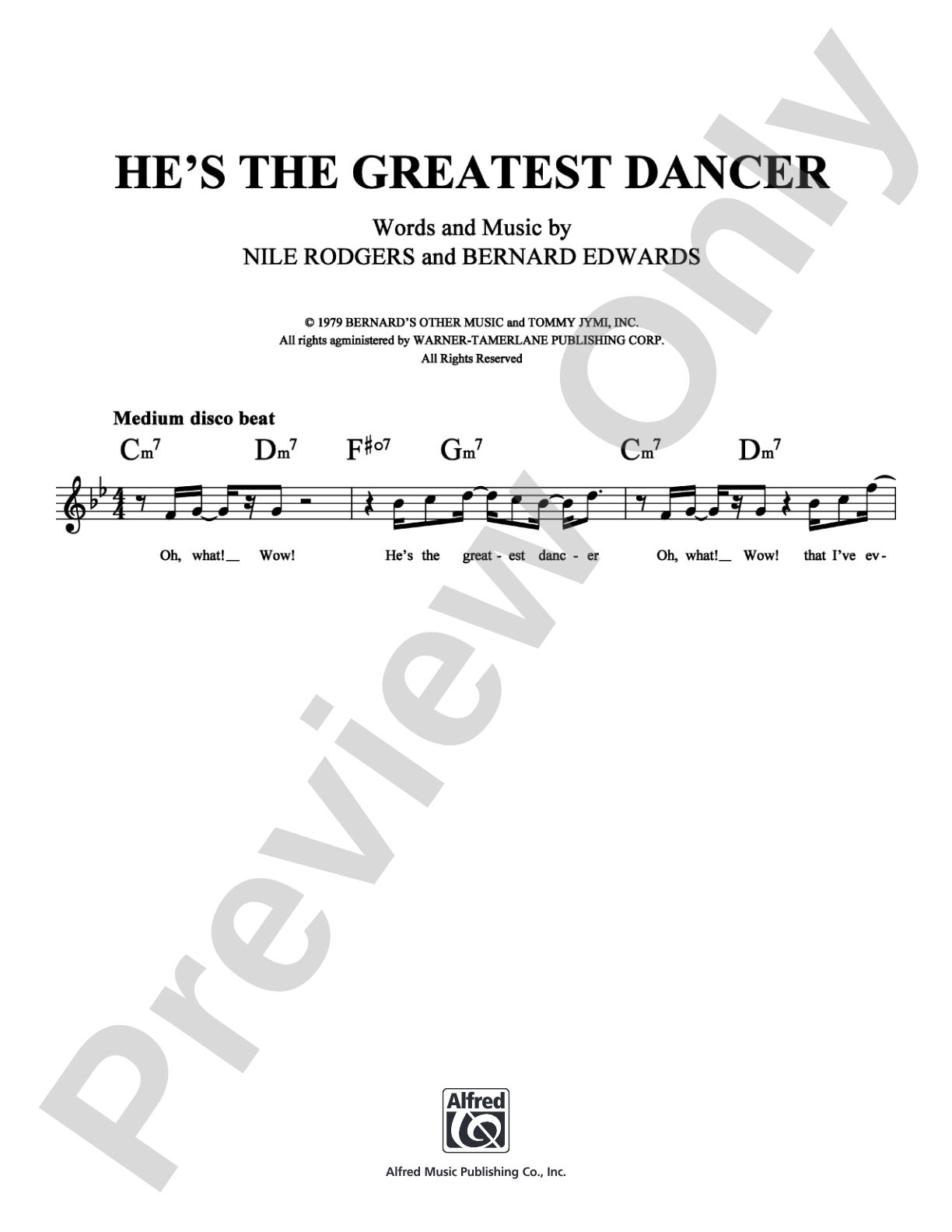
He's the Greatest Dancer: Lead Sheet Digital Sheet Music

He's the Greatest Dancer: Lead Sheet Digital Sheet Music

Bernard Edwards, Nile Rodgers, Sister Sledge

Item: 00-PS-0008987

Digital Download
$1.99
Description

He's the Greatest Dancer: Lead Sheet Digital Sheet Music isn't in MakeMusic Cloud just yet...but it could be. Let us know you'd like to see it, and you'll help shape what comes next. In the meantime, start a free trial and dive into thousands of interactive titles your students can play along with today.

Sample Audio
No sample audio found.
Sample Video
Additional Details
SKU: 00-PS-0008987

More about this title

About the Artist: Sister Sledge

Sister Sledge rose to prominence in the late 1970s and early 1980s as one of the defining voices of dance-pop and R&B. The Philadelphia-based vocal group, composed of four sisters, became known for their infectious grooves, tight harmonies, and feel-good sensibility that dominated both pop and soul radio. Their catalog reflects the energy and optimism of the disco and funk eras, making them essential reference points for understanding popular music of that period.

In music education settings, Sister Sledge's work serves as an excellent model for studying vocal arranging, call-and-response techniques, and the interplay between melody and rhythm-driven accompaniment. Their recordings demonstrate how strong ensemble blend, distinctive phrasing, and rhythmic precision create a signature sound that has remained influential across multiple generations of artists.

Why we love this

Lead sheets of funk and soul standards give students and performers direct access to the melodic and harmonic architecture that defines these grooves. This chart lets you strip away the production and focus on how melody, rhythm, and changes interact, which is exactly where most interesting musical decisions happen in contemporary styles. Conductors and arrangers planning pop or R&B-influenced programs will find this a practical resource for building new arrangements or understanding the song's harmonic foundation.

What to expect

The character of this song is pure celebratory funk: propulsive, infectious, and built on a groove that makes you want to move. The melody sits confidently over the changes, with the kind of rhythmic swagger that defined 1980s pop-soul, and the harmonic movement is direct and satisfying without being predictable.

Who it's for

This lead sheet works for jazz and pop musicians building their harmony and melody literacy, vocalists working from a chord chart, and arrangers or conductors who need a clear reference for melody and changes while developing their own orchestrations. It's equally valuable for students studying R&B and soul music history or for anyone learning to read and improvise from a lead sheet.

How to get the most out of it

  • Lock the melody to the backbeat and emphasize the syncopated phrases that give the song its swagger; the groove depends on precise rhythmic placement, not just correct pitches.
  • Pay attention to the harmonic rhythm on the lead sheet; many changes happen quickly in funk, and reading ahead will keep you anchored when the tempo pushes forward.
  • If playing with a rhythm section, use the lead sheet as a negotiating tool to decide where the melody sits relative to the comping—your part may need space to breathe, or it may need to drive the groove forward.
  • Experiment with phrasing and dynamics across repeated sections; lead sheets often show the bare skeleton, so variation is your tool for sustaining interest across multiple choruses.

How to use it

Use this in a contemporary music ensemble, jazz choir, or pops concert as a standalone feature or as part of a programming block celebrating classic dance-pop and soul. In a rhythm section or jazz combo class, it serves as a readable and engaging study in groove-based melody and syncopated phrasing. For music theory classes exploring popular song structure, it's a concrete example of how melody and harmony work in R&B and funk styles.

Skills your students will build

  • Reading and performing syncopated melodic lines
  • Understanding harmonic rhythm in funk and soul styles
  • Phrasing and dynamics across repeated sections
  • Interpreting lead sheet notation in contemporary music contexts
  • Rhythmic precision and groove-oriented performance

You May Also Like