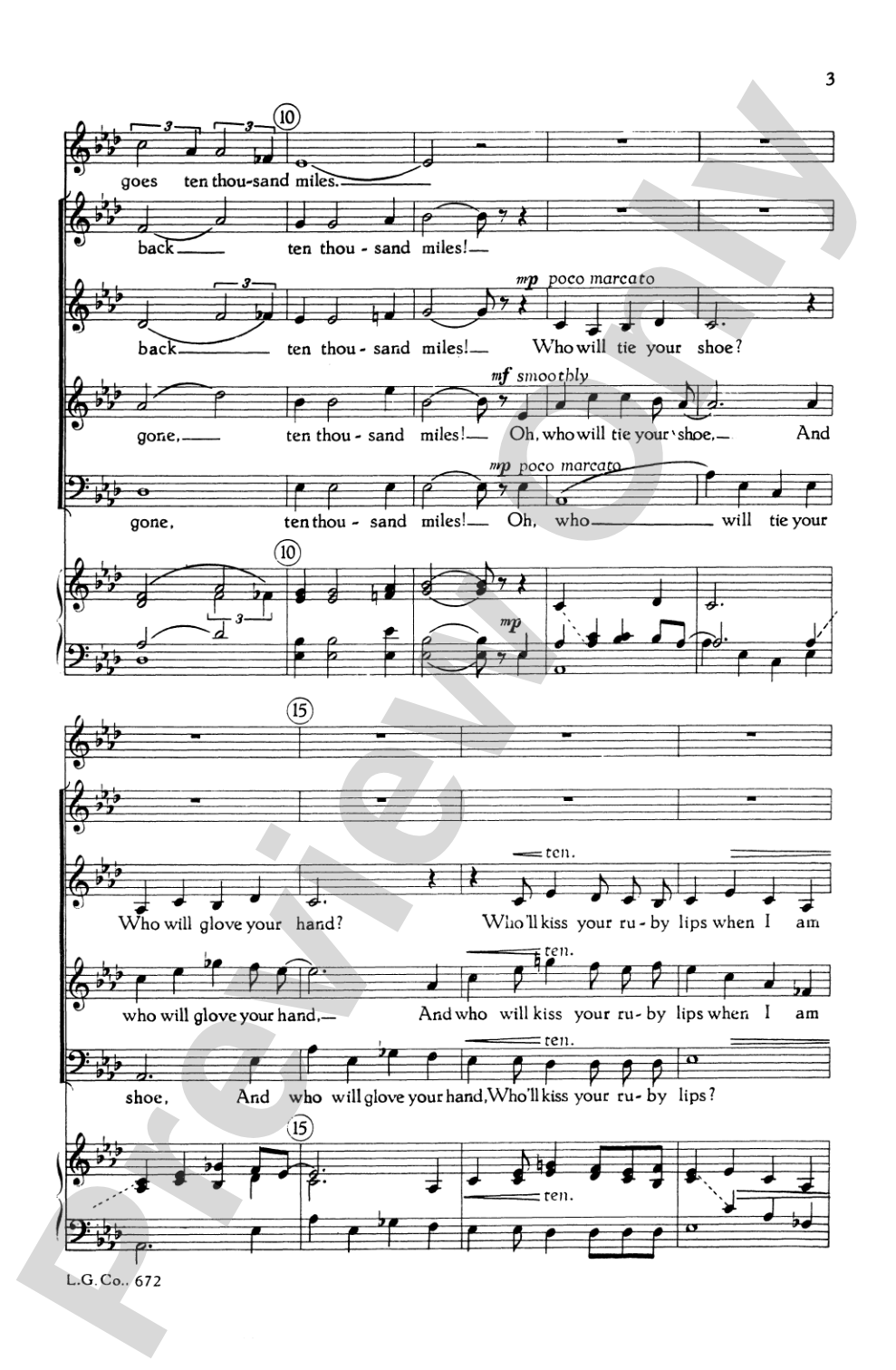
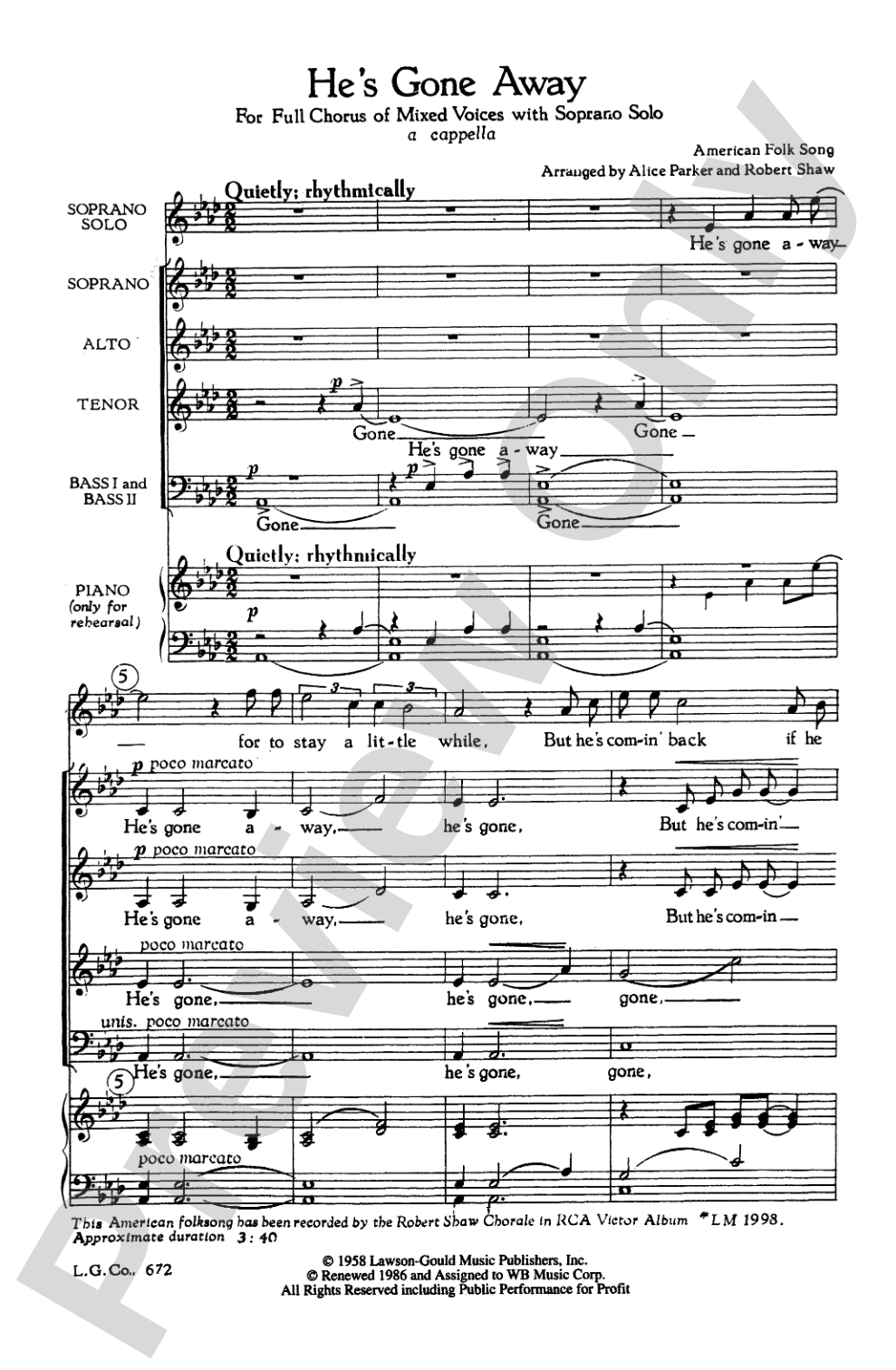
He's Gone Away Sheet Music Preview

He's Gone Away: SATB Choral Octavo

American Folk Song

American Folk Song / arr. Robert Shaw and Alice Parker

Item: 00-PO-0004936

Digital Download
$2.25

Minimum order quantity: 20 copies

Description

He's Gone Away: SATB Choral Octavo isn't in MakeMusic Cloud just yet...but it could be. Let us know you'd like to see it, and you'll help shape what comes next. In the meantime, start a free trial and dive into thousands of interactive titles your students can play along with today.

Sample Audio
No sample audio found.
Sample Video
Additional Details
Series: Alfred Archive Edition: Lawson-Gould Music Publishers
Publisher: Alfred Music
Page Count: 8
SKU: 00-PO-0004936

More about this title

About the Arranger: Robert Shaw

Robert Shaw was a legendary choral conductor, arranger, and pedagogue whose influence shaped American choral music across seven decades. He founded the Robert Shaw Chorale in 1948, an ensemble that became a model for ensemble singing and recorded extensively for RCA Victor. Shaw's arrangements and editions are marked by meticulous attention to voice leading, historical accuracy, and an unwavering belief that choral music could achieve orchestral sophistication without sacrificing accessibility.

As both conductor and arranger, Shaw championed American folk song and art song arrangements that honored their origins while revealing new harmonic and textural possibilities. His work with Alice Parker on the Lawson-Gould editions represents some of his most enduring contributions to choral literature, offering directors carefully crafted scores that challenge singers while remaining performable by serious amateur choirs.

Why we love this

Shaw and Parker's arrangement captures the mournful beauty of this Appalachian ballad without sentimentalizing it; the voice leading creates genuine musical interest across all four parts rather than delegating interest to the top line. This is the kind of arrangement that rewards repeated rehearsal, revealing new details in the harmony and text-painting that keep singers engaged through performance season.

What to expect

The piece carries the quiet inevitability of a traditional lament. Minor key harmonies and slow harmonic rhythm create spaciousness that feels almost hymn-like, while the text about loss and distance keeps the emotional center grounded in narrative rather than abstract sentiment. Singers and listeners alike should feel the weight of accumulated sorrow without artifice.

Who it's for

This octavo works well for intermediate-to-advanced choirs with secure musicreading skills and the vocal maturity to sustain soft, introspective singing. It suits choirs looking to expand their folk song repertoire with something more substantial than a simple arrangement, and it pairs naturally with concert programming that includes other American art songs or ballad traditions.

How to get the most out of it

  • Let the text inflection guide your phrasing across the longer melodic lines; Shaw's arrangement respects the natural speech rhythm of the lyrics, and fighting that impulse will feel forced.
  • Balance the inner voices carefully during harmonic passages; the arrangement's strength lies in four-part writing, and a soprano-heavy sound will flatten the effect Shaw intended.
  • Take time to hear how the arrangement treats repetition; each time a melodic fragment returns, the harmonic context shifts slightly, and those changes deserve intentional shaping.

How to use it

This arrangement serves as an excellent anchor for a concert segment built around American folk material or vocal traditions. It also works as a graceful bridge between more energetic selections, offering contrast in tempo, texture, and mood without requiring a key change or setup between pieces.

Skills your students will build

  • Singing sustained phrases with consistent line quality in minor key tonality
  • Balancing inner-voice independence with ensemble cohesion in four-part writing
  • Interpreting text-based phrasing in arrangement that honors folk song tradition
  • Listening across multiple voice parts to hear harmonic color and movement

You May Also Like