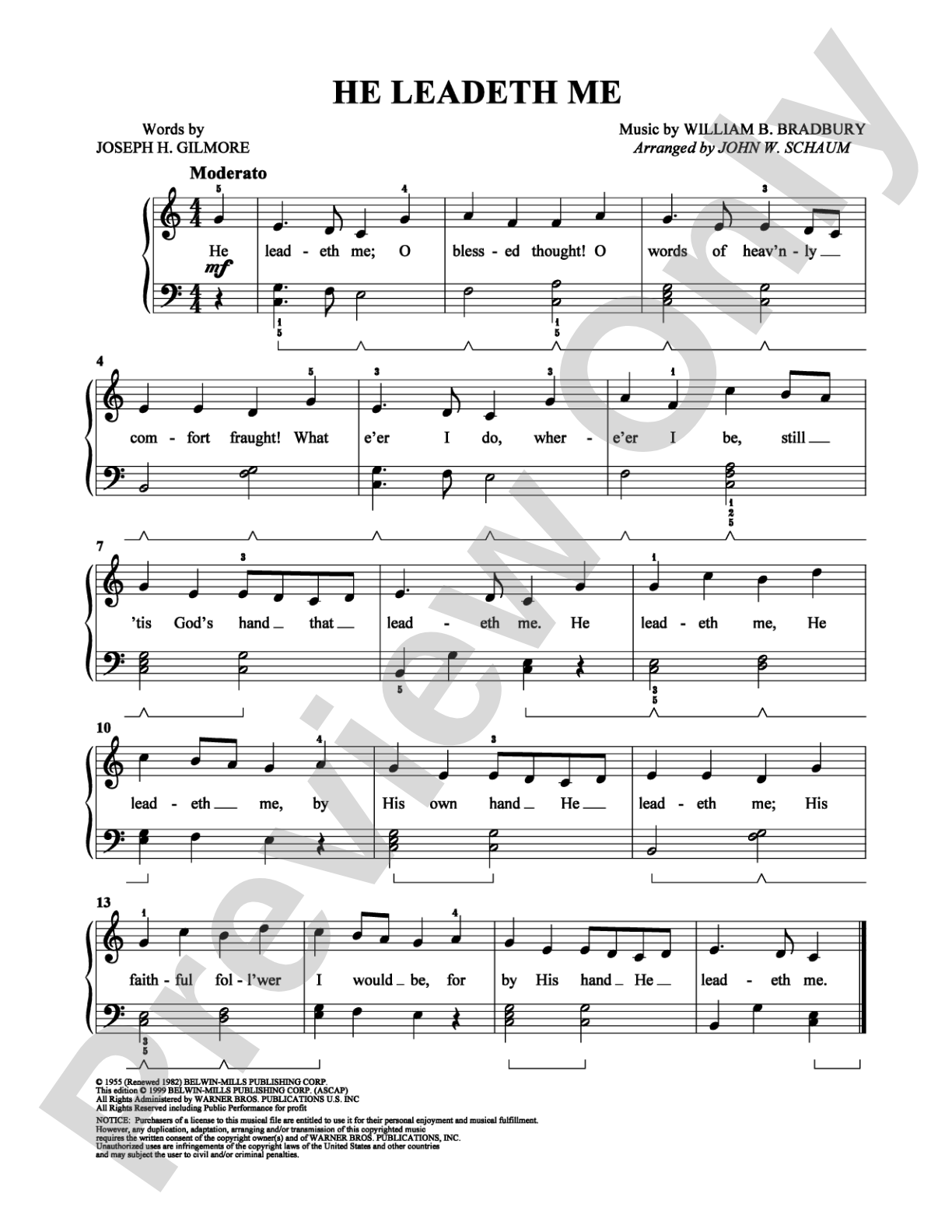
He Leadeth Me: Easy Piano Digital Sheet Music

He Leadeth Me: Easy Piano Digital Sheet Music

John W. Schaum, William B. Bradbury

Item: 00-PS-0000208

Digital Download
$2.95
Description

He Leadeth Me: Easy Piano Digital Sheet Music isn't in MakeMusic Cloud just yet...but it could be. Let us know you'd like to see it, and you'll help shape what comes next. In the meantime, start a free trial and dive into thousands of interactive titles your students can play along with today.

Sample Audio
No sample audio found.
Sample Video
Additional Details
SKU: 00-PS-0000208

More about this title

About the Composer: William B. Bradbury

William B. Bradbury (1816, 1868) was a prolific American composer, compiler, and music educator who shaped congregational singing for generations. His gift lay in writing melodies that stick with people: simple enough for any voice to grasp, memorable enough to carry home from church. Bradbury published dozens of tunebooks and trained countless music teachers, making him one of the most influential figures in 19th-century American sacred music.

Why we love this

This arrangement gives students access to a beloved hymn without technical barriers. The easy-piano version preserves the hymn's emotional core while remaining genuinely playable for early-intermediate pianists, making it useful for recitals, worship services, or as a bridge into classical repertoire with spiritual content.

What to expect

Warm and reassuring. The melody unfolds with quiet confidence, supported by gentle harmonies that feel both grounded and hopeful. There is no drama here, only the steady consolation of faith expressed through simple, direct music.

Who it's for

Early-intermediate pianists preparing repertoire for recitals, church services, or student ensemble performances. Teachers seeking approachable hymn arrangements that develop musicality without technical complexity.

How to get the most out of it

  • Emphasize the vocal melody in the right hand so the hymn tune sings clearly; treat the left hand as accompaniment support rather than equal voice.
  • Maintain steady, unhurried tempo that allows the text (when sung) to breathe naturally; gospel hymns benefit from slight rubato at phrase endings.
  • Balance dynamics across phrases rather than playing uniformly; gentle swells at cadential moments deepen the sense of resolution and assurance.

How to use it

Include this in a student recital alongside other accessible pieces of varied genres to represent American sacred music heritage. It also works well as an opening or closing piece in a worship service context, or paired with other hymn arrangements for a thematic program.

Skills your students will build

  • Reading and interpreting hymn melody and harmony
  • Playing a sustained vocal line while accompanying with left-hand texture
  • Shaping phrases with subtle dynamic control
  • Developing sensitivity to sacred music expression and style

You May Also Like