
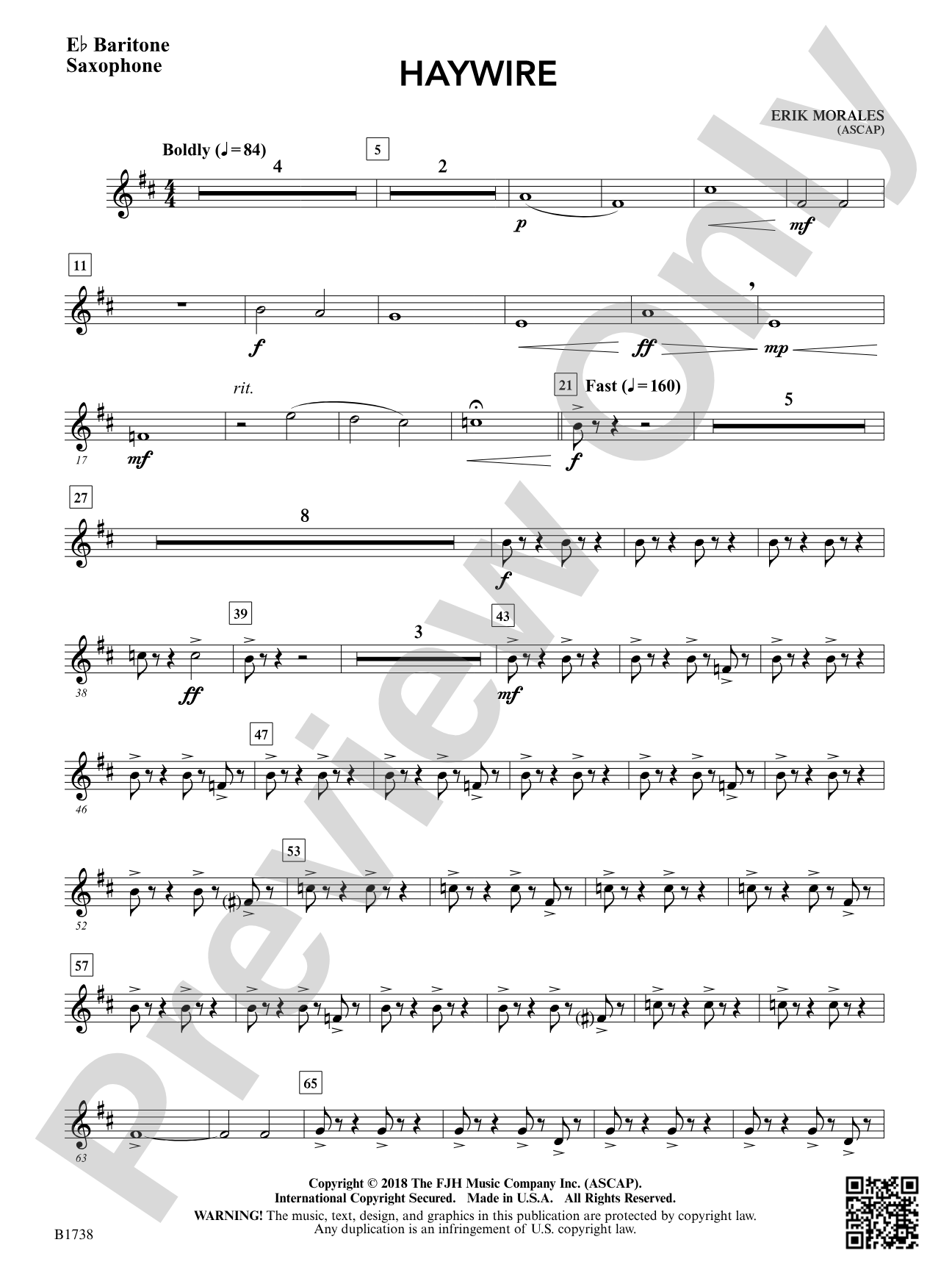

Haywire: E-flat Baritone Saxophone
By Erik Morales
Grade: 3
Item: 98-PC-DB1738_BTX
$7.00
Pickup currently not available
Description
This clever yet serious work is designed with intentional tonal misdirection. Elements of tonality work in tandem with dissonance so that simple melodies do not resolve in a manner that is expected. Highly original music that constantly takes the listener on a series of unexpected turns that culminate in a powerful, satisfying ending.


Haywire: E-flat Baritone Saxophone isn't in MakeMusic Cloud just yet...but it could be. Let us know you'd like to see it, and you'll help shape what comes next. In the meantime, start a free trial and dive into thousands of interactive titles your students can play along with today.
Request This Title
Tell us you want it.
Start Your Free Trial
Explore everything that's ready to play right now.
Sample Audio
1
Audio File
--:--
0:00
0:00
Sample Video
Additional Details
Series:
FJH Concert Band
Publisher:
The FJH Music Company, Inc.
SKU:
98-PC-DB1738_BTX
More about this title
About the Composer: Erik Morales

Erik Morales was born in New York City in 1966 and has built a prolific career as a composer across classical, jazz, and commercial idioms. With more than 150 published works spanning wind ensembles, orchestral settings, jazz groups, and chamber configurations, his music reaches performers and audiences globally. He studied composition at Florida International University and earned his bachelor's degree from the University of Louisiana, Lafayette in 1989.
Moreles began composing while still in high school, when his band director commissioned arrangements for the marching ensemble in 1985, a pivotal moment that launched his work in educational music publishing. His contributions to the trumpet repertoire are especially notable; his trumpet ensembles have earned first place finishes at the National Trumpet Competitions (2006, 2008), and his Concerto for Trumpet in C and Piano premiered at the 2009 International Trumpet Guild Conference. In 2016, he was inducted into the Louisiana Association for Jazz Education's Hall of Fame. Throughout his career, Morales has maintained a commitment to balancing artistic merit with pedagogical value, earning regular commissions from schools and organizations across the country.
Why we love this
Morales crafts a score that respects the intelligence of young musicians while delivering genuine compositional craft. The deliberate harmonic ambiguity and tonal sleight-of-hand keep both players and listeners actively engaged, making this an excellent choice for bands ready to move beyond straightforward harmonic progressions. Programming this work signals that your ensemble handles sophisticated musical architecture with maturity.
What to expect
Haywire keeps you slightly unmoored from moment to moment. Just when your ear settles into a key center, a melody sidesteps the expected resolution or harmony pulls in an unexpected direction. The cumulative effect builds genuine tension that finally releases in a conclusion that lands with earned weight and conviction.
Who it's for
Grade 3 concert bands with solid fundamentals and players who respond well to contemporary harmonic language. This work works especially well for ensembles that have already tackled some modal or chromatic writing and are ready for music that deliberately subverts listener expectations.
How to get the most out of it
- Emphasize the unexpected harmonic resolutions in sectional rehearsals; have players mark places where the melody avoids the 'obvious' landing tone so they understand the composer's intentional misdirection.
- Balance the dissonance carefully in the ensemble sound. Intonation becomes a powerful interpretive tool here; tight tuning in moments of tonal ambiguity sharpens the listening experience.
- Shape phrases around the unpredictable harmonic movement rather than falling into predictable cadence patterns. The power of the ending depends on the audience having felt genuinely off-balance throughout.
How to use it
Program this as a centerpiece work on a festival or contest concert, where its compositional sophistication will impress judges and audiences alike. It pairs well with more traditional repertoire on the same program, demonstrating your band's range and interpretive flexibility.
Skills your students will build
- Hearing and responding to unexpected harmonic progressions
- Maintaining phrase direction through non-traditional resolutions
- Balancing ensemble intonation in dissonant harmonic contexts
- Interpreting tension and release in contemporary concert band writing