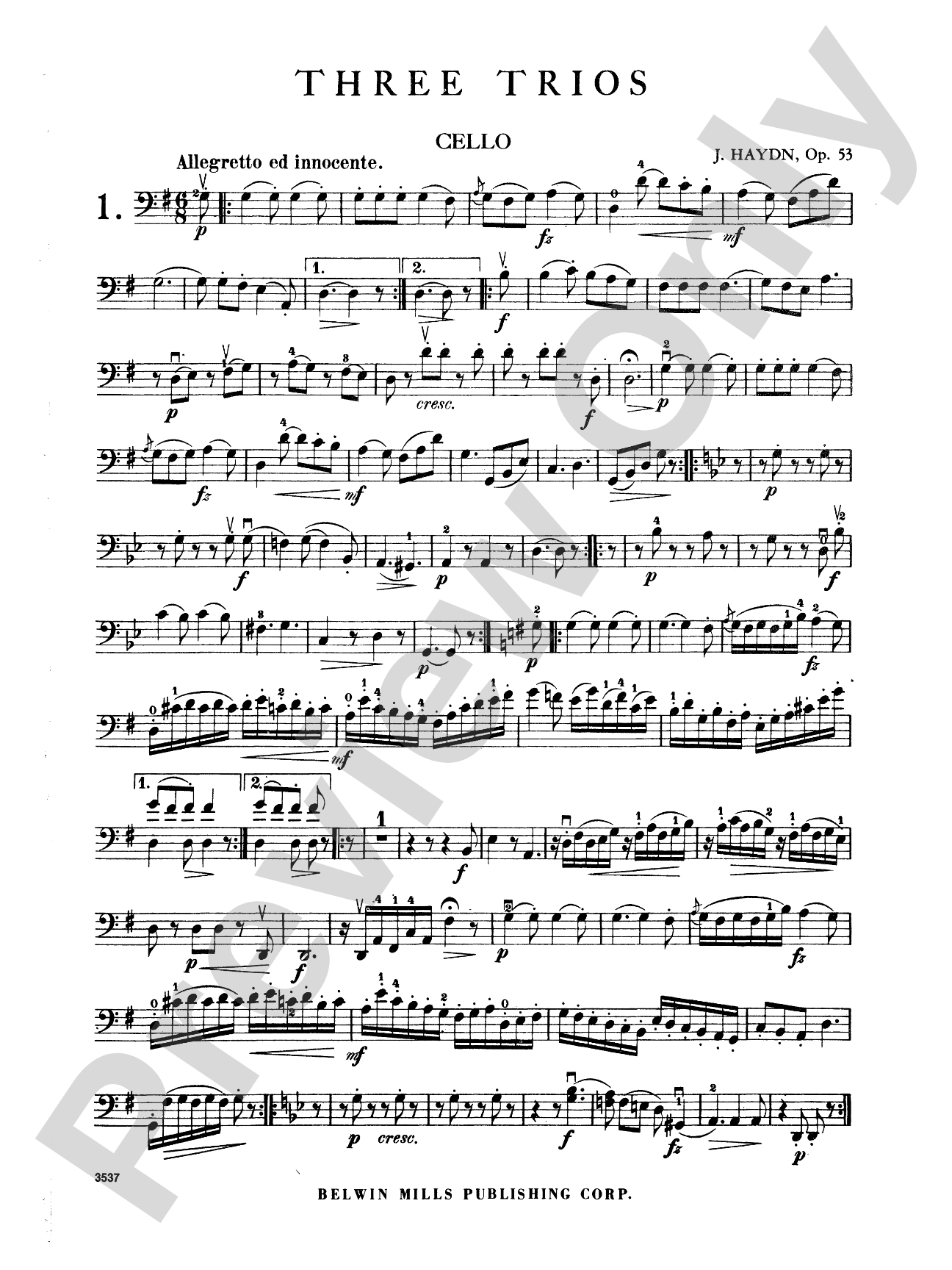
Haydn: Three Trios, Op. 53 Sheet Music Preview

Haydn: Three Trios, Op. 53

By Franz Joseph Haydn

Item: 00-PC-0007918

Digital Download
$0.99
Description
Expertly arranged String Trios by Franz Joseph Haydn from the Kalmus Edition series. This is from the Classical era.

Don't just read it, hear it, play along with it, and watch your students grow with it. In MakeMusic Cloud, Haydn: Three Trios, Op. 53 comes alive with professional accompaniment, adjustable tempo, and built-in practice tools that turn solo practice into real progress.

Sample Audio
No sample audio found.
Sample Video
Additional Details
Series: Kalmus Edition
Publisher: Alfred Music
Page Count: 32
SKU: 00-PC-0007918

More about this title

About the Composer: Franz Joseph Haydn

Franz Joseph Haydn (1732-1809) shaped the Classical era as one of its most prolific and innovative composers. His 68 string quartets and numerous chamber works established the structural and expressive vocabulary that defined the era, influencing everyone from Mozart to Beethoven. Haydn's gift for memorable melody, clear harmonic architecture, and witty orchestration made him essential listening for music students and professionals alike.

Haydn's string trios occupy a unique space in chamber music: more intimate than his symphonies, more focused than his string quartets. The Op. 53 trios showcase his mastery of three-part writing, where each instrument carries equal weight in conversation. For educators, his works offer students direct access to Classical form and voice-leading at its clearest.

Why we love this

These trios give student ensembles access to one of history's greatest minds without the technical demands of a Haydn string quartet. The Op. 53 set balances technical challenge with genuine musical rewards, and the three-part texture demands real listening and ensemble awareness from every player.

What to expect

The music unfolds with elegant clarity and conversational grace. Melodies sing in the Haydn manner—memorable without being simple, ornamented without becoming fussy—while the harmonic foundation is transparent enough that young musicians can hear exactly how the composer builds structure from basic elements. The three-voice texture creates an intimate, almost domestic quality that invites listeners closer.

Who it's for

Intermediate to advanced high school and college string players ready to tackle genuine chamber music repertoire. These trios suit festival competitions, chamber performance classes, and string ensembles seeking accessible yet substantive Classical literature.

How to get the most out of it

  • Attend closely to the viola part, which carries both harmonic responsibility and occasional melodic material. Resist the habit of treating it as accompaniment; Haydn writes for genuine trio texture.
  • Shape phrases with the forward momentum that characterizes Classical style. Allow cadences to breathe without dragging; the music's elegance lives in its clarity of line.
  • Balance the three voices so that thematic exchanges remain audible. String trios need more conscious attention to relative volume than larger ensembles because there is nowhere to hide.
  • Tune carefully at section transitions and when harmonic color shifts. The economy of the trio texture makes intonation lapses immediately noticeable.

How to use it

Program one trio as a chamber music recital centerpiece or pair it with a Baroque trio sonata to show the evolution of the genre. The Op. 53 set also works well in a concert exploring Haydn's chamber works or as a festival entry that demonstrates serious musicianship without excessive technical display.

Skills your students will build

  • Classical phrase structure and cadence recognition
  • Balancing three independent lines in real time
  • Viola literacy and ensemble texture awareness
  • Intonation adjustment in trio sonorities
  • Stylistically informed articulation and ornamentation in the Classical idiom

You May Also Like