Haydn: Three Duets, Op. 99 Sheet Music Preview

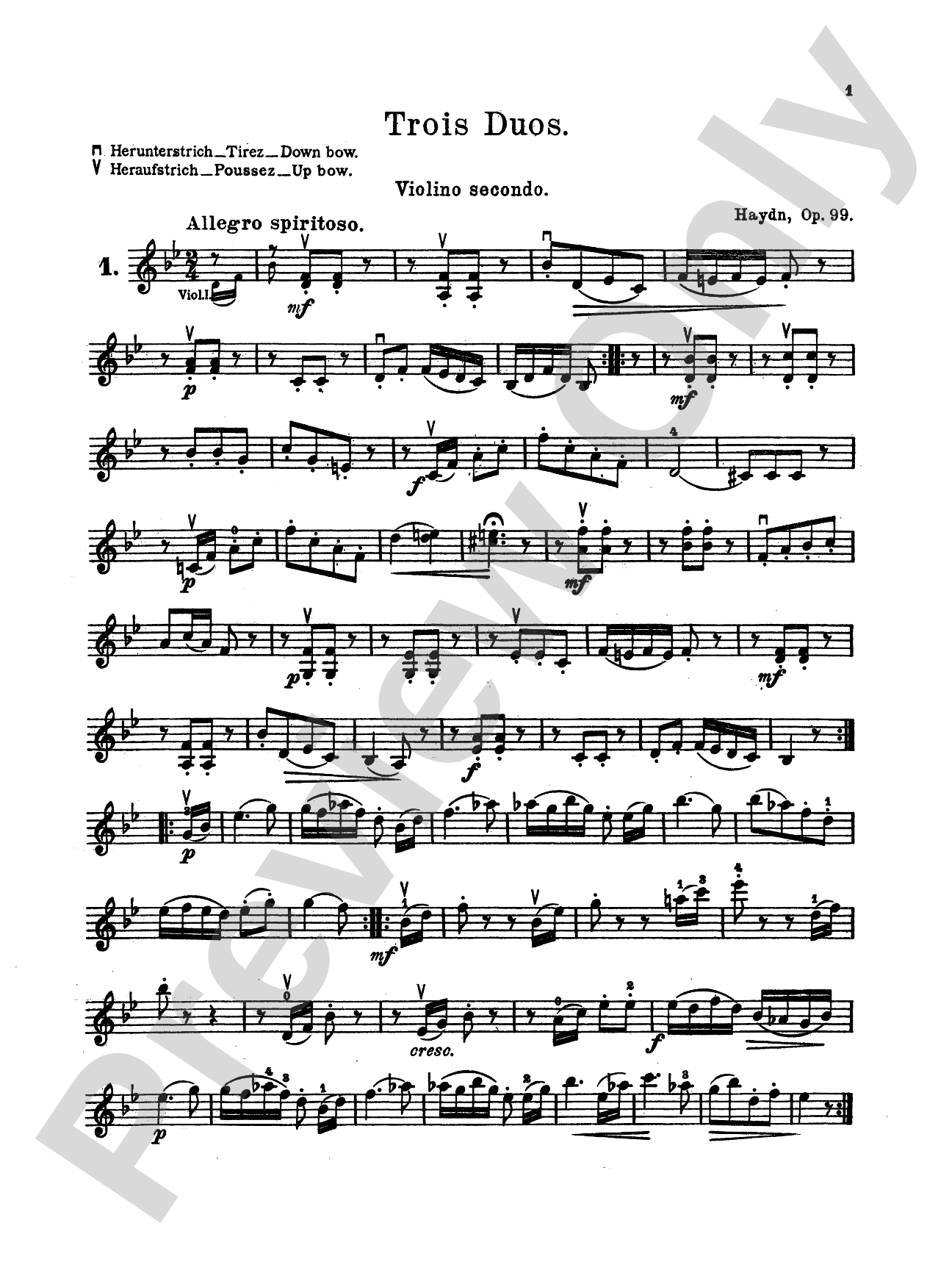
Haydn: Three Duets, Op. 99

By Franz Joseph Haydn

Item: 00-PC-0010748

Digital Download
$0.99
Description
A collection of string duets for 2 Violins, composed by Franz Joseph Haydn.

Don't just read it, hear it, play along with it, and watch your students grow with it. In MakeMusic Cloud, Haydn: Three Duets, Op. 99 comes alive with professional accompaniment, adjustable tempo, and built-in practice tools that turn solo practice into real progress.

Sample Audio
No sample audio found.
Sample Video
Additional Details
Series: Kalmus Edition
Publisher: Alfred Music
Page Count: 24
SKU: 00-PC-0010748

More about this title

About the Composer: Franz Joseph Haydn

Franz Joseph Haydn (1732-1809) shaped the Classical symphony, sonata, and string quartet into their modern forms. His prolific output across every genre established conventions that composers from Mozart to Beethoven would build upon, and his chamber works remain central to the string repertoire.

Haydn's duets occupy a special place in his catalog. Written across his career, they range from pedagogical pieces for advancing students to sophisticated concert works. Op. 99 belongs to his mature period, when his ear for counterpoint, rhythmic wit, and elegant phrasing had reached full refinement. These pieces reward attentive ensemble work and reveal why Haydn was called "the Father of the Symphony."

Why we love this

Haydn's duets sit at the exact intersection of musicianship and accessibility. The writing is idiomatic for violin, the textures are transparent enough for students to hear the counterpoint clearly, and the musical ideas are substantial enough to engage serious players. These pieces teach ensemble discipline and independence without feeling like etudes.

What to expect

Light and conversational. Haydn's duets sparkle with Classical wit and grace; they ask for precision and elegance rather than virtuosity. There is an almost playful quality to the way the violins trade ideas, creating moments of gentle counterpoint that feel like a musical friendship unfolding.

Who it's for

Violin students in upper intermediate to advanced levels who are ready to collaborate meaningfully with a peer and explore the foundation of string chamber music. Teachers preparing duos for festival performances or developing ensemble skills will find these pieces both musically rewarding and pedagogically sound.

How to get the most out of it

  • Bring out the dialogue between parts. Haydn often passes melodic fragments between the two violins; shape these exchanges so listeners track the conversation.
  • Maintain clarity of line even in fast passages. The Classical style demands clean articulation and even rhythmic spacing; resist the urge to rush or blur.
  • Balance the parts so neither violin dominates. When one violin carries the primary melody, the other should support without disappearing.
  • Use vibrato sparingly. Haydn's Classical voice calls for a cleaner, less continuous vibrato than Romantic repertoire; experiment with vibrato only on sustained notes and cadences.

How to use it

Program these as an intermission offering or as part of a chamber music concert featuring student ensembles. They also make excellent teaching demonstrations of duet balance and phrasing for younger violinists watching advanced peers. A full recital of Haydn duets creates a unified, satisfying program that showcases both technical control and musical maturity.

Skills your students will build

  • Equal voice independence in two-part writing
  • Listening and balancing while playing
  • Phrasing and articulation in Classical style
  • Counting and ensemble precision in moderate tempos
  • Awareness of harmonic function and cadential structure

You May Also Like