
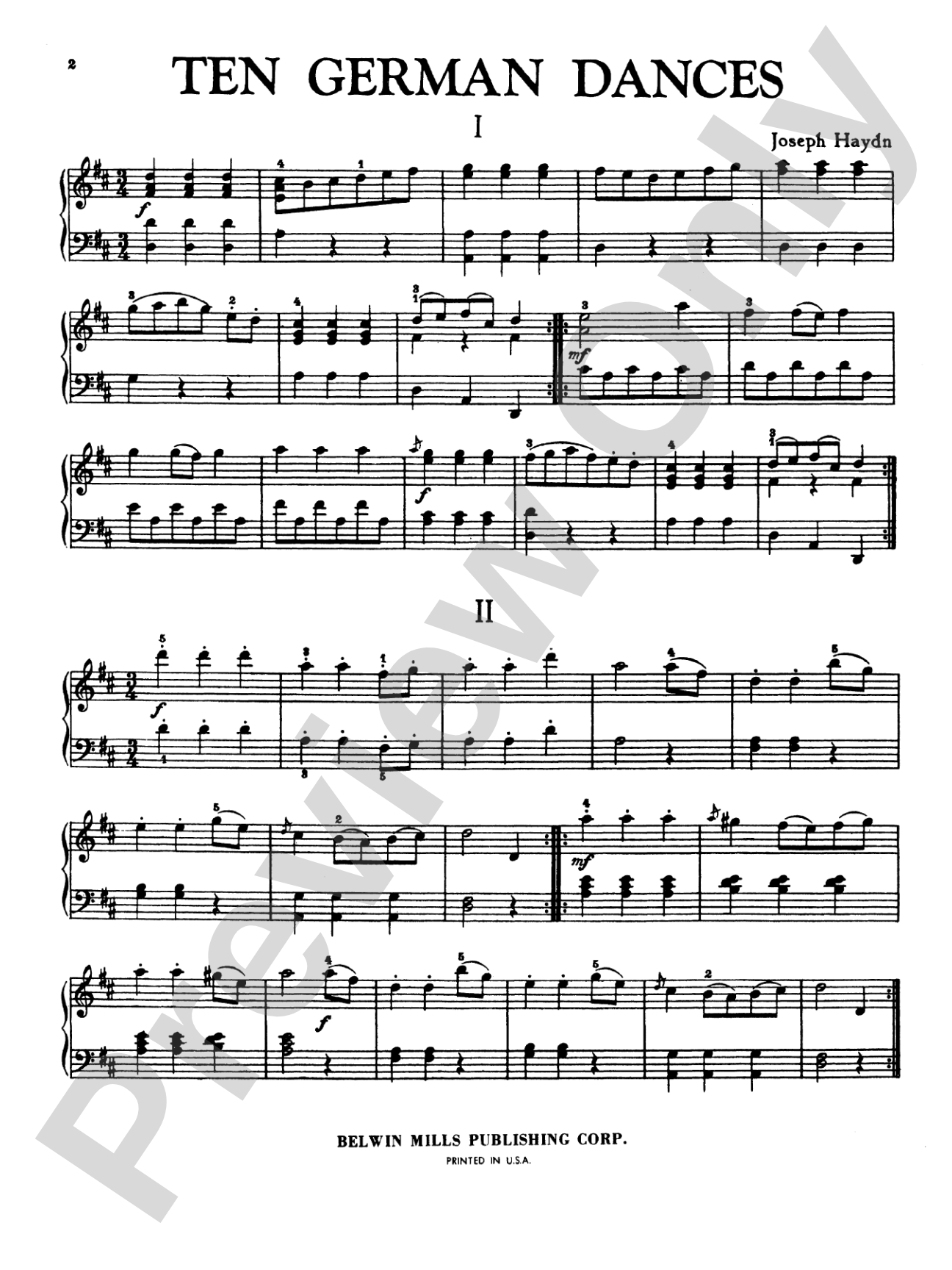

Haydn: Ten German Dances: Piano Book
By Franz Joseph Haydn
Level: Intermediate / Advanced
Item: 00-PK-0003146

$7.99
Pickup currently not available
Buy Extra Parts (Digital PDF Download)
| Product | Price | Quantity |
|---|---|---|
| Haydn: Ten German Dances | $0.99 | |
| Haydn: Ten German Dances | $0.99 | |
| Haydn: Ten German Dances | $0.99 | |
| Haydn: Ten German Dances | $0.99 | |
| Haydn: Ten German Dances | $0.99 | |
| Haydn: Ten German Dances | $0.99 | |
| Haydn: Ten German Dances | $0.99 | |
| Haydn: Ten German Dances | $0.99 | |
| Haydn: Ten German Dances | $0.99 | |
| Haydn: Ten German Dances | $0.99 |
Parts Added to Cart!
Related Items
Ten German Dances: Piano Book |
$7.95
|
View |
Description
A collection of Intermediate / Advanced piano solos composed by Franz Joseph Haydn.


Don't just read it, hear it, play along with it, and watch your students grow with it. In MakeMusic Cloud, Haydn: Ten German Dances: Piano Book comes alive with professional accompaniment, adjustable tempo, and built-in practice tools that turn solo practice into real progress.
Open in the Player
Jump straight in and assign it today.
Start Your Free Trial
Open this title and explore the full library in minutes.
Sample Audio
No sample audio found.
Sample Video
No sample videos found.
Additional Details
Series:
Kalmus Edition
Publisher:
Alfred Music
Page Count:
8
SKU:
00-PK-0003146
More about this title
About the Composer: Franz Joseph Haydn
Franz Joseph Haydn (1732-1809) spent most of his career as Kapellmeister to the Esterházy family, a position that gave him the freedom to compose prolifically across every genre. His 104 symphonies, 68 string quartets, and countless keyboard works established the structural language of the Classical era and directly influenced Mozart and Beethoven.
Haydn's genius lay in his ability to write music that is intellectually rigorous yet genuinely charming. He understood the piano as both a solo instrument and an accompaniment tool, and his keyboard works range from intimate salon pieces to technically demanding concert works. His influence on music education remains profound, as his clear forms and balanced phrasing make him an ideal composer for intermediate pianists learning to shape larger structures.
Why we love this
These dances showcase Haydn's gift for writing graceful, unpretentious music that sits perfectly under the fingers. The collection gives students a chance to play authentic Classical repertoire without the virtuosic demands of his sonatas, making it an excellent bridge between classical studies and concert-level performance.
What to expect
Bright, forward-moving, and unpretentious. These dances have the sparkle of a social gathering, elegant but never stiff, with the kind of melodic charm that sticks with you. There's humor threaded through the rhythmic play and harmonic turns, and a sense of motion that keeps the listener engaged even in short forms.
Who it's for
Intermediate to advanced pianists ready to engage with substantial Classical works beyond simplified arrangements. This collection suits private studio students preparing for recitals, young pianists exploring the keyboard repertoire of Haydn's era, and performers seeking authentic period-appropriate dance forms.
How to get the most out of it
- Shape the phrases with clear articulation between dance sections; the minuets and German dances benefit from distinct stylistic separation within each dance.
- Balance the two hands carefully so accompanying patterns in one hand never overshadow the melody, a hallmark of Classical writing.
- Practice each dance at performance tempo before assembling the full collection, as the contrasting character of each piece requires fresh attention.
How to use it
Program these as a suite or select individual dances to pair with other Classical keyboard works on a recital. They work equally well as teaching pieces for students studying form and phrasing or as light concert openers that establish a Classical sensibility before moving into weightier repertoire.
Skills your students will build
- Phrasing and articulation in Classical style
- Hand independence and textural balance between melody and accompaniment
- Understanding of dance forms and their structural conventions
- Tempo control and character differentiation across multiple short works
- Reading Classical notation and ornamentation conventions