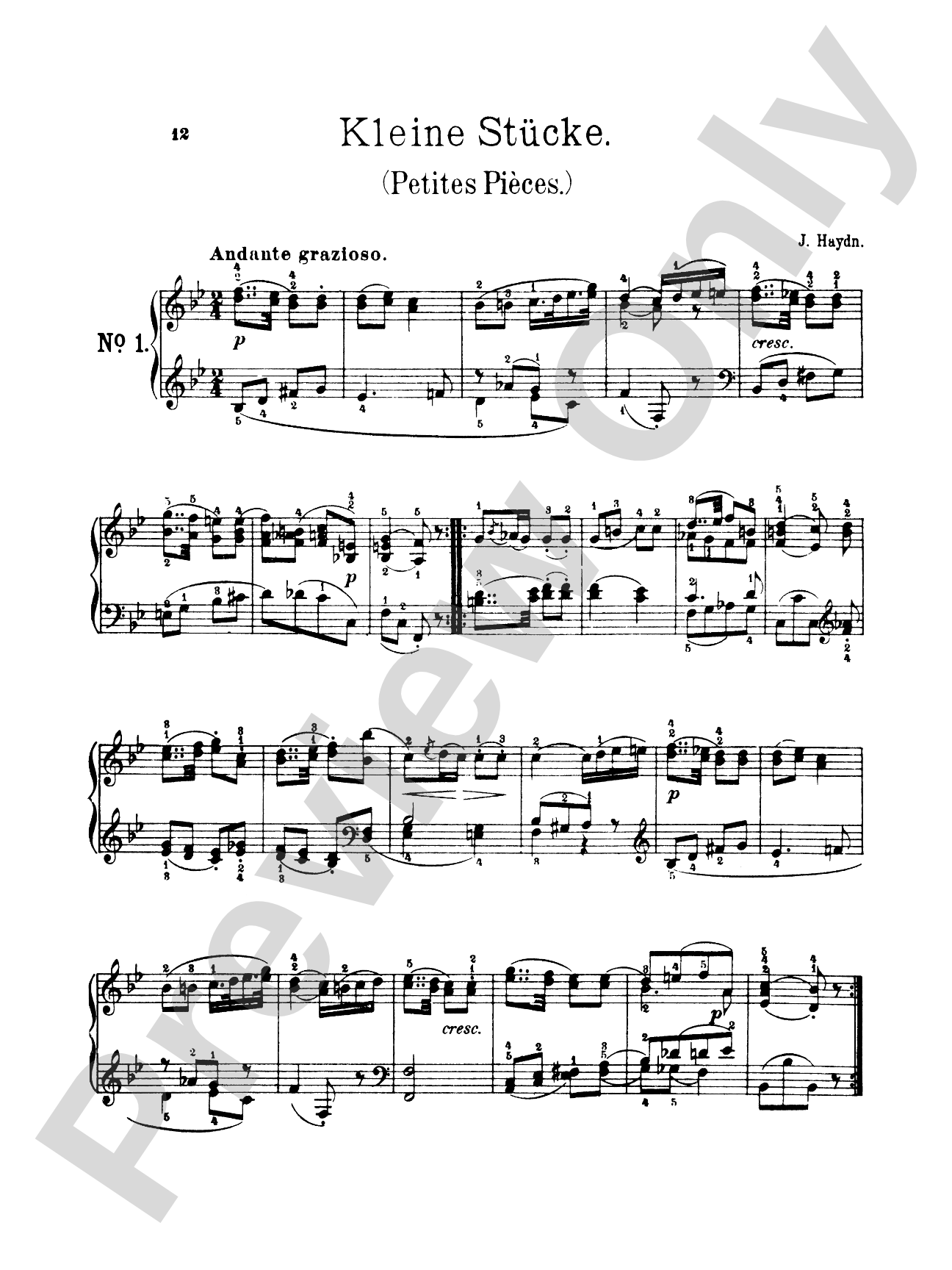
Haydn: A First Haydn Book Sheet Music Preview

Haydn: A First Haydn Book

By Franz Joseph Haydn

Level: Intermediate / Advanced

Item: 00-PC-0007852

Digital Download
$0.99
Description
A collection of Intermediate / Advanced piano solos composed by Franz Joseph Haydn.

Don't just read it, hear it, play along with it, and watch your students grow with it. In MakeMusic Cloud, Haydn: A First Haydn Book comes alive with professional accompaniment, adjustable tempo, and built-in practice tools that turn solo practice into real progress.

Sample Audio
No sample audio found.
Sample Video
Additional Details
Series: Kalmus Edition
Publisher: Alfred Music
Page Count: 16
SKU: 00-PC-0007852

More about this title

About the Composer: Franz Joseph Haydn

Franz Joseph Haydn (1732-1809) shaped the Classical era as one of its most prolific and inventive composers. His mastery of form, harmonic sophistication, and melodic invention established the sonata and symphony as central genres of Western music; his influence on Mozart and Beethoven cannot be overstated.

Haydn's piano works span his entire career and range from simple divertimenti to substantive sonatas. These pieces reveal his gift for elegant phrasing, unexpected harmonic turns, and the kind of wit that made him indispensable to music education for generations. His writing remains pedagogically valuable because it demands clarity of touch and understanding of Classical voice leading without requiring virtuosic pyrotechnics.

Why we love this

Haydn's solos sit in that rare zone where the music is genuinely interesting to play yet achievable at the intermediate-advanced level. These pieces avoid the sentimental excess of later Romantic writing while offering enough harmonic and structural substance to keep accomplished student pianists engaged intellectually. Programming Haydn signals sophistication and roots students in the repertoire that matters.

What to expect

Clear-headed and graceful, with the kind of intelligence that rewards close listening. Haydn's solos breathe easily; they neither overwhelm with virtuosity nor condescend with oversimplification. There is always a sense of forward motion, of ideas unfolding with inevitable logic, yet the writing never feels mechanical or predictable.

Who it's for

Intermediate to advanced pianists ready to move beyond Baroque counterpoint into the architectural clarity of Classical form. Students preparing for auditions or recitals benefit from Haydn's balance of technical accessibility and musical substance. Teachers seeking repertoire that develops both interpretive judgment and structural awareness will find reliable material here.

How to get the most out of it

  • Attend to Haydn's dynamic markings with precision. What appears subtle on the page (a single forte or piano) often carries structural weight; honor these gestures as signposts rather than decoration.
  • Shape phrases with gentle voice leading rather than rubato. Classical style demands that melodic lines breathe through articulation and touch, not tempo manipulation.
  • Distinguish between passage work and thematic material. Haydn often embeds important ideas in figurations that can easily disappear if not voiced with care.
  • Let rests speak. Haydn's silences are compositional choices, not empty space. Allow them to land cleanly and give the listener room to settle.

How to use it

Pair Haydn with Beethoven or Mozart to frame the Classical period's range within a single recital. A Haydn solo works beautifully in a mixed program between Baroque and Romantic works, where its measured elegance offers welcome contrast. Consider opening a student recital with Haydn to establish poise and maturity before moving into more demonstrative repertoire.

Skills your students will build

  • Identifying and performing Classical phrase structure and cadence types
  • Balancing multiple voices and inner parts without pedal dependency
  • Executing clear Alberti bass and other Haydn-era accompaniment figurations
  • Shaping Andante and Allegro tempos with appropriate Classical articulation
  • Understanding harmonic function and harmonic rhythm in tonal music

You May Also Like