
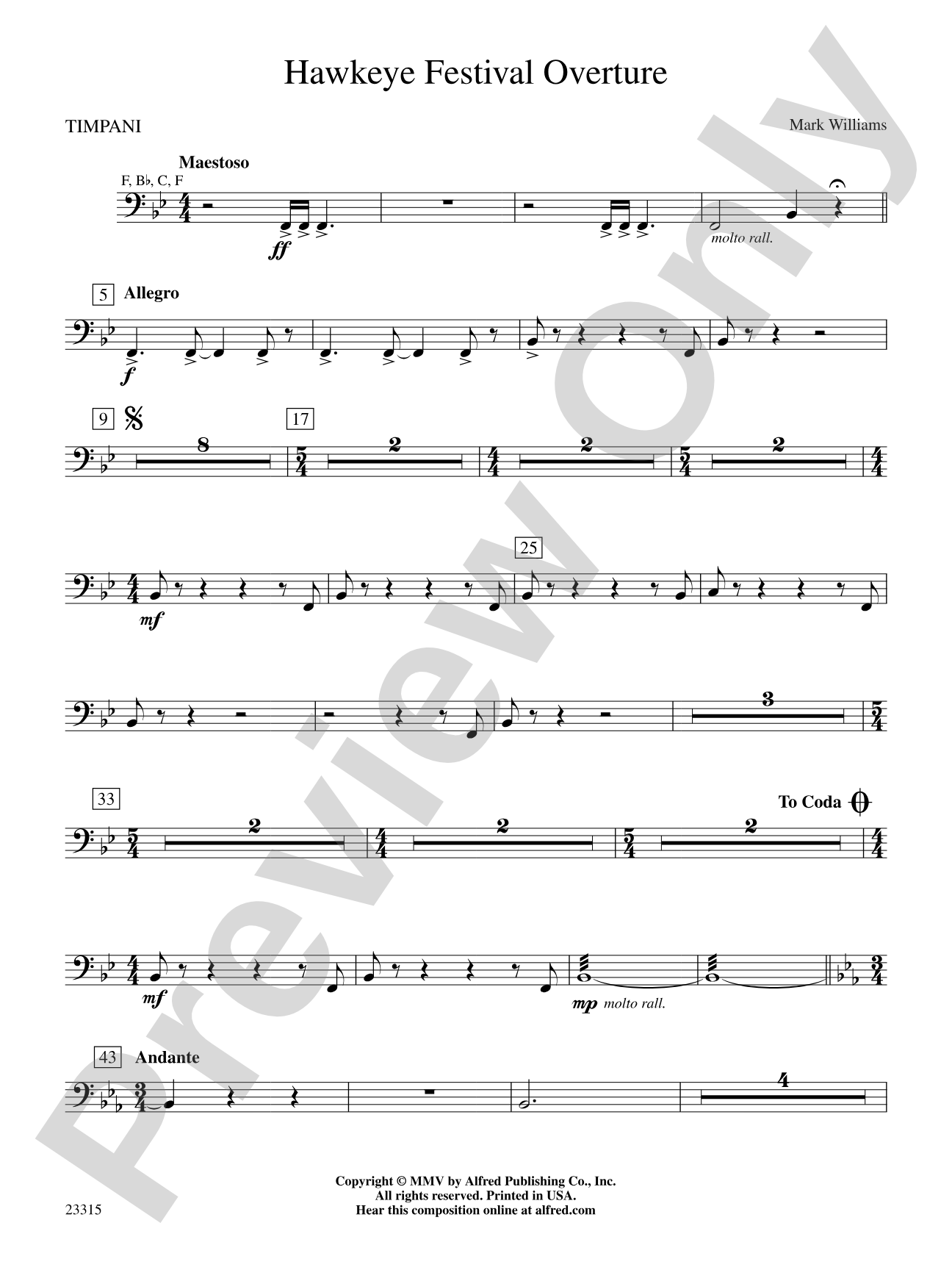

Hawkeye Festival Overture: Timpani
By Mark Williams
Grade: 3.5 (Medium)
Item: 00-PC-0000665_TMP
$3.00
Pickup currently not available
Description
Hawkeye Festival Overture begins with a bright opening fanfare which leads to a rhythmic Allegro section. An Andante section in 3/4 time features a lyric trumpet solo and numerous harmonic suspensions. A driving percussion interlude in 5/4 with a gradual pyramid that builds in the winds leads to a return of the Allegro. The work ends with a powerful re-statement of the syncopated 5/4 motives and finishes with a flourish. This very appealing work is well-suited for developing concert bands and should provide excellent opportunities for studies in general musicianship, intonation and rhythmic precision.


Don't just read it, hear it, play along with it, and watch your students grow with it. In MakeMusic Cloud, Hawkeye Festival Overture: Timpani comes alive with professional accompaniment, adjustable tempo, and built-in practice tools that turn solo practice into real progress.
Open in the Player
Jump straight in and assign it today.
Start Your Free Trial
Open this title and explore the full library in minutes.
Sample Audio
1
Audio File
--:--
0:00
0:00
Sample Video
No sample videos found.
Additional Details
Series:
Alfred Concert Band
Publisher:
Alfred Music
Page Count:
284
SKU:
00-PC-0000665_TMP
More about this title
About the Composer: Mark Williams

Mark Williams composed over 200 works for school and professional ensembles, establishing himself as a prolific voice in band and orchestral literature. His impact extended beyond the page: he co-authored the Accent on Achievement Band Method, guest conducted across 34 states and five Canadian provinces plus Australia, and served as woodwind performer and arranger for the 560th Air Force Band. Williams earned degrees from Eastern Washington University and spent his career teaching music in Washington state, with particular focus on elementary band instruction.
Throughout his career, Williams received recognition including the Gralia Competition award from the Western International Band Clinic and multiple ASCAP Special Awards. Beyond composing, he performed actively on bassoon and directed the Spokane British Brass Band as conductor and artistic director, bringing his deep understanding of ensemble sonority and function to every piece he wrote.
Why we love this
Williams builds this overture with the kind of structural clarity that makes it genuinely instructive to teach. The progression from fanfare through contrasting meters to a driving 5/4 section gives every section of the band something purposeful to do, while the harmonic suspensions in the Andante and the rhythmic precision demands in the outer sections work real musicianship without unnecessary difficulty. Bands love playing this because it sounds impressive and feels rewarding, and directors love teaching it because the compositional choices naturally address intonation, balance, and ensemble cohesion.
What to expect
Bright and energetic from the opening fanfare, the piece settles into lyricism in the middle section where a singing trumpet melody floats over rich harmonic movement. The shift to 5/4 brings a subtle edge and propulsive drive, building through layers of wind color until the work snaps back to its original swagger and closes with syncopated punch.
Who it's for
Developing concert bands working at Grade 3.5 level who are ready to tackle varied meters and harmonic sophistication. This score and parts set works for directors looking to program a substantial, musically rewarding overture that challenges musicianship without stranding less experienced players.
How to get the most out of it
- Shape the bright opening fanfare with clear articulation and consistent air support; think of it as establishing the character and energy for everything that follows, so nail the intonation early.
- Bring out the lyric trumpet solo in the Andante by having the rest of the band sit slightly back dynamically. The numerous harmonic suspensions create richness only if supporting voices aren't competing for prominence.
- Lock the 5/4 percussion interlude with a clear pulse from the percussion section and a unified view of the pyramid structure in the winds. The gradual buildup depends on precision timing and balance across the crescendo.
- Return to the Allegro with fresh energy and slightly faster tempo feel than the first occurrence. The contrast between sections will feel sharper if you avoid letting the piece drag during the transition back.
How to use it
Open a concert with this overture to set a confident, engaging tone and immediately show that your band can navigate both metric and harmonic sophistication. It pairs well in a program with lyrical or slower works because its contrasting sections give you natural programming momentum, or place it mid-concert as a bridging piece that demonstrates technical control and musical maturity.
Skills your students will build
- Reading and performing in mixed meters (3/4 and 5/4 against 4/4 context)
- Harmonic awareness through suspensions and resolution
- Rhythmic precision in complex syncopated figures, particularly in the percussion interlude
- Intonation control across dynamic contrast and harmonic movement
- Ensemble balance and blend across fanfare articulation, lyric solo support, and full-band unison passages