
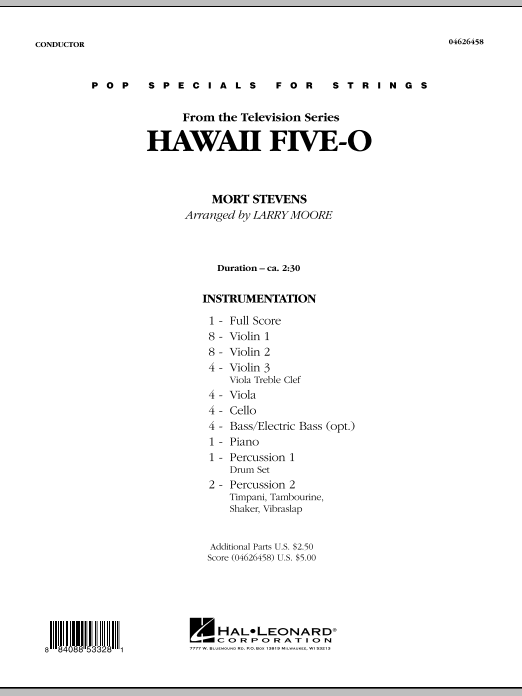

Hawaii Five-O: String Orchestra Conductor Score & Parts
By Mort Stevens / As performed by The Ventures / Arranged by Larry Moore
Grade: 3-4
Item: 35-PK00159019
$50.00
Pickup currently not available
Buy Extra Parts (Digital PDF Download)
| Product | Price | Quantity |
|---|---|---|
| Hawaii Five-O - Full Score | $6.00 | |
| Hawaii Five-O - Violin 1 | $7.00 | |
| Hawaii Five-O - Violin 2 | $7.00 | |
| Hawaii Five-O - Violin 3 (Viola Treble Clef) | $7.00 | |
| Hawaii Five-O - Viola | $7.00 | |
| Hawaii Five-O - Cello | $7.00 | |
| Hawaii Five-O - Bass | $7.00 | |
| Hawaii Five-O - Piano | $7.00 | |
| Hawaii Five-O - Percussion 1 | $7.00 | |
| Hawaii Five-O - Percussion 2 | $7.00 |
Parts Added to Cart!
Description
A new cutting-edge TV series based on the classic show once again features the memorable theme that accompanied Steve McGarrett decades ago. You'll want rock drums to help capture the energy and pulse of the original groove. Dur: 2:30


Hawaii Five-O: String Orchestra Conductor Score & Parts isn't in MakeMusic Cloud just yet...but it could be. Let us know you'd like to see it, and you'll help shape what comes next. In the meantime, start a free trial and dive into thousands of interactive titles your students can play along with today.
Request This Title
Tell us you want it.
Start Your Free Trial
Explore everything that's ready to play right now.
Sample Audio
No sample audio found.
Sample Video
No sample videos found.
Additional Details
Publisher:
Hal Leonard
SKU:
35-PK00159019
More about this title
About the Composer: Mort Stevens
Mort Stevens composed and arranged music for television throughout the 1960s and 1970s, establishing himself as a master of compact, memorable themes that defined entire series. His work on Hawaii Five-O became iconic precisely because it distilled complex grooves and orchestral color into a form that listeners recognized instantly and never forgot.
Stevens understood that television music had to work within strict time constraints while delivering maximum impact. His themes became blueprints for how to write for ensemble in ways that felt both sophisticated and immediately accessible to general audiences.
Why we love this
This arrangement captures the original's signature urgency without requiring a full orchestra or rhythm section from your ensemble. The grade 3-4 strings do the heavy lifting while the optional rock drums (or a savvy percussionist with brushes and sticks) deliver that propulsive feel that makes the theme so recognizable. Your students get to play something that matters culturally, alongside music they actually hear on screen.
What to expect
Sleek and propulsive. The strings drive forward with purpose while the optional drums push the groove into sharp focus. There's a coolness to this arrangement that comes from its restraint; it doesn't oversell the drama. Instead, it trusts that the melody and rhythm together create tension without needing orchestral bombast.
Who it's for
String orchestras at the intermediate level who want repertoire with genuine cultural currency. This works equally well for ensembles building confidence in rhythmic accuracy and those seeking a contemporary program piece that resonates beyond the music classroom.
How to get the most out of it
- Nail the unison figures in the opening. Rhythmic cohesion across the string section is what sells the urgency here; micro-timing matters as much as intonation.
- If using recorded drums, rehearse several times with the playback before concert. The groove locks the strings in place, but it requires the orchestra to surrender to its pulse rather than fight it.
- Balance the melody between first and second violins carefully during the main theme statement. This arrangement relies on clear voice leading to maintain forward momentum.
- Avoid letting the piece drag below the marked tempo. Even a few beats per minute slower will flatten the energy that makes this theme work.
How to use it
Perfect as a concert opener or closer. The two-and-a-half-minute duration means it can anchor a pops concert, sit comfortably between heavier classical works, or serve as a palette-cleanser that connects with student musicians who grew up watching the reboot. Consider pairing it with other film and television themes at the same level to build a cohesive program around arrangement and groove.
Skills your students will build
- Maintaining rhythmic precision in unison passages
- Responding to percussion leadership and pulse
- Shaping melody over a driving accompaniment pattern
- Balancing ensemble sound while featuring different sectional voices
- Playing with contemporary groove and forward motion