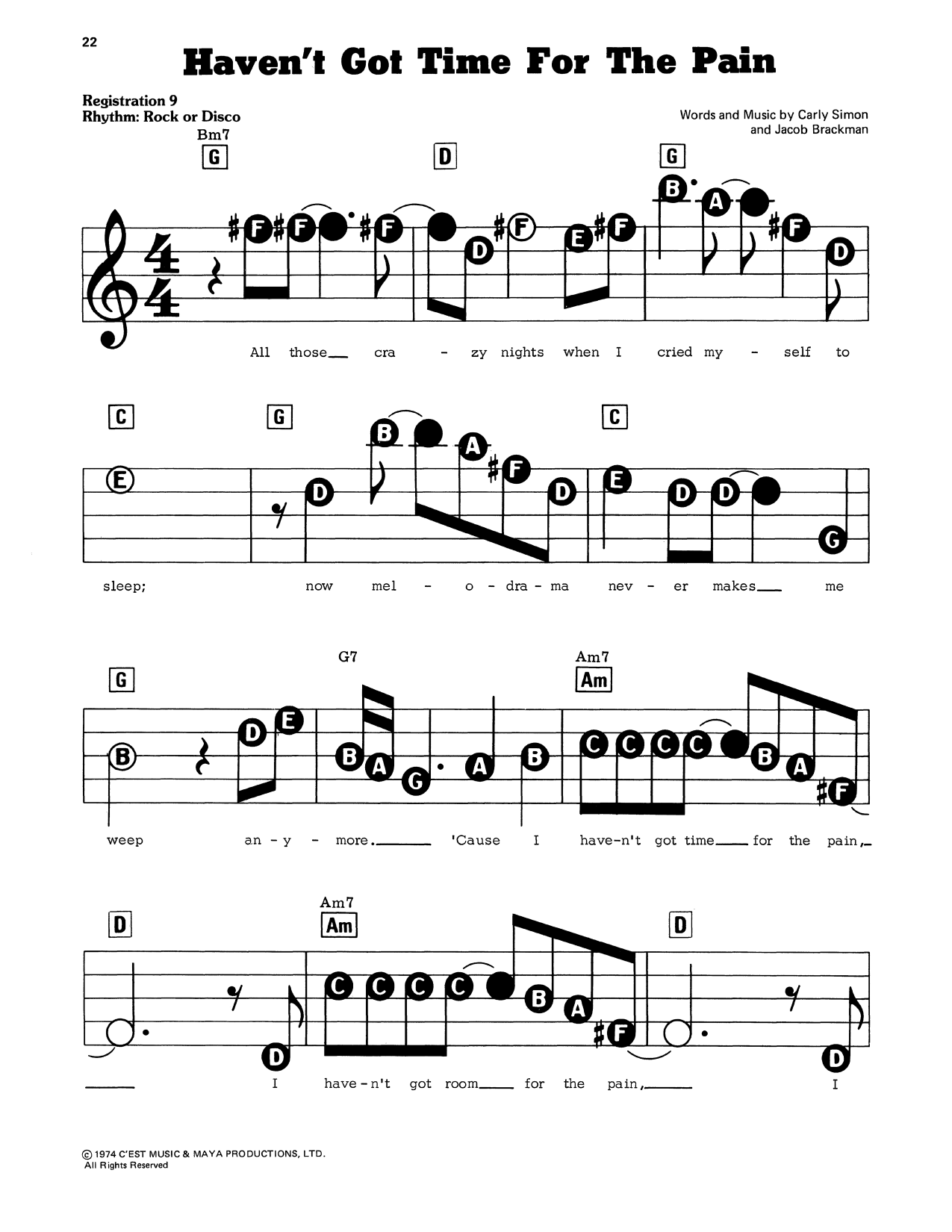
Haven't Got Time For The Pain Sheet Music Preview

Haven't Got Time For The Pain: E-Z Play Today

As performed by Carly Simon

Item: 35-DS01867803

Digital Download
$4.99
Description

Haven't Got Time For The Pain: E-Z Play Today isn't in MakeMusic Cloud just yet...but it could be. Let us know you'd like to see it, and you'll help shape what comes next. In the meantime, start a free trial and dive into thousands of interactive titles your students can play along with today.

Sample Audio
No sample audio found.
Sample Video
Additional Details
Publisher: Hal Leonard
Page Count: 3
SKU: 35-DS01867803

More about this title

About the Artist: Carly Simon

Carly Simon emerged as a defining voice in 1970s pop and rock, known for her distinctive contralto and sophisticated songwriting that blended confessional lyrics with polished production. Her work spans multiple genres and earned her five Grammy Awards, including recognition for both her vocal performance and compositional craft. Simon's influence on singer-songwriters extends well beyond her era, making her catalog a valuable resource for understanding how pop standards are constructed.

Why we love this

This E-Z Play arrangement opens a well-crafted 1970s pop song to pianists still building fluency with chord changes and rhythmic independence between hands. The accessible voicings don't sacrifice the song's character; students encounter the harmonic sophistication that made Simon's work enduring while staying within reach of intermediate players.

What to expect

Wry, reflective, and tinged with resignation. The song settles into an unhurried groove that feels more conversational than grand, with an underlying current of dry humor that keeps it from becoming heavy.

Who it's for

This works well for pianists in the late beginner or early intermediate stage who are ready to tackle pop standards with genuine harmonic content. It's also useful for vocalists who need an accompaniment that's simple enough to prepare quickly but faithful enough to support serious performance.

How to get the most out of it

  • Shape the melody with subtle dynamic nuance rather than strict evenness; Simon's phrasing often emphasizes certain syllables that call for slight weight shifts at phrase boundaries.
  • Balance the left-hand accompaniment so it supports rather than competes with the vocal or melodic line, letting the harmonic foundation live underneath.
  • Pay attention to where the groove sits rhythmically; maintaining a relaxed, conversational pace will let the song's emotional content land without rushing.
  • Explore the recorded version to hear how the original arrangement uses space and dynamics, then adapt those insights to your own interpretation of this simplified setting.

How to use it

Pair this with other 1970s singer-songwriter material to build a set that showcases how melody and harmony function in popular song. It works equally well as a solo piano feature or as an accompaniment for a vocalist in a cabaret-style concert.

Skills your students will build

  • Reading lead-sheet notation with chord symbols
  • Translating standard chord progressions into left-hand voicings
  • Balancing melodic independence while maintaining rhythmic cohesion
  • Interpreting dynamic and interpretive choices from written music

You May Also Like