Haven't Got Time For The Pain Sheet Music Preview

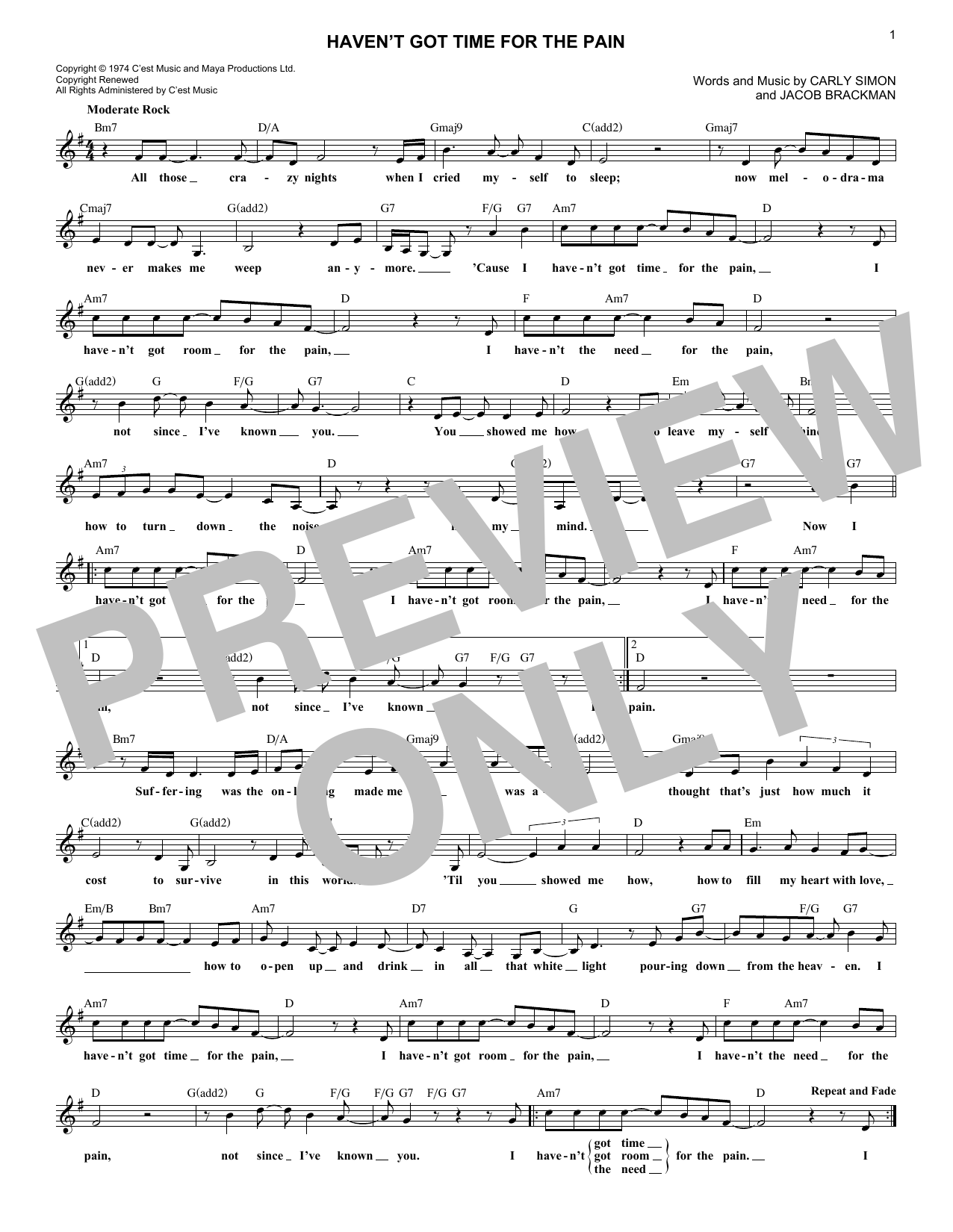
Haven't Got Time For The Pain: Lead Sheet / Fake Book

As performed by Carly Simon

Item: 35-DS00379722

Digital Download
$3.99
Description

Haven't Got Time For The Pain: Lead Sheet / Fake Book isn't in MakeMusic Cloud just yet...but it could be. Let us know you'd like to see it, and you'll help shape what comes next. In the meantime, start a free trial and dive into thousands of interactive titles your students can play along with today.

Sample Audio
No sample audio found.
Sample Video
Additional Details
Publisher: Hal Leonard
Page Count: 1
SKU: 35-DS00379722

More about this title

About the Artist: Carly Simon

Carly Simon emerged as a major force in 1970s pop and rock, known for her distinctive contralto voice and introspective songwriting. Her work spans confessional ballads and sophisticated pop arrangements, establishing her as both a skilled vocalist and a composer with genuine musical literacy.

Why we love this

This lead sheet captures one of Simon's most direct emotional statements, offering singers a chance to work with a melody that rewards genuine phrasing and dynamic control. The harmonic sophistication typical of Simon's writing gives pianists material with real substance, making it equally satisfying for both rhythm section players and vocalists.

What to expect

Spare and unflinching, with an almost spoken quality that pulls listeners into an intimate conversation. The music mirrors the lyrical content: straightforward on the surface, but layered with harmonic detail that reveals itself with repeated listening.

Who it's for

Vocalists building a pop and rock repertoire will find this essential, as Simon's work demands both technical control and emotional authenticity. Pianists and keyboardists will appreciate the harmonic writing and its accessibility for accompanying singers in lessons, rehearsals, or informal performance settings.

How to get the most out of it

  • Pay attention to lyrical stress when shaping the melody; let the words guide your phrasing rather than forcing the tune into regular phrase lengths.
  • Explore the harmonic colors in the accompaniment: Simon's chord choices often contain passing tones and extensions that add emotional weight when voiced thoughtfully.
  • Commit to the song's conversational tone. This isn't a number to belt; it's a direct address that lands harder when delivered with restraint.

How to use it

This works well in a cabaret or concert setting that features singer-songwriter repertoire from the 1970s and beyond. It pairs naturally with other introspective pop material and gives vocalists a chance to demonstrate interpretive skills in a more contemporary context than traditional standards.

Skills your students will build

  • Phrasing non-metrical vocal lines with lyrical intent
  • Voicing and interpreting chord symbols in a pop context
  • Accompanying singers while maintaining harmonic independence
  • Reading and performing from lead sheet notation

You May Also Like