
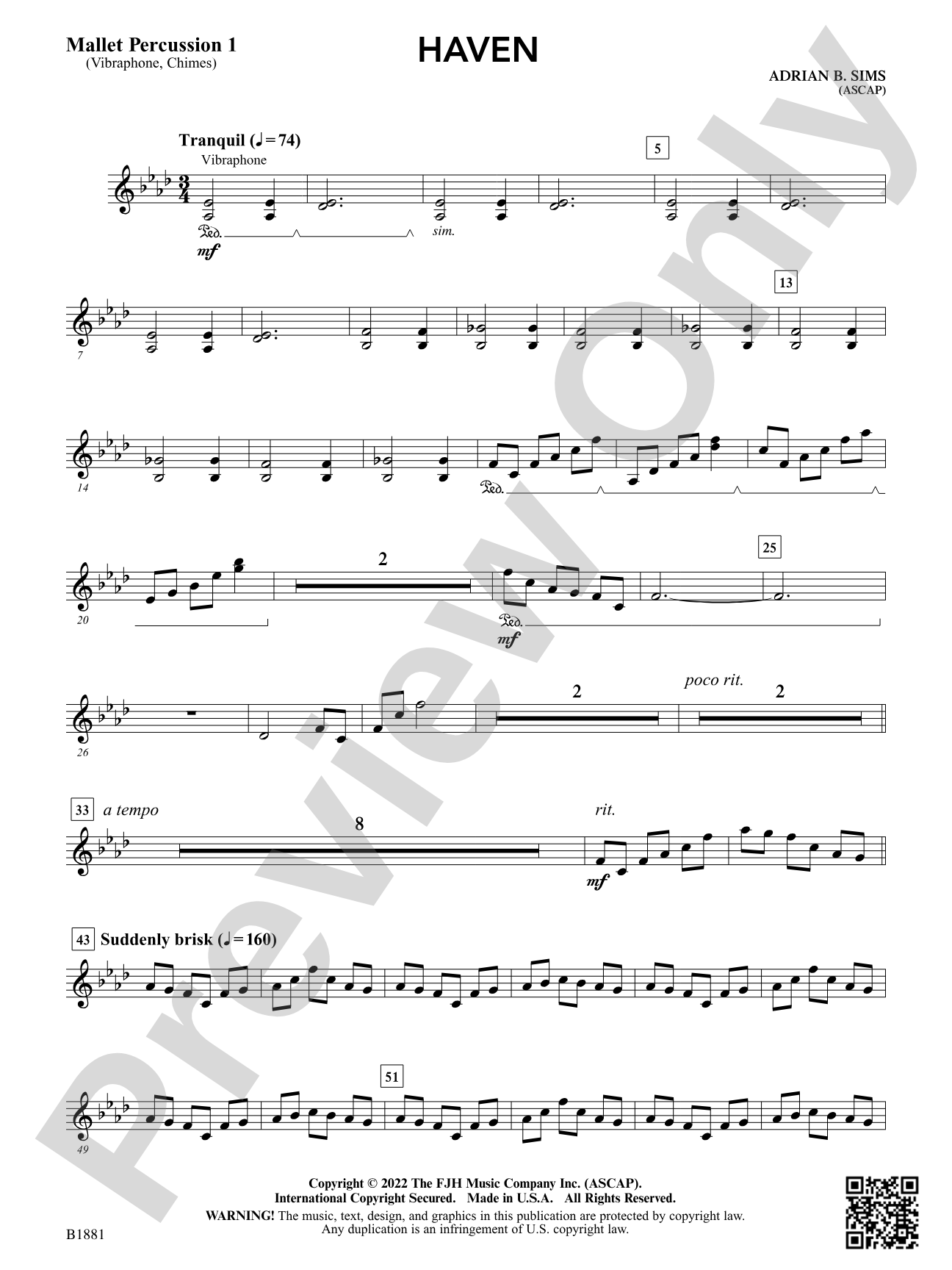

Haven: Mallet Percussion 1
By Adrian B. Sims
Grade: 4
Item: 98-PC-DB1881_M1
$7.00
Pickup currently not available
Description
This introspective work explores the relationship between oneself and the outside world. Turbulent forces and fast driving rhythms surround the listener in turmoil as personal growth takes place. Exciting woodwind flourishes, exhilarating percussive rhythms, and glorious brass fanfares bring this enthusiastic journey of self-discovery to a close. A powerful work and subject matter for mature bands.


Don't just read it, hear it, play along with it, and watch your students grow with it. In MakeMusic Cloud, Haven: Mallet Percussion 1 comes alive with professional accompaniment, adjustable tempo, and built-in practice tools that turn solo practice into real progress.
Open in the Player
Jump straight in and assign it today.
Start Your Free Trial
Open this title and explore the full library in minutes.
Sample Audio
1
Audio File
--:--
0:00
0:00
Sample Video
Additional Details
Series:
FJH Symphonic Band
Publisher:
The FJH Music Company, Inc.
SKU:
98-PC-DB1881_M1
More about this title
About the Composer: Adrian B. Sims

Adrian B. Sims was born in Seattle, Washington in 2000 and developed his musicianship across multiple roles: as a composer, conductor, educator, and trombonist. He studied at Catonsville High School in Maryland and continued his training at the University of Maryland, where he is pursuing a dual degree in Music Education and Composition. His mentors include Dr. Robert Gibson, Professor of Composition at the University of Maryland, and renowned composer Brian Balmages.
Sims's music has been performed at significant venues including the Midwest Band and Orchestra Clinic and has earned recognition on the Bandworld Top 100 List. He has won multiple composition competitions, among them the Maryland Music Educators Association Young Composers Project and the Make Music Young Composers Contest. As a trombonist, he performs in the university's top ensembles and has collaborated with the Baltimore Symphony Orchestra. Throughout his development, he has benefited from the mentorship of band directors Christopher Gnagey and Cindy Stevenson, and currently studies bass trombone with Matthew Guilford, solo bass trombonist with the National Symphony Orchestra.
Why we love this
Haven strikes a rare balance between philosophical depth and immediate musical engagement. The work genuinely earns its Grade 4 placement by requiring real interpretive maturity from your ensemble: the introspective sections demand restraint and control, while the triumphant finale rewards powerful, unified brass and woodwind voicing. Directors preparing for festivals will find a piece with substantive artistic content that doesn't rely on technical pyrotechnics alone.
What to expect
Haven unfolds like an internal conversation made audible. Early sections churn with restless energy and external pressure, the orchestration thick and driving. As the piece progresses, moments of clarity break through, and by the finale, a sense of hard-won understanding arrives through brilliant brass gestures and soaring woodwind writing that feels genuinely cathartic.
Who it's for
This work suits concert bands at the high school level and capable middle school groups with solid sectional balance and interpretive awareness. The piece asks students to engage with abstract emotional content, so ensembles that have developed listening skills and responsive conducting awareness will get the most from it.
How to get the most out of it
- Shape the quieter passages with dynamic subtlety. The contrast between turbulence and introspection only registers if your band commits fully to the softer material; resist the temptation to let ensemble sound collapse when the volume drops.
- Secure the woodwind flourishes with rhythmic precision. These moments stand out most when they land cleanly and with confidence; mark the subdivisions carefully in sectional rehearsals.
- Balance the brass fanfares so they feel triumphant rather than overwhelming. The piece's emotional arc depends on this final section feeling earned, not simply loud; work for clarity in the voicing even at full volume.
- Allow the driving rhythmic sections to breathe slightly. Relentless tempo without any give flattens the sense of struggle; subtle flexibility in phrases will deepen the sense of personal journey.
How to use it
Program Haven as a centerpiece work when you want to showcase your band's interpretive range and emotional depth, particularly in festival competition or concert settings that reward substantive musicianship. It pairs effectively with lighter opening or closing selections, since its narrative arc and serious thematic content work best when given attention and space in the program.
Skills your students will build
- Reading and responding to expressive conducting gestures in non-literal ways
- Balancing ensemble sound across contrasting dynamic levels
- Ensemble rhythm and articulation cohesion in rapid woodwind passages
- Sustaining lyrical tone quality while maintaining ensemble unity
- Understanding thematic development and musical narrative structure