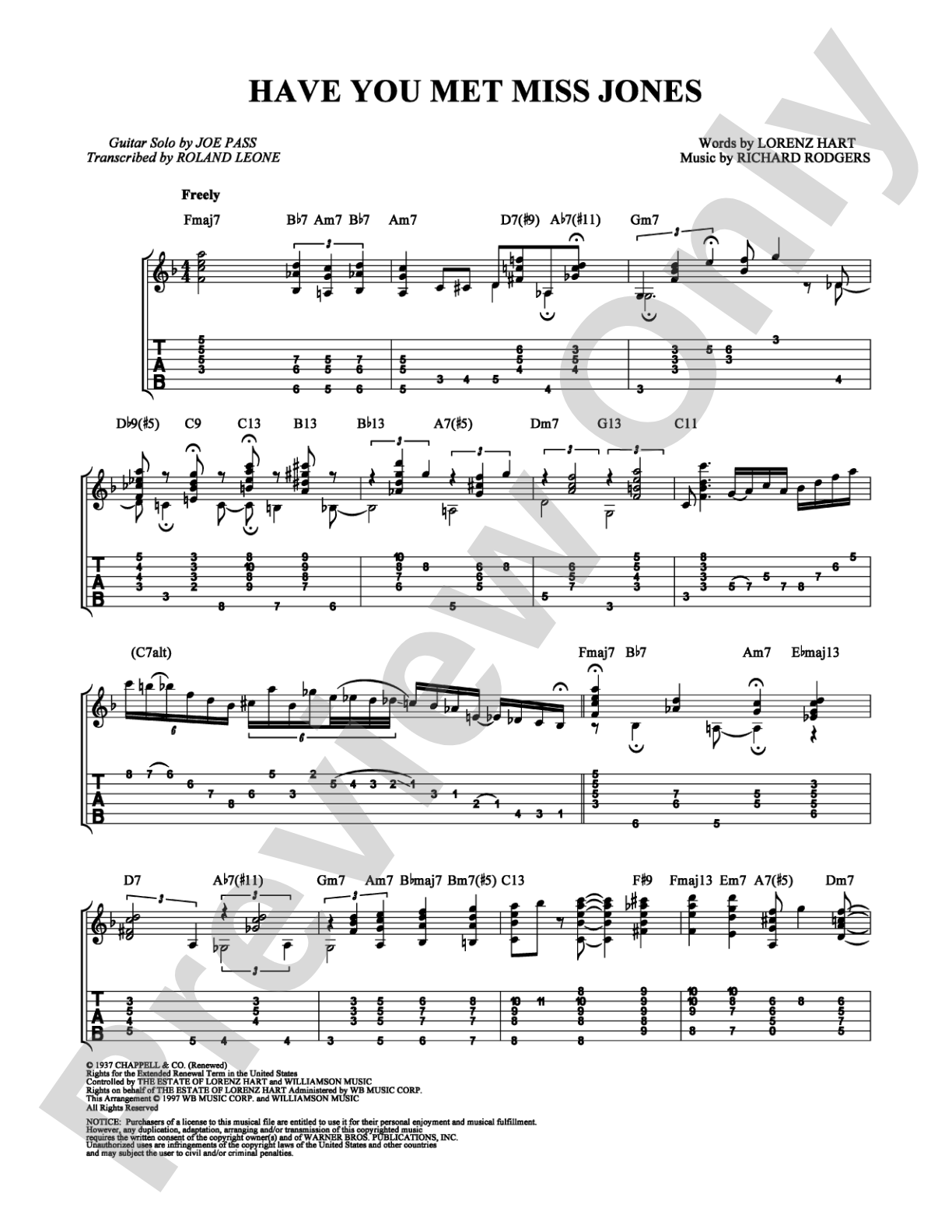
Have You Met Miss Jones: Guitar TAB Digital Sheet Music

Have You Met Miss Jones: Guitar TAB Digital Sheet Music

Richard Rodgers, Joe Pass

Item: 00-PS-0003720

Digital Download
$2.99
Description

Have You Met Miss Jones: Guitar TAB Digital Sheet Music isn't in MakeMusic Cloud just yet...but it could be. Let us know you'd like to see it, and you'll help shape what comes next. In the meantime, start a free trial and dive into thousands of interactive titles your students can play along with today.

Sample Audio
No sample audio found.
Sample Video
Additional Details
SKU: 00-PS-0003720

More about this title

About the Artist: Joe Pass

Joe Pass (1929-1994) was a virtuoso guitarist whose harmonic sophistication and single-note clarity redefined what jazz guitar could express. Self-taught and prolific across seven decades, Pass mastered chord melody arrangements, improvisation over complex changes, and unaccompanied solo guitar work that influenced generations of players. His approach to jazz standards emphasized voice leading and harmonic reharmonization, making his interpretations both accessible and intellectually rigorous.

Pass recorded extensively as a leader and collaborator, earning recognition as one of jazz's most technically commanding and musically inventive guitarists. His interpretations of the Great American Songbook remain essential reference points for understanding how to voice chords efficiently on guitar and navigate bebop-era chord progressions with clarity and taste.

Why we love this

Pass's take on this standard demonstrates what chord melody arranging looks like when executed by someone who understands every harmonic option available on the instrument. Rather than settling for simple voicings, his version shows students how to voice entire passages while maintaining clear melody, teaching them to think about the guitar as a harmony instrument first. This transcription is genuinely valuable for players who want to study how a master navigator opens up the fingerboard.

What to expect

Elegant and conversational, with the melody floating over shifting harmonies that feel both inevitable and surprising. Pass's arrangement has the quality of a musician thinking out loud, exploring different harmonic colors while maintaining the song's warmth and character. The interplay between melody and accompaniment creates the feeling of listening to a intimate solo performance rather than a transcription.

Who it's for

Jazz guitarists studying chord melody technique and harmonic reharmonization at the intermediate to advanced level. This resource serves musicians who want to understand how a master soloist approached a timeless standard and are ready to tackle fingerings and voicings that prioritize voice leading over comfort.

How to get the most out of it

  • Study the harmonic movement beneath the melody line. Pass often voices the tune in the middle register while moving lower voices underneath; this interplay between parts is what gives the arrangement its sophistication.
  • Work through the piece slowly enough to understand each chord shape and how it connects to the next. The fingering choices are intentional; they enable smooth voice leading rather than speed.
  • Listen closely to Pass's original recording to hear how he phrases through the chord changes and where he employs slight rhythmic flexibility. The TAB shows you what he played, not the interpretive nuance that brings it to life.
  • Pay attention to any extended or altered chords. Pass often reharmonizes standard changes; making sure you hear these variations before playing them will deepen your understanding of jazz chord language.

How to use it

Assign this as a study piece for guitarists preparing for jazz jam sessions or recitals where demonstrating harmonic knowledge matters alongside technique. You might also program it as a teaching reference within a jazz history or chord melody unit, where students can analyze how Pass voices each phrase and reconstruct the logic of his choices.

Skills your students will build

  • Chord melody arranging on guitar (melody line with harmonic accompaniment)
  • Voice leading across chord changes
  • Reading and executing jazz chord voicings from TAB
  • Understanding harmonic reharmonization and extension use
  • Recognizing fingering strategy that serves musical intent rather than technical ease

You May Also Like