Have You Ever Been (To Electric Ladyland) Sheet Music Preview

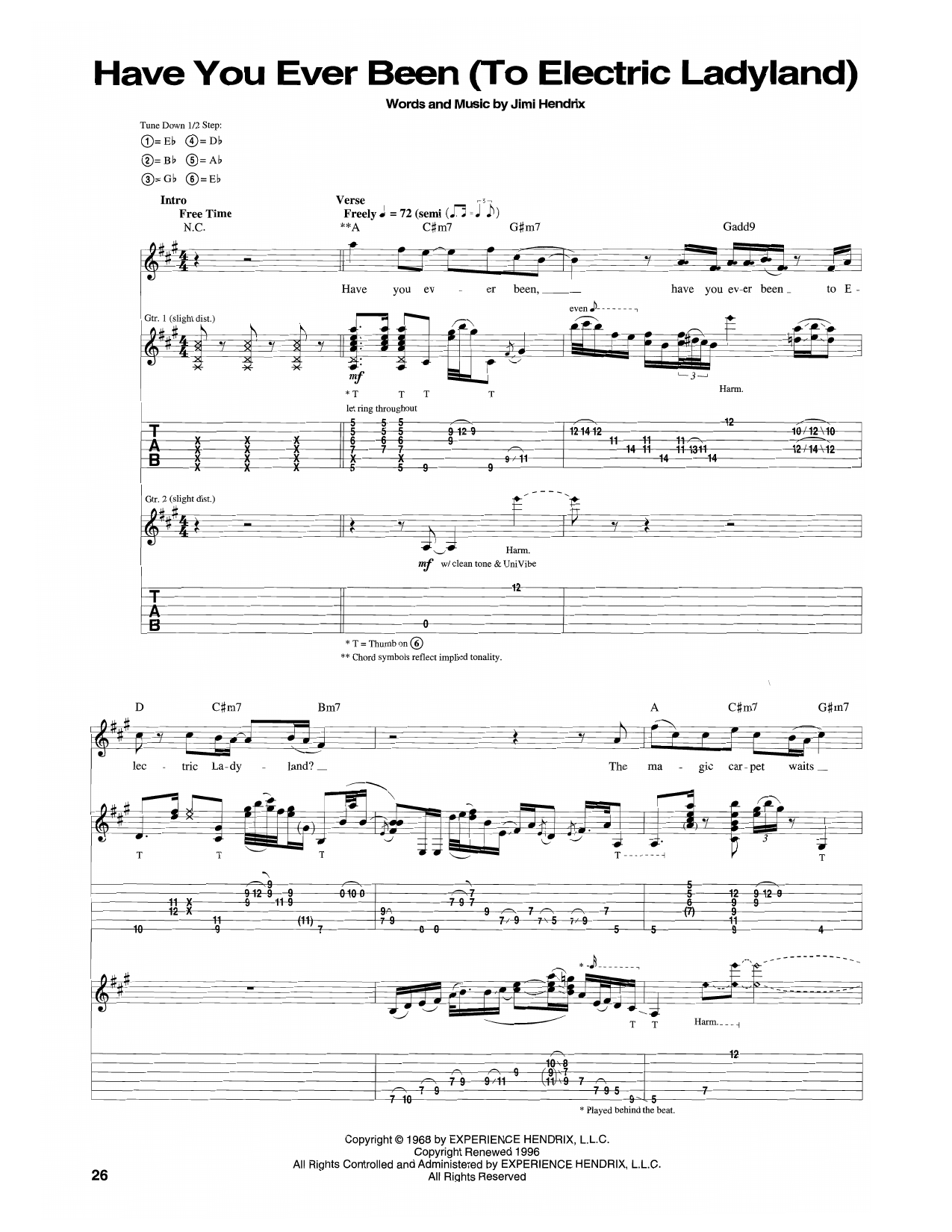
Have You Ever Been (To Electric Ladyland): Guitar Tab

As performed by Jimi Hendrix

Item: 35-DS01970162

Digital Download
$5.99
Description

Discover MakeMusic Cloud: thousands of interactive titles your students can play along with today.

Sample Audio
No sample audio found.
Sample Video
Additional Details
Publisher: Hal Leonard
Page Count: 5
SKU: 35-DS01970162

More about this title

About the Artist: Jimi Hendrix

Jimi Hendrix revolutionized electric guitar in the 1960s through fearless experimentation with distortion, feedback, and unconventional playing techniques. His approach to the instrument as a voice rather than merely a rhythm tool fundamentally changed what guitarists believed was possible, influencing generations across jazz, rock, funk, and beyond.

For music educators, Hendrix's work offers a masterclass in combining technical mastery with raw creativity. His recordings and compositions remain essential listening for students learning how innovation emerges when musicians push the boundaries of their instrument's capabilities.

Why we love this

This track gives students access to Hendrix's signature sound in playable form. The guitar tab format makes his innovative techniques and harmonic ideas concrete and learnable, rather than something to reverse-engineer by ear.

What to expect

Psychedelic and grounded at once. The song moves with a hypnotic, syncopated feel while maintaining a deep blues foundation underneath the experimental textures. Playing it demands both precision and looseness.

Who it's for

Intermediate to advanced guitarists who want to decode Hendrix's harmonic thinking and playing style. This works well for students exploring how classic rock compositions were constructed and for those interested in the intersection of blues, rock, and jazz vocabulary.

How to get the most out of it

  • Study the recorded version first to internalize Hendrix's phrasing and rhythmic placement. His timing often sits behind or ahead of the beat in ways that define the groove.
  • Experiment with distortion and effects gradually as you master the underlying voicings. The tab captures the fundamental harmony; the texture comes from how you shape your tone.
  • Pay attention to muted strings and partial muting techniques notated in the tab. These create the percussive attack and definition that make the part lock into the rhythm section.

How to use it

Include this in a unit on influential guitarists or as a supplementary study when teaching jazz-rock fusion. It's also valuable for ensemble contexts where a guitarist can explore soloing over changes while the band learns to lock into a grooved, syncopated feel.

Skills your students will build

  • Reading and executing guitar tab with effect notations
  • Understanding blues-based harmonic movement in a rock context
  • Developing muting techniques for rhythmic definition
  • Exploring distortion and tone shaping as compositional elements
  • Syncopated rhythmic placement and feel-based timing

You May Also Like