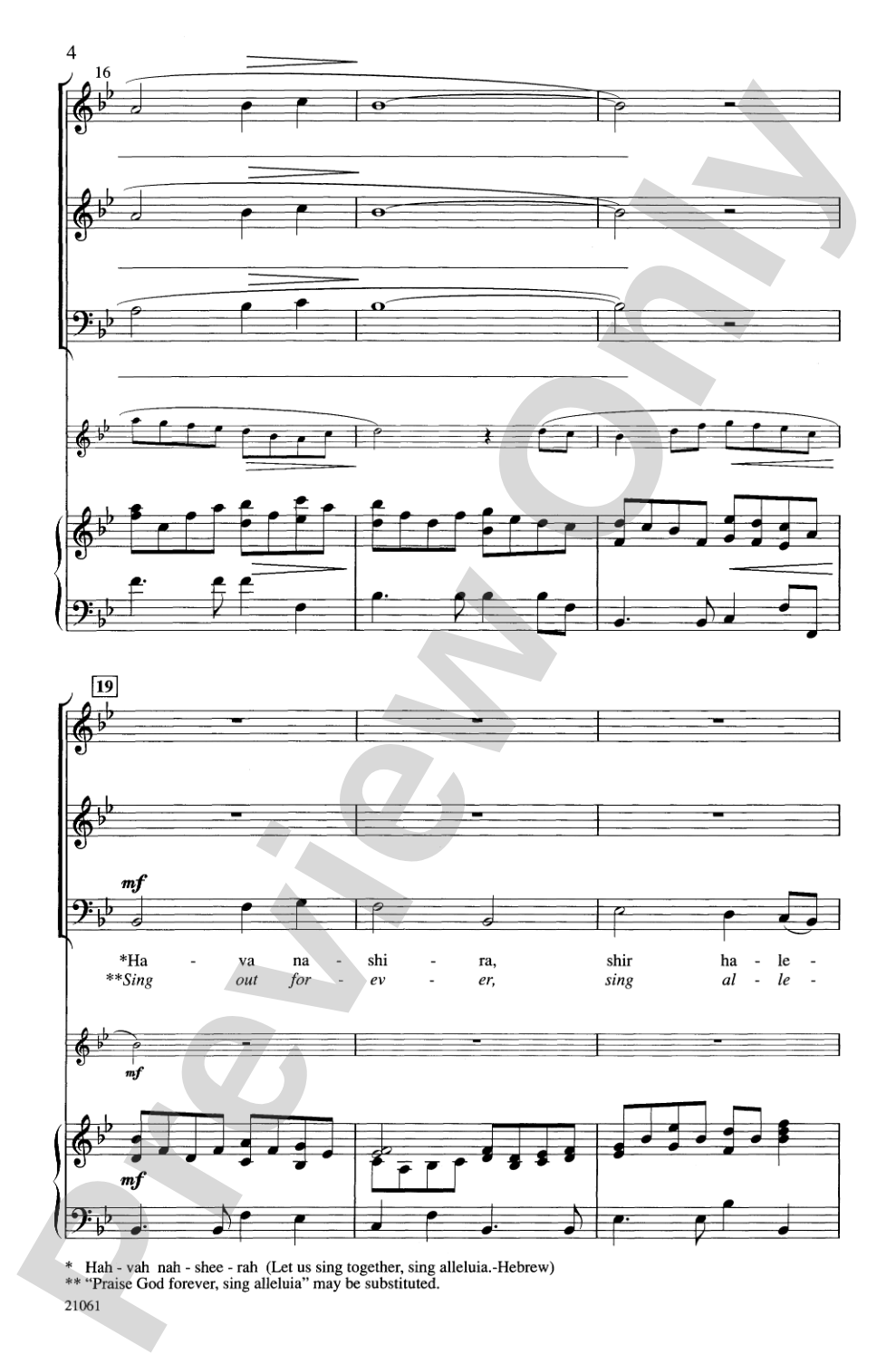
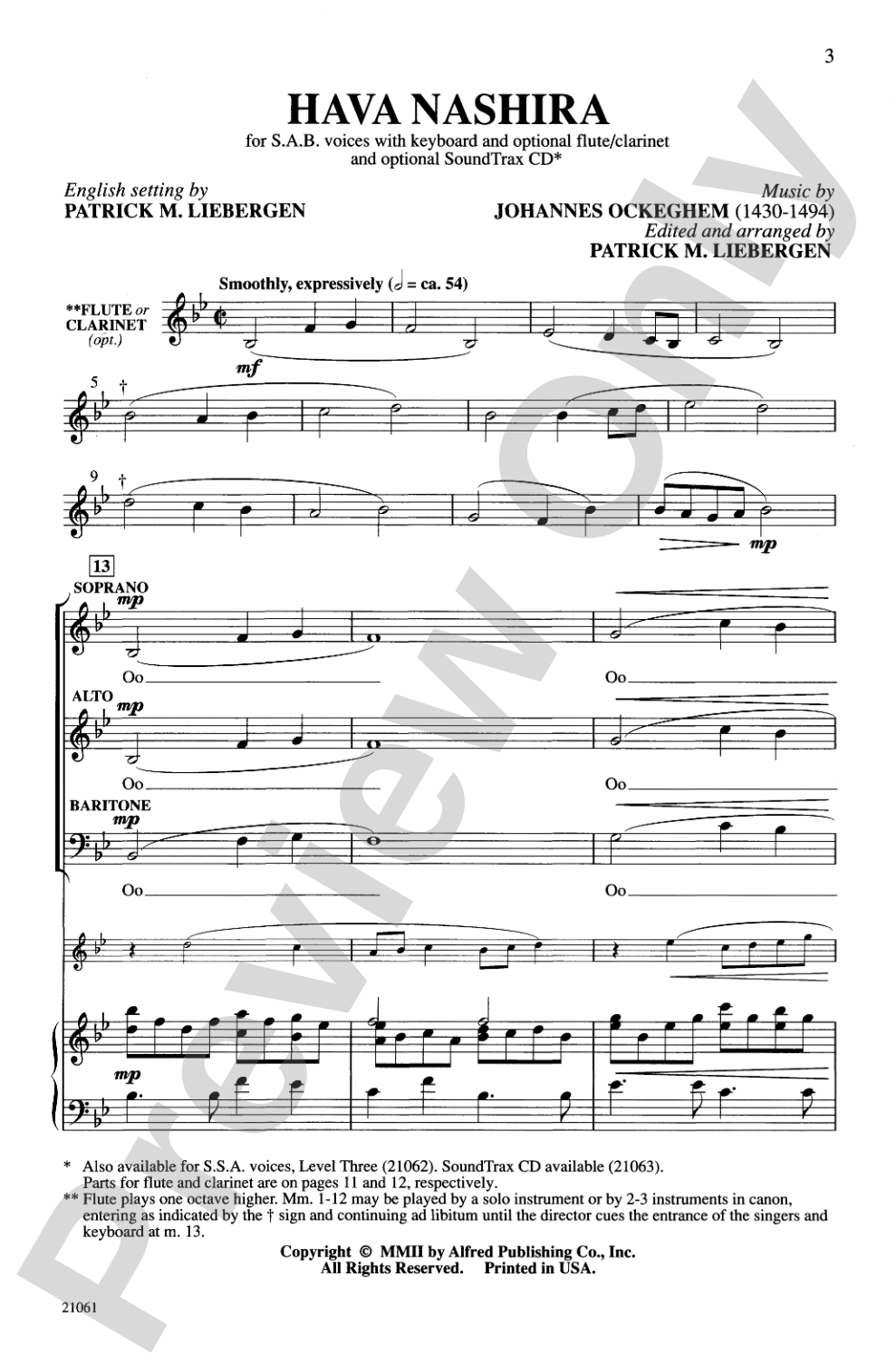
Hava Nashira (Let Us Sing Together) Sheet Music Preview

Hava Nashira (Let Us Sing Together): SAB Choral Octavo

(Let Us Sing Together)

Arr. Patrick M. Liebergen

Item: 00-PO-0004243

Digital Download
$2.25

Minimum order quantity: 20 copies

Description
Johannes Ockeghem wrote this haunting and expressive canon over 500 years ago, yet Patrick Liebergen's arrangement makes it sound as fresh as if it were written yesterday. May be performed with an ancient Hebrew text or with the optional English text. Either way, it's a song that proclaims the joy of singing. Optional flute or clarinet parts are included in the publication.

Hava Nashira (Let Us Sing Together): SAB Choral Octavo isn't in MakeMusic Cloud just yet...but it could be. Let us know you'd like to see it, and you'll help shape what comes next. In the meantime, start a free trial and dive into thousands of interactive titles your students can play along with today.

Sample Audio
0:00
0:00
Sample Video
Additional Details
Series: Alfred Archive Edition: Alfred Choral Designs
Publisher: Alfred Music
Page Count: 12
SKU: 00-PO-0004243
Instrumentation: Opt. Flute or Clarinet

More about this title

About the Arranger: Patrick M. Liebergen

Patrick M. Liebergen is an accomplished choral arranger whose work spans classical repertoire, world music, and multicultural texts. His arrangements are known for honoring the integrity of source material while opening it to modern choral ensembles, making sophisticated musical ideas accessible without oversimplifying them.

Why we love this

Liebergen rescues a 16th-century Ockeghem canon from the archives and makes it sing with immediate relevance. The option to perform in Hebrew or English, paired with optional instrumental color, gives you genuine flexibility for Chanukah, winter, or any season celebrating community and musical joy. It's the kind of piece that feels both scholarly and joyful at once.

What to expect

Ancient yet immediate. The canon structure creates a shimmering, layered sound that feels both structured and organic, as if the voices are having a quiet conversation rather than singing at each other. There's a timeless gentleness here, reinforced by the optional instrumental writing, that invites listeners into a moment of shared singing.

Who it's for

Choirs ready to tackle a piece that rewards careful attention to part independence and harmonic listening. Your SAB ensemble needs confident singers who can hold their line without doubling, though the writing itself is well-crafted for mixed voices at this level. This works for choirs that program winter concerts, Chanukah celebrations, or repertoire focused on multicultural and Jewish heritage.

How to get the most out of it

  • Bring out the canon structure clearly by ensuring each voice entrance is heard distinctly; mark the staggered entries in rehearsal so singers understand the architectural logic beneath the surface.
  • If using the flute or clarinet parts, let them double or punctuate phrases rather than compete with the voices; they work best as gentle instrumental color that enhances rather than dominates.
  • Approach the harmonic language with attention to phrasing across bar lines; the piece breathes in long arcs, not short gestures, so resist chopping phrases into small chunks.
  • Consider the textual choice (Hebrew or English) as a programming decision that shapes the piece's context; rehearse whichever language you select with clear vowel shapes and natural speech rhythms.

How to use it

Position this as a jewel in a winter or Chanukah program where it can breathe on its own, or pair it thoughtfully with other world music or spiritual texts. The 12-page score and optional parts make it ideal for concerts exploring musical heritage across cultures. If you're building a program around joy and community, this piece carries that message without sentimentality.

Skills your students will build

  • Canon singing and independent voice leading
  • Harmonic listening and blend across SAB voicing
  • Language diction in Hebrew and/or English
  • Coordination with optional instrumental parts
  • Long-line phrasing and sustained tone quality

You May Also Like