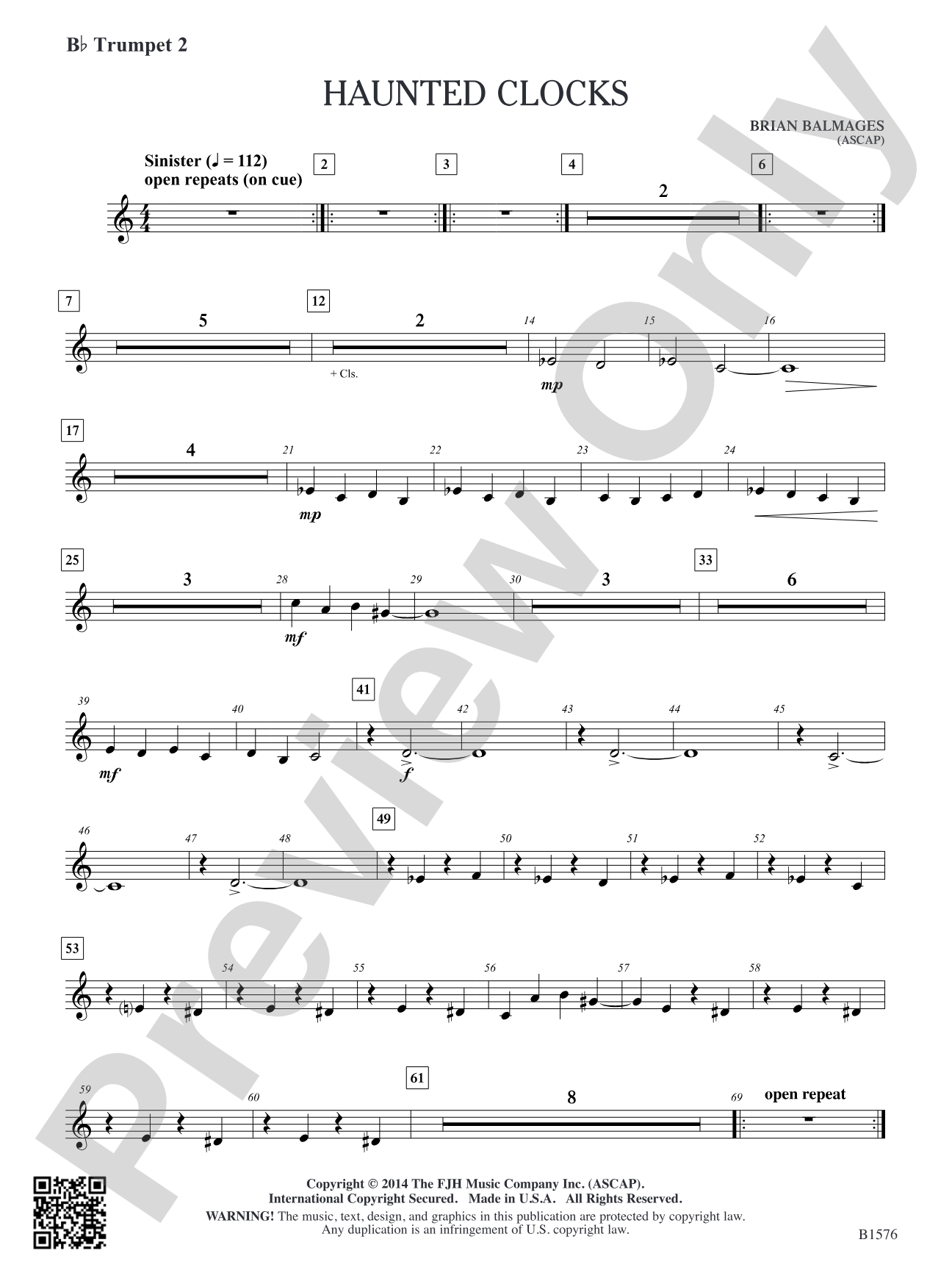
Haunted Clocks: B-flat Trumpet 2
By Brian Balmages
Grade: 1.5
Item: 98-PC-DB1576_T2
Pickup currently not available
Description
Don't just read it, hear it, play along with it, and watch your students grow with it. In MakeMusic Cloud, Haunted Clocks: B-flat Trumpet 2 comes alive with professional accompaniment, adjustable tempo, and built-in practice tools that turn solo practice into real progress.
Jump straight in and assign it today.
Open this title and explore the full library in minutes.
Sample Audio
Sample Video
Additional Details
More about this title
About the Composer: Brian Balmages

Brian Balmages has established himself as a composer and conductor working across orchestral, band, and chamber idioms with equal fluency. His works have been performed by ensembles ranging from professional orchestras to elementary school groups in prestigious venues including Carnegie Hall, the Kennedy Center, and the Sydney Opera House. He holds membership in the American Bandmasters Association and received the A. Austin Harding Award from the American School Band Directors Association. His composition Love and Light won the 2020 NBA William D. Revelli Composition Contest.
Balmages has conducted extensively with all-state and regional ensembles as well as university and professional orchestras worldwide, appearing at the Midwest Clinic, College Band Directors Conference, and numerous international festivals. He received the James Madison University Distinguished Alumni Award and was commissioned by the University of Miami to compose music for the presidential inauguration. Currently serving as Director of MakeMusic Publications and Digital Education for Alfred and MakeMusic, he continues to shape contemporary band and orchestral music education.
Why we love this
Balmages approaches programmatic writing with genuine inventiveness rather than theatrical cliché. The aleatoric techniques and layered clock effects create a soundscape that engages young ensemble players in real musical problem-solving, teaching them how to execute written indeterminacy while still achieving ensemble cohesion. At grade 1.5, it's accessible enough for developing bands yet sophisticated enough to hold audience attention and generate genuine rehearsal discovery.
What to expect
A mischievous, gradually building energy as inanimate objects stir to life. The piece balances whimsy with an undercurrent of unease created by the Dies Irae variations, generating a soundscape that feels both inventive and slightly otherworldly.
Who it's for
Concert bands at the early intermediate level, particularly those seeking a programmatic work that combines imagination with technical accessibility. Developing ensembles benefit from the clear narrative structure and aleatoric writing, which teaches coordination and listening without requiring advanced technical facility.
How to get the most out of it
- Establish the rhythmic independence of each clock part before combining them. Have individual sections practice their clock effects separately so they understand the precise rhythmic pattern and can execute it confidently when layered.
- Balance the clock effects so they remain distinct and audible. Some clocks need to sit back; others come forward. Map this balance in the score during rehearsal so every clock is intentional rather than accidental.
- Shape the various presentations of the Dies Irae to reflect their harmonic alterations. The shifts from traditional to distorted versions of this iconic melody will register most clearly if conductors clarify which chords or voicings have changed.
- Communicate the narrative arc to your ensemble. Knowing the story of a clock factory awakening helps musicians commit to the sound they're creating and understand why certain effects matter musically, not just theatrically.
How to use it
Program this as an opener or a second piece to set an energetic, creative tone for a concert. Its programmatic nature and imaginative orchestration make it an excellent choice for young musician festivals, school showcases, or family concerts where repertoire needs to engage both musicians and casual listeners.
Skills your students will build
- Executing aleatoric notation and ensemble coordination within controlled indeterminacy
- Layering independent rhythmic parts while maintaining group cohesion
- Recognizing and interpreting harmonic alterations to a familiar melodic source
- Sustaining focused ensemble listening across the duration of a programmatic narrative
- Performing extended instrumental effects (wind-up, grandfather clock, cuckoo sounds) with precision and character