
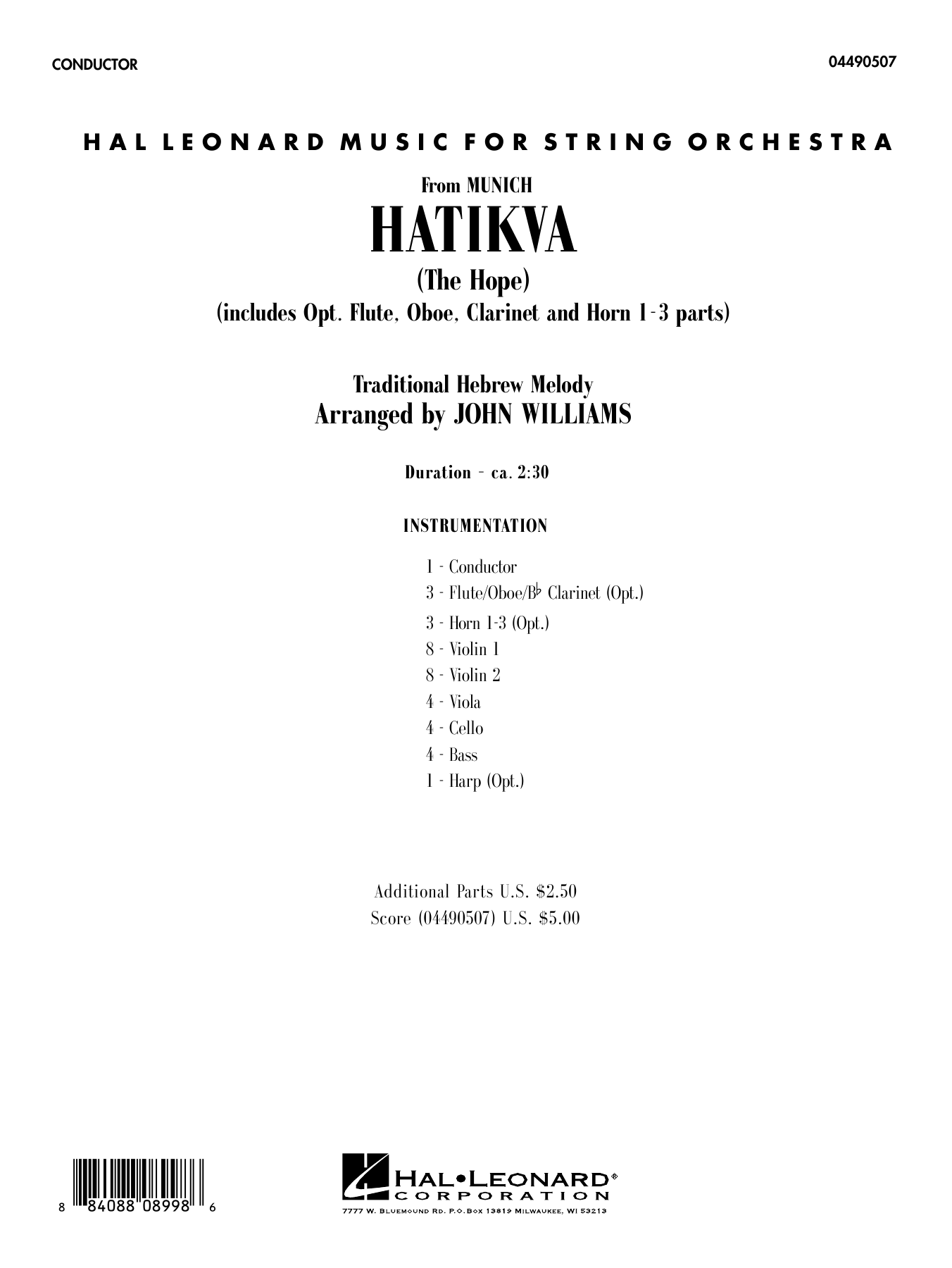

Hatikva (from Munich) (arr. John Williams): String Orchestra Conductor Score & Parts
Arranged by John Williams
Grade: 3-4
Item: 35-PK01413453
$45.00
Pickup currently not available
Buy Extra Parts (Digital PDF Download)
Parts Added to Cart!
Description
As heard in the recent docudrama film by Steven Spielberg, John Williams' treatment of the Israeli national anthem gives a special reverence and power to this beloved hymn. This is the authentic edition as played in the film. (Includes optional parts for flute, oboe, clarinet and three horns)


Hatikva (from Munich) (arr. John Williams): String Orchestra Conductor Score & Parts isn't in MakeMusic Cloud just yet...but it could be. Let us know you'd like to see it, and you'll help shape what comes next. In the meantime, start a free trial and dive into thousands of interactive titles your students can play along with today.
Request This Title
Tell us you want it.
Start Your Free Trial
Explore everything that's ready to play right now.
Sample Audio
No sample audio found.
Sample Video
No sample videos found.
Additional Details
Publisher:
Hal Leonard
SKU:
35-PK01413453
More about this title
About the Arranger: John Williams
John Williams stands as one of the most celebrated film composers of our time, with seven decades of work spanning cinema's most iconic moments. His mastery of orchestration and gift for transforming existing musical material into cinematic statements make him an invaluable resource for music educators seeking to bridge classical technique with contemporary listening.
Why we love this
Williams elevates Hatikva beyond a straightforward orchestration by infusing it with the emotional weight his film scores carry. The string writing creates both intimacy and grandeur, making this arrangement feel like a genuine compositional statement rather than a functional transcription. Your students will recognize this isn't just "the national anthem" but a carefully crafted moment of cinema brought into the rehearsal room.
What to expect
There is a quiet strength in these pages. Williams' arrangement respects the hymn's contemplative core while surrounding it with orchestral warmth and occasional swells of power. The piece moves through moments of transparency where individual string sections carry the weight before the ensemble swells with unified purpose.
Who it's for
String orchestras at the intermediate to early advanced level will find the technical demands manageable while the emotional content remains substantial. This works equally well for programs seeking concert repertoire that resonates with audiences or for classroom engagement with film music as a compositional art form.
How to get the most out of it
- Shape the opening phrases with long, supported bows that allow the melody to breathe without rushing. Williams' arrangement rewards players who think in terms of legit vocal phrasing rather than mechanical articulation.
- Balance the optional wind parts carefully if you include them. These doublings and countermelodies should enhance the string foundation, not compete with it. Test the balance in your seating arrangement before the first rehearsal.
- Pay attention to dynamic shifts between sections. This arrangement uses orchestration changes rather than sudden dynamic explosions to mark structural moments, so listen for where Williams moves the thematic material between string sections.
How to use it
Consider this as a closing selection for a concert exploring cultural identity in music, or pair it with other film music arrangements to highlight how cinema drives contemporary orchestration. The optional wind parts make it flexible for different ensemble sizes, so you can program it whether your brass section is available that evening.
Skills your students will build
- Legit phrasing and breath control in string writing
- Balance between homophonic and contrapuntal textures
- Intonation tuning within sustained harmonic passages
- Stylistic interpretation of emotionally weighted material
- Ensemble listening across divisi sections