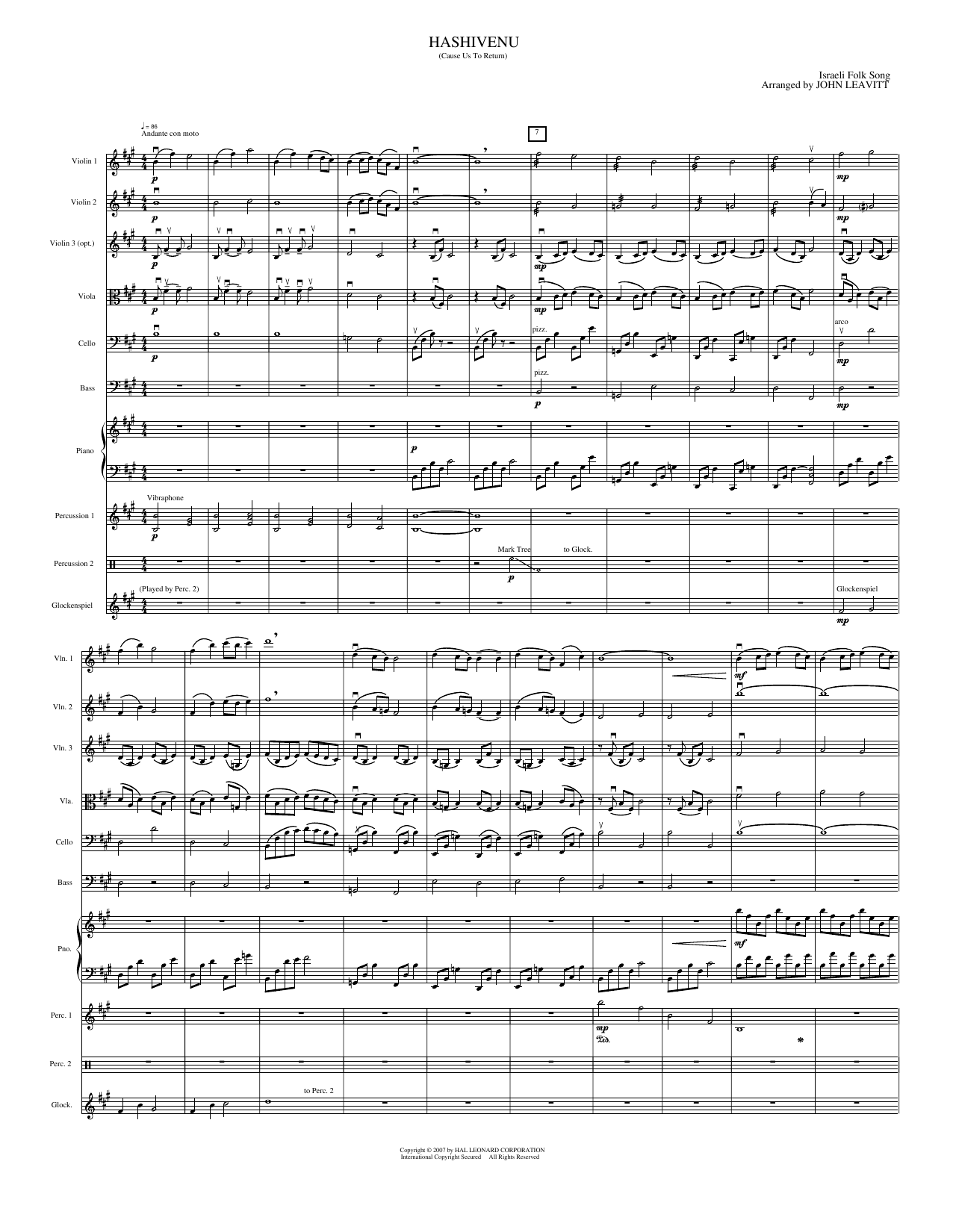
John Leavitt has established himself as a versatile composer and arranger with deep roots in choral and instrumental music education. His arrangements span multiple genres and ensemble types, consistently demonstrating an ear for effective voicing and pedagogically sound writing that respects both the capabilities and growth potential of student musicians.
Why we love this
Leavitt's arrangement opens this piece to string orchestras with elegant simplicity, preserving the spiritual essence while making it accessible to intermediate players. The voicing sits naturally under student hands, and the part writing builds genuine musicality without requiring virtuosic technical demands.
What to expect
Hashivenu carries a reflective, gentle quality. The arrangement unfolds with understated beauty, creating an intimate sound world where straightforward harmonic language and accessible melodies invite listeners into a moment of quiet contemplation.
Who it's for
Intermediate string orchestras (grades 3-4) looking for repertoire with spiritual depth and festival programming potential. This works equally well for directors seeking material that challenges musicianship without introducing complex technical barriers.
How to get the most out of it
Balance the melody across your first violins and violas; these voices carry the primary thematic content and deserve clarity without drowning the harmonic foundation underneath.
Shape phrases as a unified ensemble rather than section by section. Breathe together at logical cadence points to maintain the piece's contemplative character.
Pay attention to rhythmic precision in the accompaniment figures; steady, unrushed rhythmic support becomes the backbone that allows soloists to sing with freedom.
Explore dynamic contrast between sections. The arrangement rewards subtle shifts in volume that highlight structural moments without requiring extreme ranges.
How to use it
Consider this for festival competitions or spring concerts where your program needs a moment of contrast and introspection. It pairs naturally with more energetic works and provides an effective vehicle for developing expressive playing and phrase awareness in younger orchestras.
Skills your students will build
Sustaining long tones with consistent tone quality and intonation
Phrasing and musical shaping in a homophonic texture
Ensemble balance between melody and accompaniment voices
Following a conductor through lyrical, non-metric phrasing
Attention to dynamic gradations and their expressive effect
You May Also Like
Scan to Complete Your Purchase
Use your phone's camera to scan the code below
You'll log in on your phone and the order will be added to your account