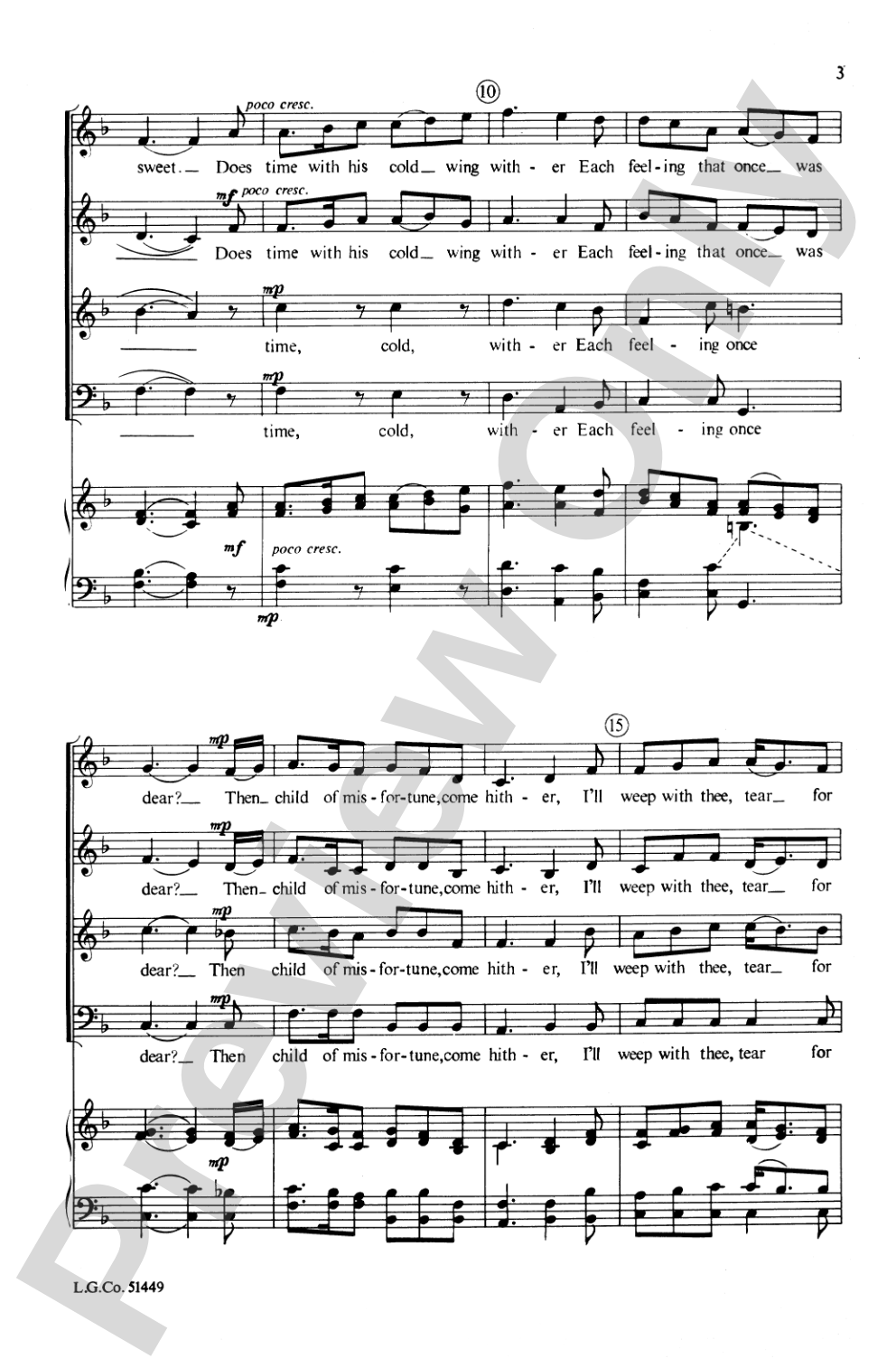
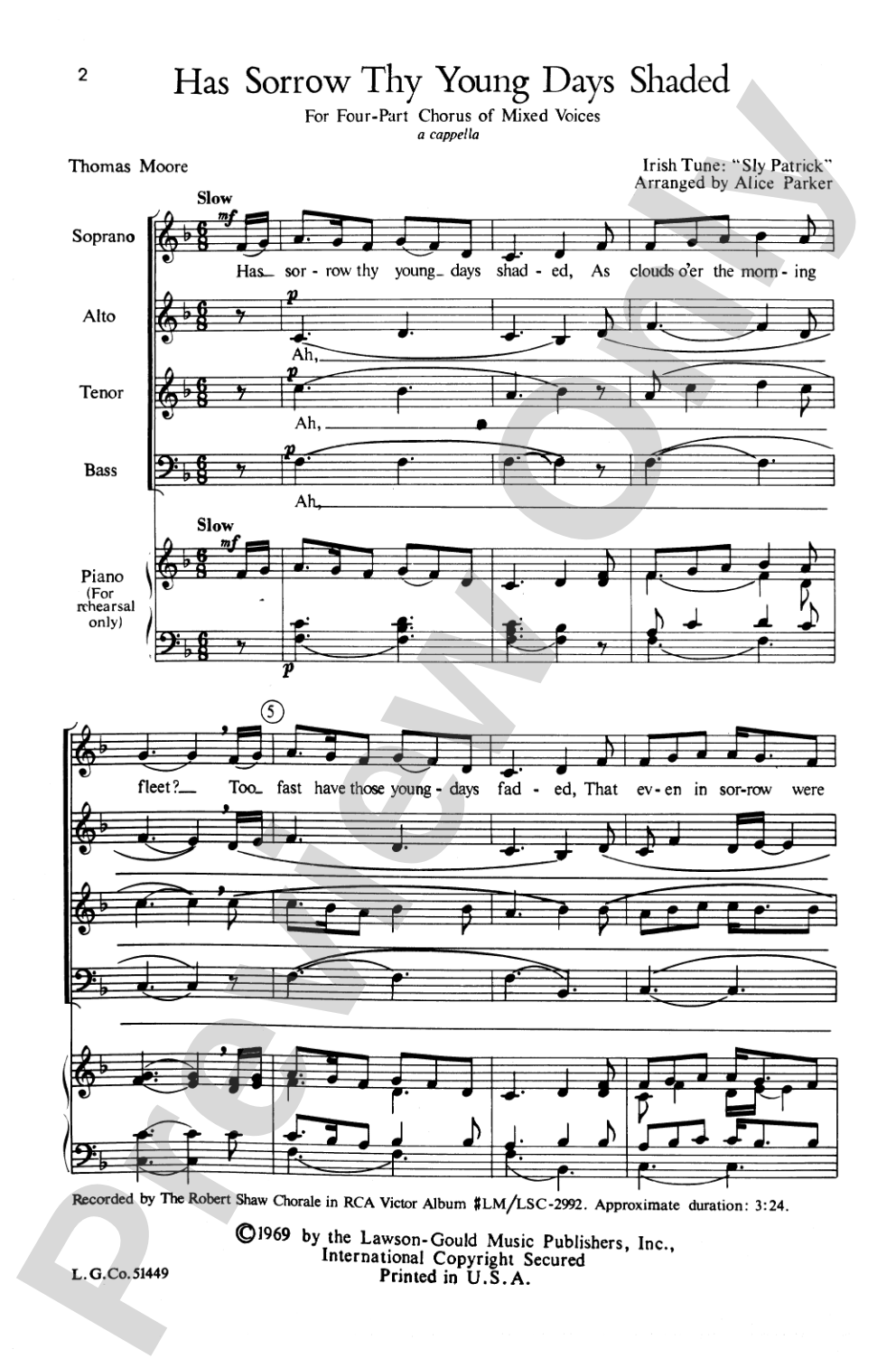
Has Sorrow Thy Young Days Shaded Sheet Music Preview

Has Sorrow Thy Young Days Shaded: SATB Choral Octavo

Arr. Alice Parker

Item: 00-PO-0002663

Digital Download
$2.25

Minimum order quantity: 20 copies

Description

Has Sorrow Thy Young Days Shaded: SATB Choral Octavo isn't in MakeMusic Cloud just yet...but it could be. Let us know you'd like to see it, and you'll help shape what comes next. In the meantime, start a free trial and dive into thousands of interactive titles your students can play along with today.

Sample Audio
No sample audio found.
Sample Video
Additional Details
Series: Alfred Archive Edition: Robert Shaw Choral Series
Publisher: Alfred Music
Page Count: 8
SKU: 00-PO-0002663

More about this title

About the Arranger: Alice Parker

Alice Parker

Alice Parker's career bridges composition, conducting, and pedagogy in ways that have shaped American choral music for decades. She studied at Smith College and Juilliard, where she began her influential partnership with Robert Shaw; together they created a vast catalog of settings for American folksongs, hymns, and spirituals that remain cornerstones of choral libraries worldwide. Parker's own compositions span operas, song cycles, cantatas, and over five hundred published works across many genres.

In 1985, Parker founded MELODIOUS ACCORD, INC., directing her focus toward what she considered the foundation of all singing: the melody itself. She authored influential books on melodic style, choral improvisation, and church music, including The Melodious Accord Hymnal and her essays on song leading. Her contributions to choral music earned her the Robert Shaw Award from the American Choral Directors Association, the Harvard Glee Club Foundation Medal, and six honorary doctorates, among many other honors. She served as Director Laureate of Chorus America and was named Distinguished Composer of the Year 2000 by the American Guild of Organists.

Why we love this

Parker's treatment of this folk text reveals why her Parker/Shaw collaborations became standard repertoire across America. The arrangement respects the melody's inherent beauty while creating rich harmonic support that challenges and rewards four-part singing without becoming fussy or overdone.

What to expect

The piece carries the quiet dignity of a folk meditation, its melody rooted and contemplative rather than showy. Parker's harmonies deepen the emotional weight of the text without overwhelming it, creating moments of gentle richness that feel both inevitable and earned.

Who it's for

Intermediate to advanced community choruses, collegiate singers, and church choirs seeking substantial yet accessible repertoire that honors American folk tradition. This arrangement works equally well for concert programs or liturgical settings where the text feels appropriate to your worship context.

How to get the most out of it

  • Honor the folk melody's natural phrasing by resisting the urge to add ritard at phrase endings; let the text breathing points guide your shaping instead.
  • Balance soprano and alto lines carefully in passages where both parts carry thematic material; neither should overshadow the other.
  • Approach the harmonies with clarity and intonation in mind. Parker's chords often move by stepwise motion, which singers can follow more easily when parts are precisely tuned.
  • Communicate the song's emotional arc through dynamic control rather than tempo changes; this folk arrangement asks for restraint and integrity of line.

How to use it

Program this alongside other American folksong settings to anchor a concert section on vocal heritage, or pair it with spirituals and hymn arrangements for a program exploring sacred folk repertoire. Its intimate eight pages and moderate difficulty make it a natural fit for mid-season programming when your singers have built ensemble cohesion.

Skills your students will build

  • Singing folk melody with harmonic independence
  • Balancing independent vocal lines within SATB texture
  • Intonation in stepwise harmonic progressions
  • Phrasing literary text with musical integrity
  • Reading eight-page choral scores with sustained focus

You May Also Like