
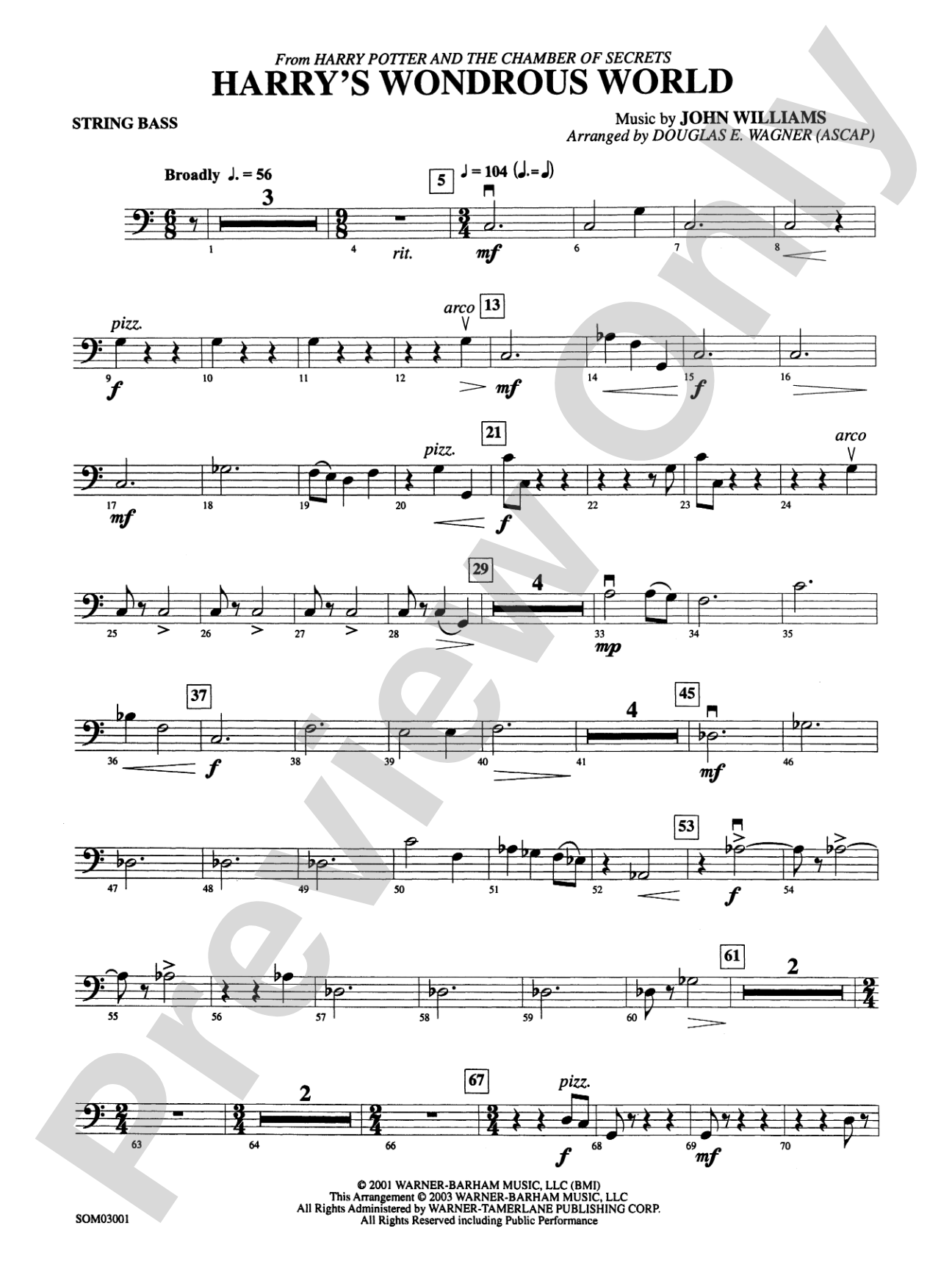

Harry's Wondrous World (from Harry Potter and the Chamber of Secrets): String Bass
By John Williams / arr. Douglas E. Wagner
Grade: 2.5
Item: 00-PC-0015257_SB
$5.99
Pickup currently not available
Description
Used in both of the first two Harry Potter films and true to the composer's original intent, Harry's wonderous world is now available in an impressive Doug Wagner arrangement that will thrill your audiences and students alike. The arrangement has a variety of textures and dynamics, yet is recognizable to everyone who has seen either of the blockbuster films. Complete your program with this scrumptious arrangement. (3:43)
For educational usage/non-profit performances only; for professional arrangements, visit our rental library at alfred.com/rental.


For educational usage/non-profit performances only; for professional arrangements, visit our rental library at alfred.com/rental.
Don't just read it, hear it, play along with it, and watch your students grow with it. In MakeMusic Cloud, Harry's Wondrous World (from Harry Potter and the Chamber of Secrets): String Bass comes alive with professional accompaniment, adjustable tempo, and built-in practice tools that turn solo practice into real progress.
Open in the Player
Jump straight in and assign it today.
Start Your Free Trial
Open this title and explore the full library in minutes.
Sample Audio
1
Audio File
--:--
0:00
0:00
Sample Video
Additional Details
Series:
Pop Intermediate String Orchestra
Publisher:
Alfred Music
Page Count:
156
SKU:
00-PC-0015257_SB
More about this title
About the Composer: John Williams
John Williams stands among the most celebrated film composers of all time, with a career spanning nearly six decades and an output that has defined the sound of modern cinema. His gift for crafting memorable melodies that serve the emotional arc of a story while remaining instantly recognizable has made his work a staple in music education, where students encounter his themes across film, concert, and chamber settings.
Williams' approach to orchestration is fundamentally pedagogical: he builds complexity thoughtfully, balances tutti passages with solo moments, and constructs clear harmonic progressions that make his music both accessible and rewarding to perform. His work in the Harry Potter series demonstrates this principle perfectly, creating music that speaks to audiences of all ages while remaining musically substantial enough to engage serious student musicians.
Why we love this
Douglas Wagner's arrangement captures the wonder and accessibility of Williams' original without sacrificing musical substance. At Grade 2.5, it sits in that sweet spot where strings have enough facility to handle rhythmic and textural variety, yet the core melodic idea remains the star. Your students will feel genuinely proud playing something this recognizable.
What to expect
The piece unfolds like a gentle invitation into a world of magic and discovery. Williams' theme carries an almost lyrical quality, with a melody that soars naturally over warmly voiced harmonies. There's buoyancy here without heaviness, wonder without bombast, making it feel both intimate and grand.
Who it's for
This works beautifully for developing string orchestras that have solid intonation and basic bow control but are still building rhythmic independence. It's equally at home in a middle school concert or a high school chamber ensemble looking for something immediately engaging.
How to get the most out of it
- Shape the opening phrase with a gentle crescendo toward the second bar; let the melody breathe rather than play it straight through, which will help the soaring quality come alive.
- Balance the texture when harmonic layers enter: the inner voices (violas and second violins) should support without overpowering the first violin line.
- Use the dynamic markings as your roadmap for phrasing. The arrangement includes purposeful shifts in orchestration that help clarify form; marking these transitions in rehearsal prevents the piece from feeling uniform.
- Pull back slightly in the ensemble sections to let lighter textures resonate. This arrangement thrives on contrast between full and sparse moments.
How to use it
Program this as a concert opener or as the heart of a mixed-repertoire concert where you want something your audience will recognize immediately. It pairs well alongside other film music or as a bridge between classical and contemporary literature in an evening of varied styles.
Skills your students will build
- Sustaining legit singing tone through longer melodic phrases
- Balancing sectional sound when melody moves between first and second violins
- Dynamic control and shaping within a clearly tonal harmonic framework
- Reading coordinated rhythm between multiple string parts
- Understanding texture and orchestration as tools for musical storytelling