
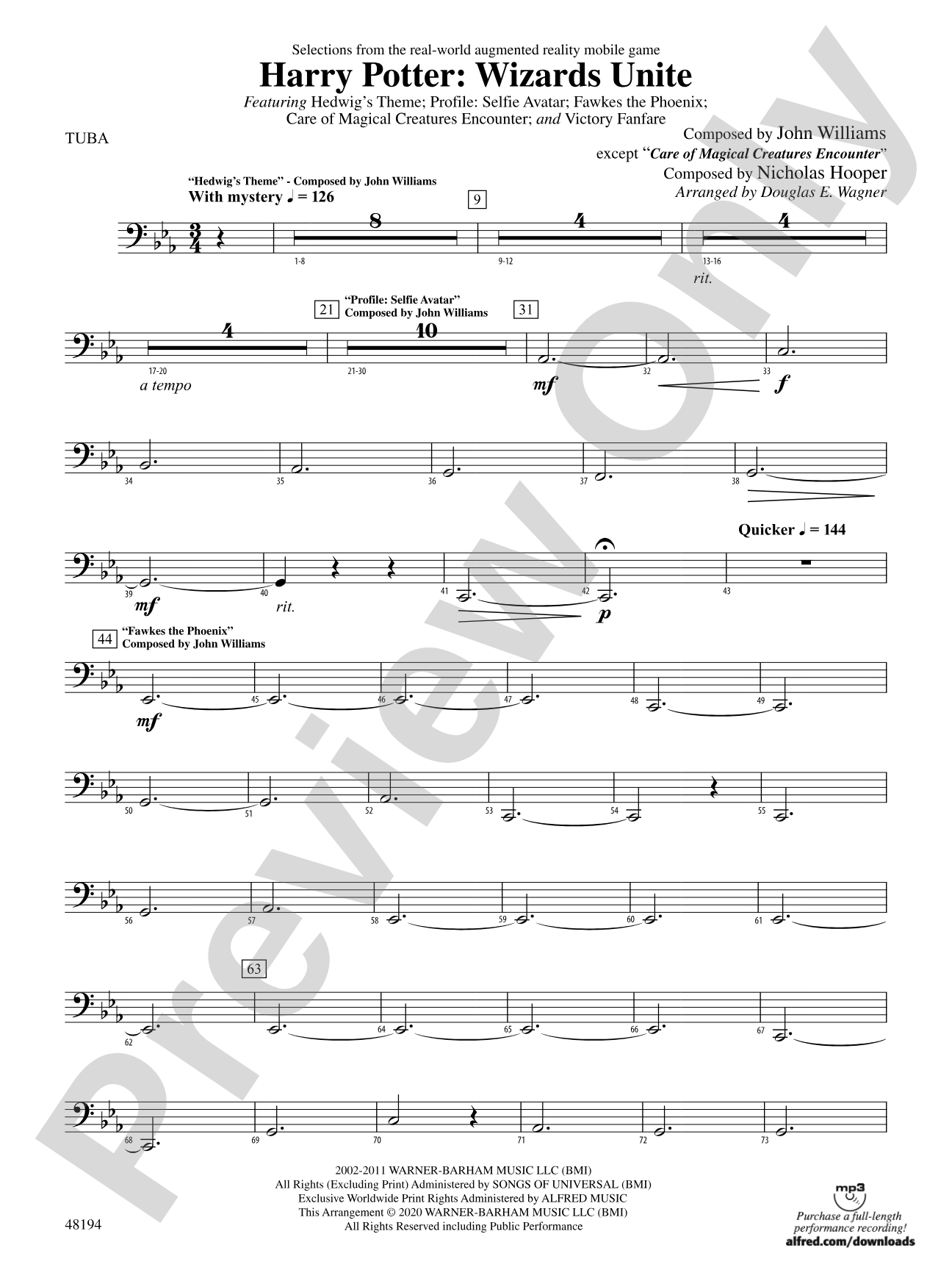

Harry Potter: Wizards Unite: Tuba
Featuring: Hedwig's Theme / Profile: Selfie Avatar / Fawkes the Phoenix / Care of Magical Creatures Encounter / Victory Fanfare
Composed by John Williams / except "Care of Magical Creatures Encounter" composed by Nicholas Hooper / arr. Douglas E. Wagner
Grade: 2 (Medium-Easy)
Item: 00-PC-0018416_TB1
$3.00
Pickup currently not available
Description
Players combat fantastic beasts, brew potions, find magical artifacts, and cast life-changing spells along with their favorite characters. Familiar to any fan, the diverse augmented reality mobile game music includes "Hedwig's Theme," "Profile: Selfie Avatar," "Fawkes the Phoenix," "Care of the Magical Creatures Encounter," and "Victory Fanfare." So, my wizarding friends, wands at the ready! Here we go! (3:30) This title is available in MakeMusic Cloud.
For educational usage/non-profit performances only; for professional arrangements, visit our rental library at alfred.com/rental.


For educational usage/non-profit performances only; for professional arrangements, visit our rental library at alfred.com/rental.
Don't just read it, hear it, play along with it, and watch your students grow with it. In MakeMusic Cloud, Harry Potter: Wizards Unite: Tuba comes alive with professional accompaniment, adjustable tempo, and built-in practice tools that turn solo practice into real progress.
Open in the Player
Jump straight in and assign it today.
Start Your Free Trial
Open this title and explore the full library in minutes.
Sample Audio
1
Audio File
--:--
0:00
0:00
Sample Video
Additional Details
Series:
Pop Young Band
Publisher:
Alfred Music
Page Count:
252
SKU:
00-PC-0018416_TB1
More about this title
About the Composer: John Williams
John Williams stands as one of the most recorded composers in history, with a catalog spanning seven decades of film and concert music. His ability to craft memorable, singable themes that work across ensembles and skill levels has made his music essential to music education; countless young musicians encounter his melodies in their first years of playing.
Why we love this
This arrangement captures the playful energy and emotional beats of the Harry Potter universe without demanding advanced technical facility. A Grade 2 band gets to inhabit genuinely theatrical material, and the five-movement structure gives students the satisfaction of a complete suite experience in rehearsal time that's realistic for most programs.
What to expect
Magical and accessible. The familiar melodic content carries listeners instantly into the wizarding world, while the arrangement remains transparent and playful. You hear the joy of adventure and the satisfaction of heroic moments, all expressed in orchestration young players can actually shape and perform.
Who it's for
Conductors programming for young bands seeking music that engages student musicians and audiences alike. Any band at Grade 2 level looking for thematic, recognizable material that builds confidence without requiring advanced solo facility.
How to get the most out of it
- Balance the melody clearly across woodwinds and brass; these themes need to sing above the harmonic foundation, so adjust dynamic layers during sectional rehearsals rather than relying on printed dynamics alone.
- Lock the rhythm section (bass and percussion) early. The "Hedwig's Theme" and "Victory Fanfare" sections depend on precise rhythmic clarity to land their theatrical moments.
- Shape phrases by attending to where harmonic movement naturally peaks, especially in "Fawkes the Phoenix." Williams' writing tends to build toward structural goals, so avoid playing through phrase endings.
- Assign a brief verbal character to each movement before you rehearse it. Students who understand they're playing a magical encounter in one moment and a victory celebration in the next will bring appropriate energy to their entrances and releases.
How to use it
Program this as a complete suite for a spring or end-of-year concert, where its familiar themes draw families and casual listeners into the concert hall. It also works well as a standalone feature during a pops-focused concert, or as part of a film music unit where students study how themes adapt across different media.
Skills your students will build
- Balancing melody against harmonic accompaniment
- Executing rhythmic precision in ensemble settings
- Shaping phrases according to harmonic movement
- Managing multiple style shifts within a single work
- Reading transposed parts for mixed instrumentation