
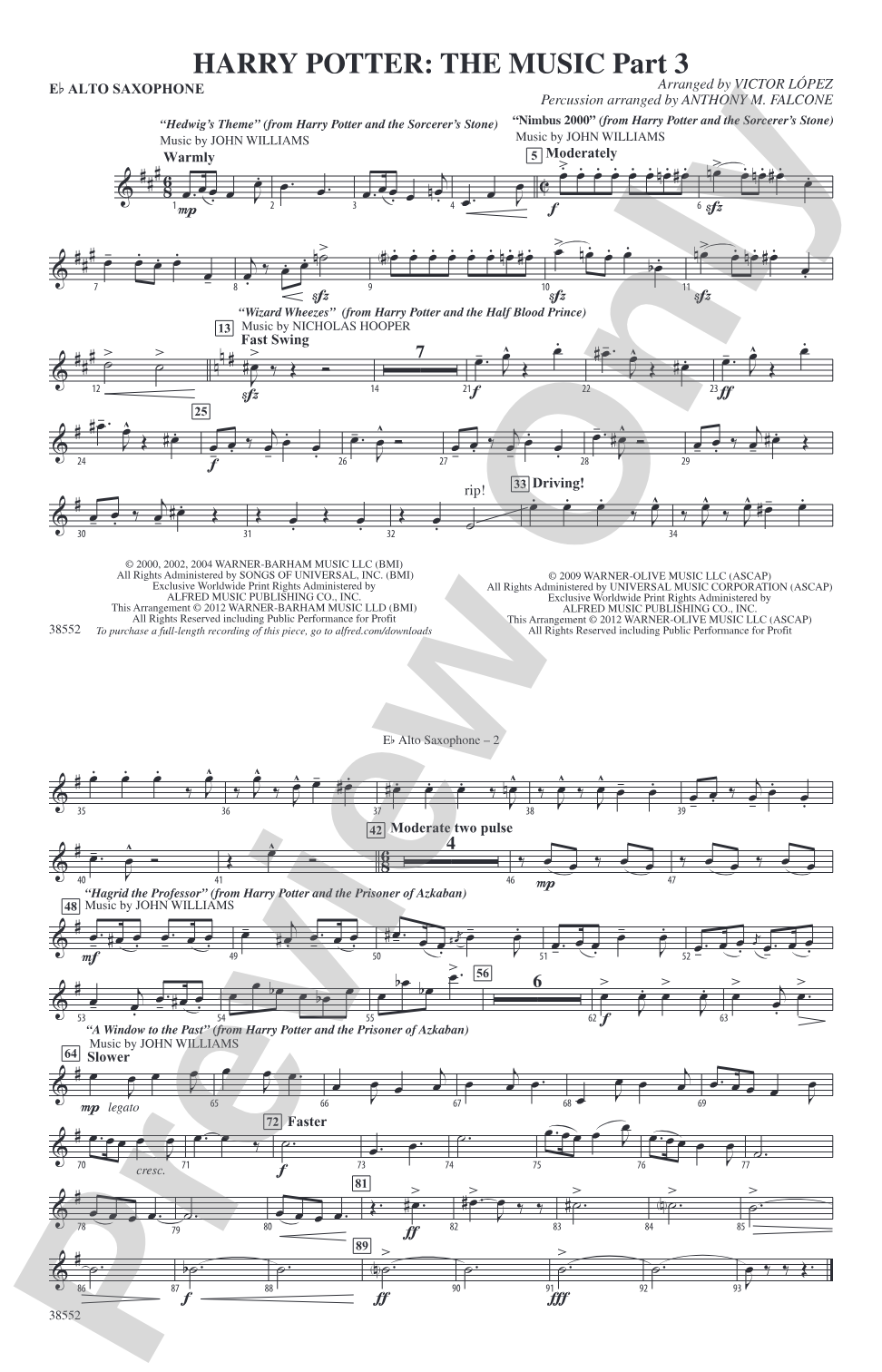

Harry Potter: The Music, Part 3: E-flat Alto Saxophone
Featuring: Hedwig's Theme / Nimbus 2000 / Wizard Wheezes / Hagrid the Professor / A Window to the Past
Music by John Williams and Nicholas Hooper / arr. Victor López, percussion arr. Anthony M. Falcone
Grade: 3 (Medium)
Item: 00-PC-0018291_AX1
$3.00
Pickup currently not available
Description
We conclude our Harry Potter show with a medley of five memorable tunes. After short but different restatements of "Hedwig's Theme" and "Nimbus 2000," the chart moves into the rip-roaring swing tune "Wizard Wheezes." This is followed by the often humorous "Hagrid the Professor," which features an optional brass quartet, before ending with the gorgeous and poignant "A Window to the Past." This wonderful show features extraordinary music arranged by an extraordinary writer!
For educational usage/non-profit performances only; for professional arrangements, visit our rental library at alfred.com/rental.


For educational usage/non-profit performances only; for professional arrangements, visit our rental library at alfred.com/rental.
Don't just read it, hear it, play along with it, and watch your students grow with it. In MakeMusic Cloud, Harry Potter: The Music, Part 3: E-flat Alto Saxophone comes alive with professional accompaniment, adjustable tempo, and built-in practice tools that turn solo practice into real progress.
Open in the Player
Jump straight in and assign it today.
Start Your Free Trial
Open this title and explore the full library in minutes.
Sample Audio
1
Audio File
--:--
0:00
0:00
Sample Video
Additional Details
Series:
Mega Sounds for Marching Band
Publisher:
Alfred Music
Page Count:
224
SKU:
00-PC-0018291_AX1
More about this title
About the Composer: John Williams
John Williams stands as one of the most prolific and celebrated film composers of the past 50 years. His ability to craft instantly recognizable, emotionally resonant themes has made him a fixture in popular culture and a profound influence on how audiences experience story through music. Williams's orchestral writing demonstrates mastery of classical forms and instrumental color, making his film scores enduring models for music educators teaching composition, arrangement, and orchestration.
Why we love this
This medley captures the distinctive personality of each theme while giving your band genuine musical substance to work with. The arrangement respects the Grade 3 ensemble's abilities without dumbing down the harmonic language or orchestration, and the mix of tempos and styles keeps both performers and audiences engaged across five movements.
What to expect
Playful yet purposeful. The medley bounces between bright, almost comedic moments and genuine emotional weight, especially in the reflective final movement. Listeners will recognize these melodies immediately, but performers will appreciate the arranging details that make each section feel fresh and musically rewarding.
Who it's for
Marching bands at the Grade 3 level who want audience-friendly repertoire with legitimate musical depth and variety. This works equally well for schools building a pop-culture-themed show or directors seeking accessible pieces that don't sacrifice arranging craft.
How to get the most out of it
- Balance the softer, legit passages in "A Window to the Past" by asking your low brass to anchor the harmony without overwhelming the woodwind soloists above them.
- The swing feel in "Wizard Wheezes" demands loose, behind-the-beat articulation from the brass section; rehearse this feel separately before running the full section.
- Pay attention to the optional brass quartet feature in "Hagrid the Professor." If you choose to use it, isolate those players for balance checks so the rest of the band doesn't overshadow them.
- Build momentum through the transitions between movements; treat each restatement as a chance to add energy and shape, not simply repeat what came before.
How to use it
Program this as a complete show closer or as the centerpiece of a themed concert built around film music. The five-movement structure works beautifully as a standalone feature that showcases your band's range across tempos, dynamics, and styles without requiring additional setup or narrative framing.
Skills your students will build
- Managing stylistic shifts within a single piece (legit ballad, swing, march-adjacent sections)
- Balancing melody and harmony across different instrumental families
- Reading compound parts and optional sections in a multi-movement context
- Executing sustained, expressive phrasing in contrast with rhythmic, articulated passages
- Responding to conductor cues that signal mood and tempo transitions