
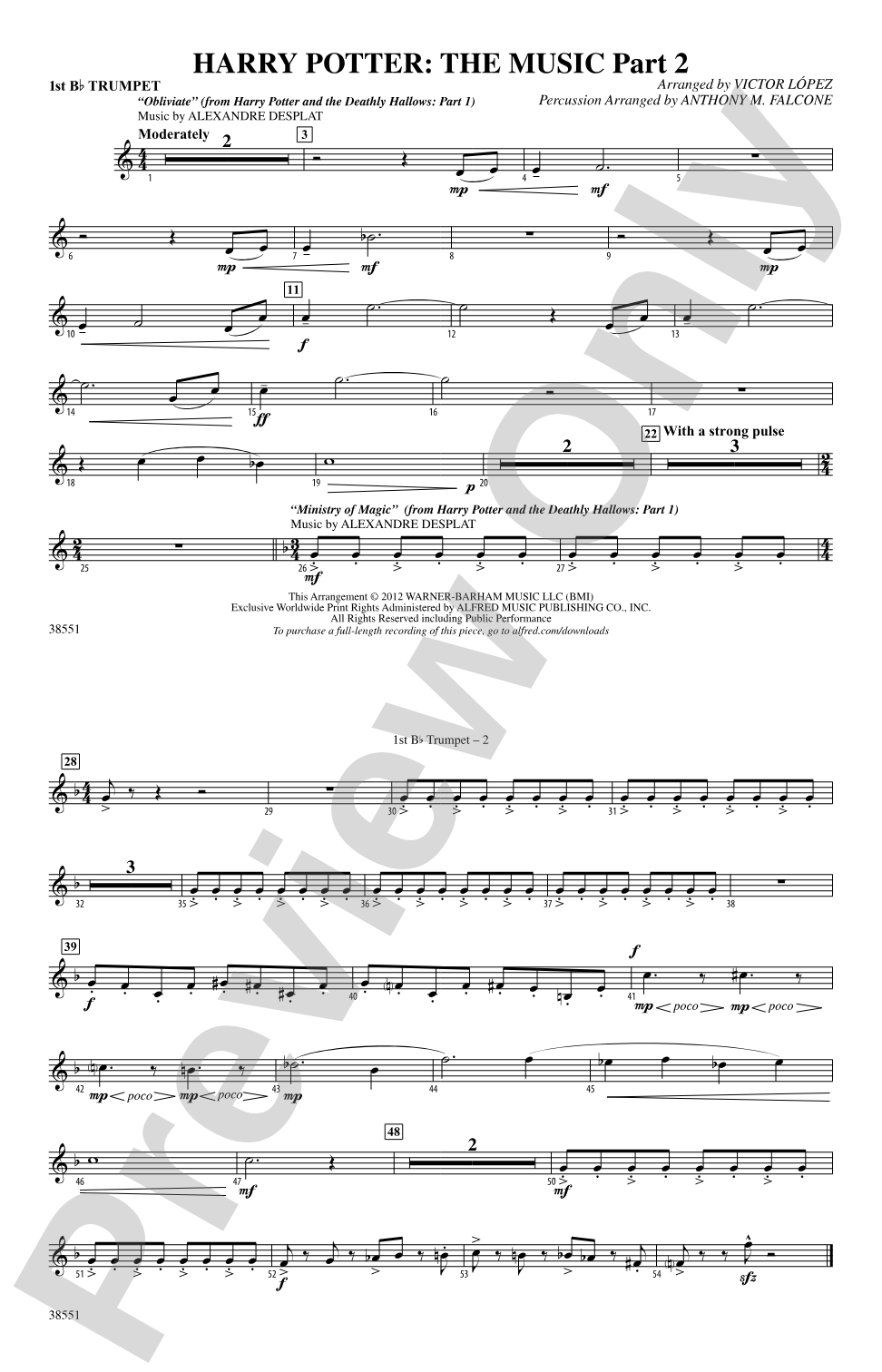

Harry Potter: The Music, Part 2: 1st B-flat Trumpet
Featuring: Obliviate / Ministry of Magic
Music by Alexandre Desplat / arr. Victor López, percussion arr. Anthony M. Falcone
Grade: 3 (Medium)
Item: 00-PC-0018290_T1
$3.00
Pickup currently not available
Description
Part 2 of our complete Harry Potter show contains music from Harry Potter and the Deathly Hallows. It begins with the mysteriously beautiful "Obliviate," which starts softly and gradually builds to a huge statement, before giving way to the rhythmic "Ministry of Magic."
For educational usage/non-profit performances only; for professional arrangements, visit our rental library at alfred.com/rental.


For educational usage/non-profit performances only; for professional arrangements, visit our rental library at alfred.com/rental.
Don't just read it, hear it, play along with it, and watch your students grow with it. In MakeMusic Cloud, Harry Potter: The Music, Part 2: 1st B-flat Trumpet comes alive with professional accompaniment, adjustable tempo, and built-in practice tools that turn solo practice into real progress.
Open in the Player
Jump straight in and assign it today.
Start Your Free Trial
Open this title and explore the full library in minutes.
Sample Audio
1
Audio File
--:--
0:00
0:00
Sample Video
Additional Details
Series:
Mega Sounds for Marching Band
Publisher:
Alfred Music
Page Count:
210
SKU:
00-PC-0018290_T1
More about this title
About the Composer: Alexandre Desplat
Alexandre Desplat has composed the scores for all eight Harry Potter films, establishing himself as one of the most recognizable voices in contemporary film music. His work across the series demonstrates a sophisticated understanding of orchestral color and thematic development, moving from the whimsical wonder of the early films to the darker, more complex soundscapes of the later installments.
Desplat's film scores have earned him multiple Grammy and Golden Globe nominations. His ability to craft memorable themes that serve both narrative and emotional purposes makes his music particularly valuable for music educators seeking high-engagement repertoire that resonates with students.
Why we love this
Victor López and Anthony M. Falcone have crafted arrangements that preserve the dramatic arc and harmonic sophistication of Desplat's original film scores while remaining accessible to Grade 3 musicians. The pairing of "Obliviate" and "Ministry of Magic" gives your band a complete dramatic arc within a single show, moving from quiet, introspective scoring to propulsive, energetic material that builds audience engagement and showcases your ensemble's dynamic range.
What to expect
"Obliviate" draws you into a world of quiet magic and hidden secrets, unfolding with deliberate, almost hypnotic pacing before swelling into a powerful realization. "Ministry of Magic" shifts the energy entirely—crisp, purposeful, and rhythmically propulsive, capturing bureaucratic tension and forward momentum with driving accompaniment and commanding melodic statements.
Who it's for
This show works for marching bands at the Grade 3 level (typically high school bands with some experience and developmental bands) who want to program recognizable, high-engagement music with genuine musical substance. Directors programming fall shows, Halloween concerts, or shows with a dark or mysterious theme will find both pieces immediately relevant.
How to get the most out of it
- Balance the gradual crescendo in "Obliviate" by assigning the softest opening phrases to principal players with clear tone production; let the texture build through doubling and section swells rather than overall volume increases.
- In "Ministry of Magic," anchor the rhythmic momentum with a locked, precise rhythm section; minor fluctuations in pulse become noticeable when the accompaniment pattern is as driving and repetitive as this passage demands.
- Use the conductor score to shape phrase breathing across both movements; the transition between the mysterious opening and the rhythmic middle section requires clear gestural communication about character shift.
- Highlight the contrast in instrumentation between the two selections by adjusting which sections carry the main material; listen for opportunities where your arrangement distributes melody and countermelody to different voices.
How to use it
Program this as a complete show unto itself, or use "Ministry of Magic" as a high-energy closer to contrast with softer opening selections. The two pieces together give you roughly 8-10 minutes of material and work well for educational performances, pep band appearances, or concert band contexts where you want to showcase your ensemble's ability to execute both sensitive dynamic control and tight rhythmic precision.
Skills your students will build
- Dynamic control and gradual crescendo management through extended passages
- Rhythmic precision and ensemble lock in repetitive, driving accompaniment figures
- Executing dramatic character shifts and transitions between contrasting musical sections
- Balancing principal voices and secondary parts to create layered orchestral texture
- Maintaining consistent ensemble blend across multiple melodic and harmonic layers