
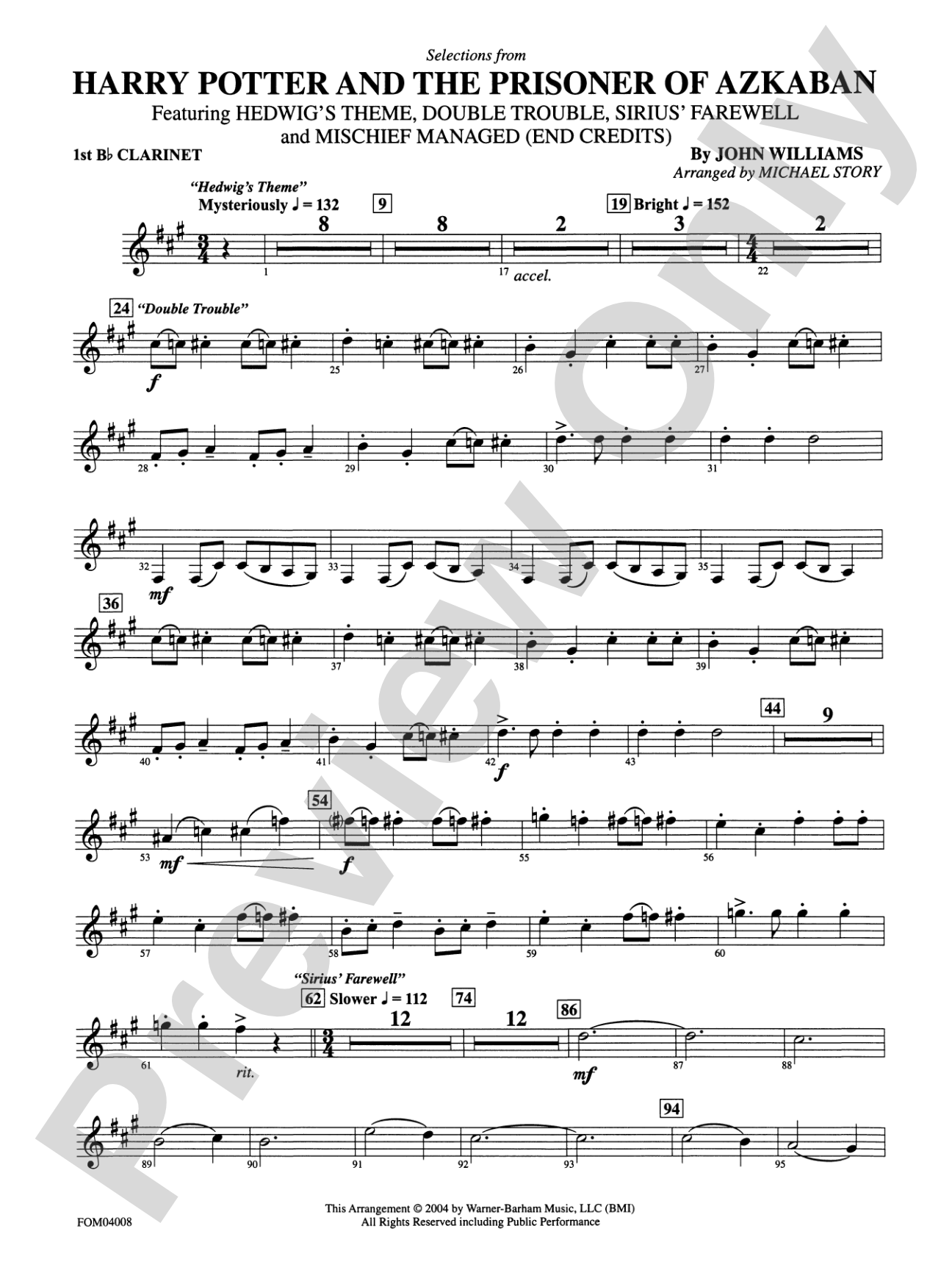

Harry Potter and the Prisoner of Azkaban: 1st B-flat Clarinet
Featuring: Hedwig's Theme / Double Trouble / Sirius' Farewell / Mischief Managed (End Credits)
By John Williams / arr. Michael Story
Grade: 2
Item: 00-PC-0016110_C1
$3.00
Pickup currently not available
Description
Program this striking medley from the blockbuster motion picture soundtrack on your spring concert this year! Many of the cherished melodies from the first two movies are intertwined with the newest themes. Titles include: "Lumos! (Hedwig's Theme)," "Double Trouble," "Sirius' Farewell," and "Mischief Managed." A sure-fire winner!
For educational usage/non-profit performances only; for professional arrangements, visit our rental library at alfred.com/rental.


For educational usage/non-profit performances only; for professional arrangements, visit our rental library at alfred.com/rental.
Don't just read it, hear it, play along with it, and watch your students grow with it. In MakeMusic Cloud, Harry Potter and the Prisoner of Azkaban: 1st B-flat Clarinet comes alive with professional accompaniment, adjustable tempo, and built-in practice tools that turn solo practice into real progress.
Open in the Player
Jump straight in and assign it today.
Start Your Free Trial
Open this title and explore the full library in minutes.
Sample Audio
No sample audio found.
Sample Video
No sample videos found.
Additional Details
Series:
Pop Intermediate String/Full Orchestra
Publisher:
Alfred Music
Page Count:
252
SKU:
00-PC-0016110_C1
More about this title
About the Composer: John Williams
John Williams stands among the most prolific and celebrated film composers of all time, with a career spanning more than six decades. His mastery of orchestral writing and ability to craft instantly memorable themes have defined the soundtracks for some of cinema's most beloved franchises, including Star Wars, Indiana Jones, Jurassic Park, and the Harry Potter series. His work demonstrates a deep understanding of classical orchestration paired with an instinctive gift for melody, making his scores equally powerful in the concert hall and on screen.
Williams' approach to composition emphasizes emotional clarity and architectural strength. Each theme carries distinct melodic character and harmonic purpose, allowing musicians of varying levels to grasp and communicate the music's intent. His scores for young audiences, in particular, combine accessibility with genuine musical substance, offering student musicians the opportunity to perform concert-quality material that feels both engaging and achievable.
Why we love this
Michael Story's arrangement captures the essence of Williams' most iconic Potterverse themes while maintaining musical integrity across grade 2 scoring. The medley structure works brilliantly on a spring concert, offering audiences the satisfaction of recognizing beloved material woven together with fresh harmonic coloring and orchestral texture. This is the kind of piece that reminds your ensemble why they started playing music in the first place.
What to expect
The opening captures the ethereal magic of Hedwig's Theme before moving into the roguish energy of Double Trouble. Darker harmonic territory marks Sirius' Farewell with genuine emotional weight, and the finale returns to wonder and mischief as the piece resolves. Throughout, Williams' orchestration invites each section to participate in the storytelling, making the ensemble feel like they're part of something larger than themselves.
Who it's for
This arrangement serves orchestras at the grade 2 level that want to program recognizable, engaging repertoire without compromising musical substance. It works equally well for secondary school orchestras building audience appeal and for community ensembles looking to expand beyond standard classical fare.
How to get the most out of it
- Balance the nostalgia. Since audiences know these melodies from the films, lean into clean phrasing and unhurried tempos that let familiar material breathe rather than rushing to get through the recognition moments.
- Assign principal voices deliberately across the four movements. The transitions between thematic material will feel seamless if you've identified exactly which sections carry each theme and rehearsed those handoffs specifically.
- Shape dynamics around the emotional arc of the narrative. The piece moves from the whimsy of Hedwig's Theme through darker moments to resolution, so treat each section's dynamic contour as part of the storytelling.
- Use the conductor score to mark cues for yourself well in advance. At 252 pages, familiarity with the full orchestration will make your gestures clearer and your rehearsal time more efficient.
How to use it
Program this as a closing piece on a spring or end-of-year concert when you want to send audiences home with joy and recognition. It pairs well with shorter classical selections earlier in the program, offering a clear dramatic shift that demonstrates your orchestra's range. The piece works particularly effectively in school assemblies or community concerts where younger audiences might not yet have deep classical reference points but will respond immediately to the themes.
Skills your students will build
- Sustaining lyrical phrasing across multiple sections of varying character
- Executing clear transitions between contrasting thematic material
- Balancing principal melody voices while maintaining harmonic texture
- Reading and responding to conductor gestures in a multi-movement structure