
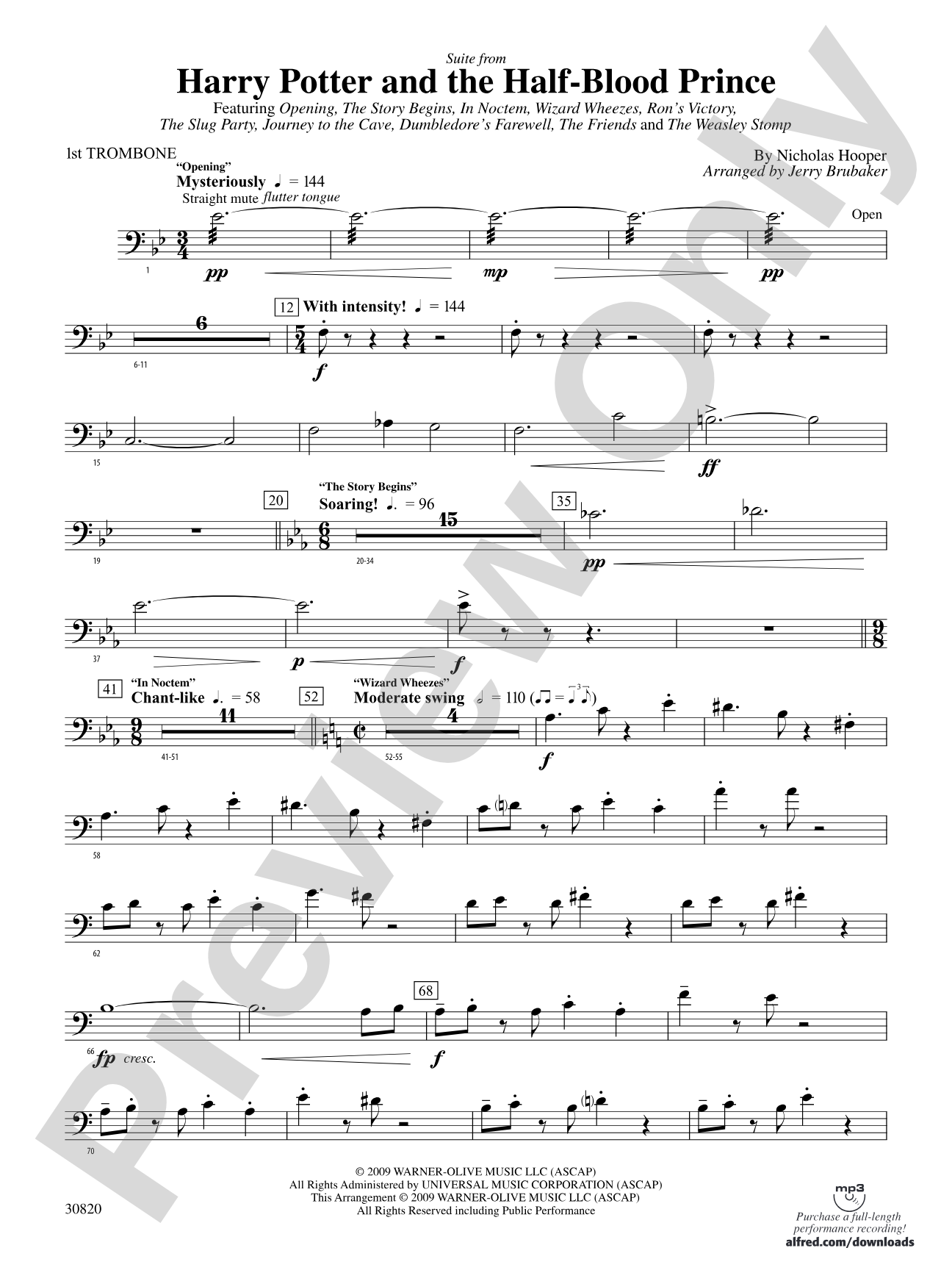

Harry Potter and the Half-Blood Prince, Suite from: 1st Trombone
Featuring: Opening / The Story Begins / In Noctem / Wizard Wheezes / Ron's Victory / The Slug Party / Journey to the Cave / Dumbledore's Farewell / The Friends / The Weasley Stomp
By Nicholas Hooper / arr. Jerry Brubaker
Grade: 3.5 (Medium Easy to Medium)
Item: 00-PC-0015733_TN1
$5.99
Pickup currently not available
Description
Starting with the "Opening" music and transitioning to "The Story Begins," the medley develops incorporating "In Noctem," the jazzy "Wizard Wheezes," "Ron's Victory," "The Slug Party," "Journey to the Cave," "Dumbledore's Farewell," "The Friends," and closing with "The Weasley Stomp." True to the original film-score, this jam-packed medley will bring the excitement and energy to your students and audiences alike. Stunning!
For educational usage/non-profit performances only; for professional arrangements, visit our rental library at alfred.com/rental.


For educational usage/non-profit performances only; for professional arrangements, visit our rental library at alfred.com/rental.
Don't just read it, hear it, play along with it, and watch your students grow with it. In MakeMusic Cloud, Harry Potter and the Half-Blood Prince, Suite from: 1st Trombone comes alive with professional accompaniment, adjustable tempo, and built-in practice tools that turn solo practice into real progress.
Open in the Player
Jump straight in and assign it today.
Start Your Free Trial
Open this title and explore the full library in minutes.
Sample Audio
1
Audio File
--:--
0:00
0:00
Sample Video
No sample videos found.
Additional Details
Series:
Pop Concert Band
Publisher:
Alfred Music
Page Count:
264
SKU:
00-PC-0015733_TN1
More about this title
About the Composer: Nicholas Hooper
Nicholas Hooper composed the scores for the final four Harry Potter films, establishing himself as a major voice in film music composition. His work on the Half-Blood Prince and Deathly Hallows soundtracks showcases his ability to balance orchestral sophistication with thematic accessibility, creating music that resonates with both casual listeners and musicians studying contemporary scoring techniques.
Why we love this
This suite proves that film music transcends its source and stands on its own as engaging concert band literature. Jerry Brubaker's arrangement honors Hooper's original intentions while crafting a medley that builds momentum and emotional weight, giving your band genuine moments of heroism, humor, and pathos without requiring students to have seen the films.
What to expect
This medley carries you through a journey of magic, mischief, and melancholy. You move from mysterious opening gestures through playful wizardry, soaring heroism, and moments of genuine tenderness before landing in celebratory triumph, all without losing the sweep and drama that makes film scoring so compelling.
Who it's for
Band directors seeking substantial medley repertoire for students at the intermediate level will find this suite accessible without being simplistic. The grade 3.5 difficulty keeps it within reach for developing players while offering genuine musical and emotional content that keeps stronger students engaged.
How to get the most out of it
- Balance the ensemble carefully during transitions between themes so each melodic idea registers clearly; the medley format demands clean handoffs between sections.
- Attend to the contrasting moods, especially the shift from the jazzy "Wizard Wheezes" to the darker "Journey to the Cave." These changes of character give the band something real to play toward.
- The closing "Weasley Stomp" needs rhythmic precision and energy from the full ensemble; treat it as your moment to drive home the excitement you've built through the entire piece.
- Watch for dynamic variety in the quieter moments like "Dumbledore's Farewell." Soft playing with emotional intent matters as much as the fortissimo sections.
How to use it
Program this as a centerpiece for a popular-music or film-music themed concert, or use it as a crowd-pleasing finale that sends the audience home energized. The medley's length and variety make it perfect for showcasing what your band can do across multiple moods and styles in a single performance.
Skills your students will build
- Reading multiple thematic transitions and style shifts within a single work
- Balancing ensemble voicing in medley arrangements with exposed melodic lines
- Maintaining tempo stability and rhythmic precision during sectional handoffs
- Differentiating articulation and tone color across contrasting emotional landscapes
- Dynamic control from soft, sustained passages to energetic fortissimo sections