
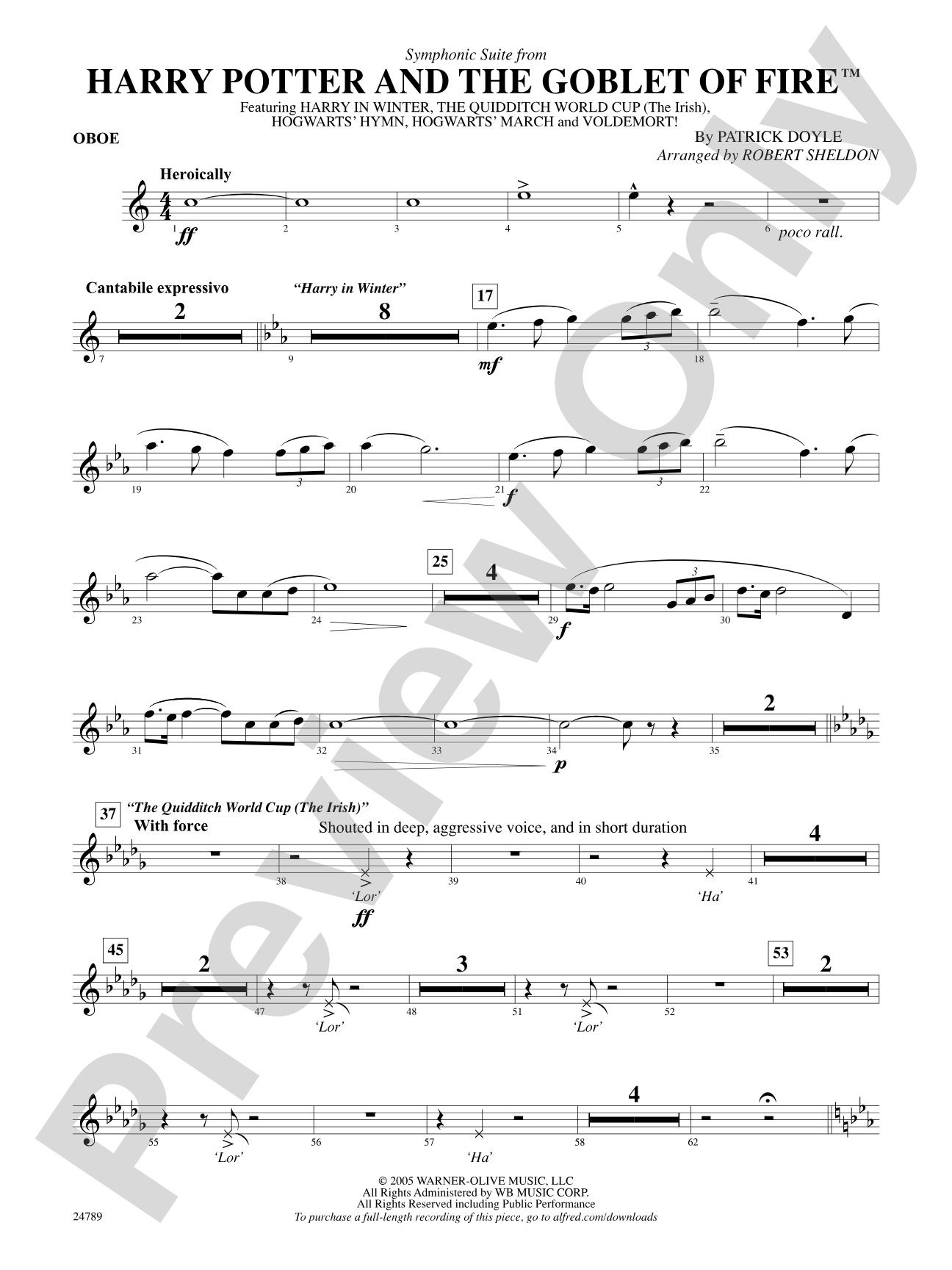

Harry Potter and the Goblet of Fire, Symphonic Suite from: Oboe
Featuring: Harry in Winter / The Quidditch World Cup (The Irish) / Hogwarts' Hymn / Hogwarts' March / Voldemort!
By Patrick Doyle / arr. Robert Sheldon
Grade: 4 (Medium)
Item: 00-PC-0015648_O1
$5.99
Pickup currently not available
Description
Robert Sheldon has crafted this exemplary medley from Harry Potter and the Goblet of Fire™. With all the exuberance and passion of the original Patrick Doyle blockbuster film score, the symphonic suite contains, "Harry In Winter," "The Quidditch World Cup (The Irish)," "Hogwarts' Hymn," "Hogwarts' March" and "Voldemort!" A comprehensive musical journey to accompany the fourth classic book in the series.
For educational usage/non-profit performances only; for professional arrangements, visit our rental library at alfred.com/rental.


For educational usage/non-profit performances only; for professional arrangements, visit our rental library at alfred.com/rental.
Don't just read it, hear it, play along with it, and watch your students grow with it. In MakeMusic Cloud, Harry Potter and the Goblet of Fire, Symphonic Suite from: Oboe comes alive with professional accompaniment, adjustable tempo, and built-in practice tools that turn solo practice into real progress.
Open in the Player
Jump straight in and assign it today.
Start Your Free Trial
Open this title and explore the full library in minutes.
Sample Audio
1
Audio File
--:--
0:00
0:00
Sample Video
No sample videos found.
Additional Details
Series:
Pop Symphonic Band
Publisher:
Alfred Music
Page Count:
272
SKU:
00-PC-0015648_O1
More about this title
About the Composer: Patrick Doyle
Patrick Doyle is a Scottish film composer whose work across major motion pictures has made him a defining voice in contemporary orchestral cinema. His scores for the Harry Potter series (particularly the third through sixth films) established him as a master of magical storytelling through music, blending classical orchestration with accessible melodic writing that resonates across audiences of all ages.
Doyle's gift for character and narrative through instrumental color makes his work exceptionally rewarding for young musicians to perform. His melodies are singable, his harmonic language is sophisticated without being forbidding, and his orchestration naturally highlights ensemble balance and section independence, all of which serve educational ensembles well.
Why we love this
Robert Sheldon's arrangement captures the sweep and drama of Doyle's original score while respecting what makes each theme musically distinct. The suite spans genuine emotional range, from the introspective warmth of 'Harry In Winter' to the visceral climax of 'Voldemort!', giving your band material that develops musicianship through contrast rather than repetition alone. Programming this demonstrates that film music deserves serious attention in the concert band repertoire.
What to expect
The journey from winter solitude to magical spectacle to dark confrontation unfolds with genuine cinematic storytelling. You experience moments of tender reflection, festive pageantry, and genuine tension, all delivered through Doyle's hallmark combination of orchestral color and emotional clarity.
Who it's for
This suite is designed for intermediate to advanced concert bands seeking substantive film music with genuine dramatic arc. It works equally well for ensembles building confidence in their musicianship and those ready to tackle more sophisticated programming choices.
How to get the most out of it
- Balance the ensemble during the Quidditch World Cup section where multiple themes layer; the melody often lives in a single voice family while accompaniment patterns support from below.
- The 'Hogwarts' Hymn' gains dignity through slow vibrato in the upper woodwinds and warm, sustained horn voicing; resist the urge to rush this moment.
- Bring out dynamic contrast in 'Voldemort!' by ensuring that softer passages feel genuinely quiet and purposeful, not tentative; this creates real menace when the full band enters.
- Use the score to mark exactly where underscoring instruments (often low brass or low woodwinds) anchor harmonic motion; young musicians often miss these lines because they're not the obvious melody.
How to use it
Program this as a centerpiece that stands alongside traditional concert band classics rather than as a novelty item. Its length and dramatic scope make it suitable for a full second half of a concert, and the variety of character keeps audience attention through all five movements. This also works beautifully as your winter or spring concert opener if you want to establish energy and engagement immediately.
Skills your students will build
- Sustaining long musical lines without sacrificing shape or direction
- Balancing melody and accompaniment across multiple instrument families simultaneously
- Reading and responding to frequent dynamic and tempo changes within a cohesive work
- Producing characteristic tone colors to match distinct musical moods (introspective, celebratory, menacing)
- Maintaining ensemble precision during rapid rhythmic figures and syncopation
- Understanding how film composers use instrumentation to reinforce narrative and character