
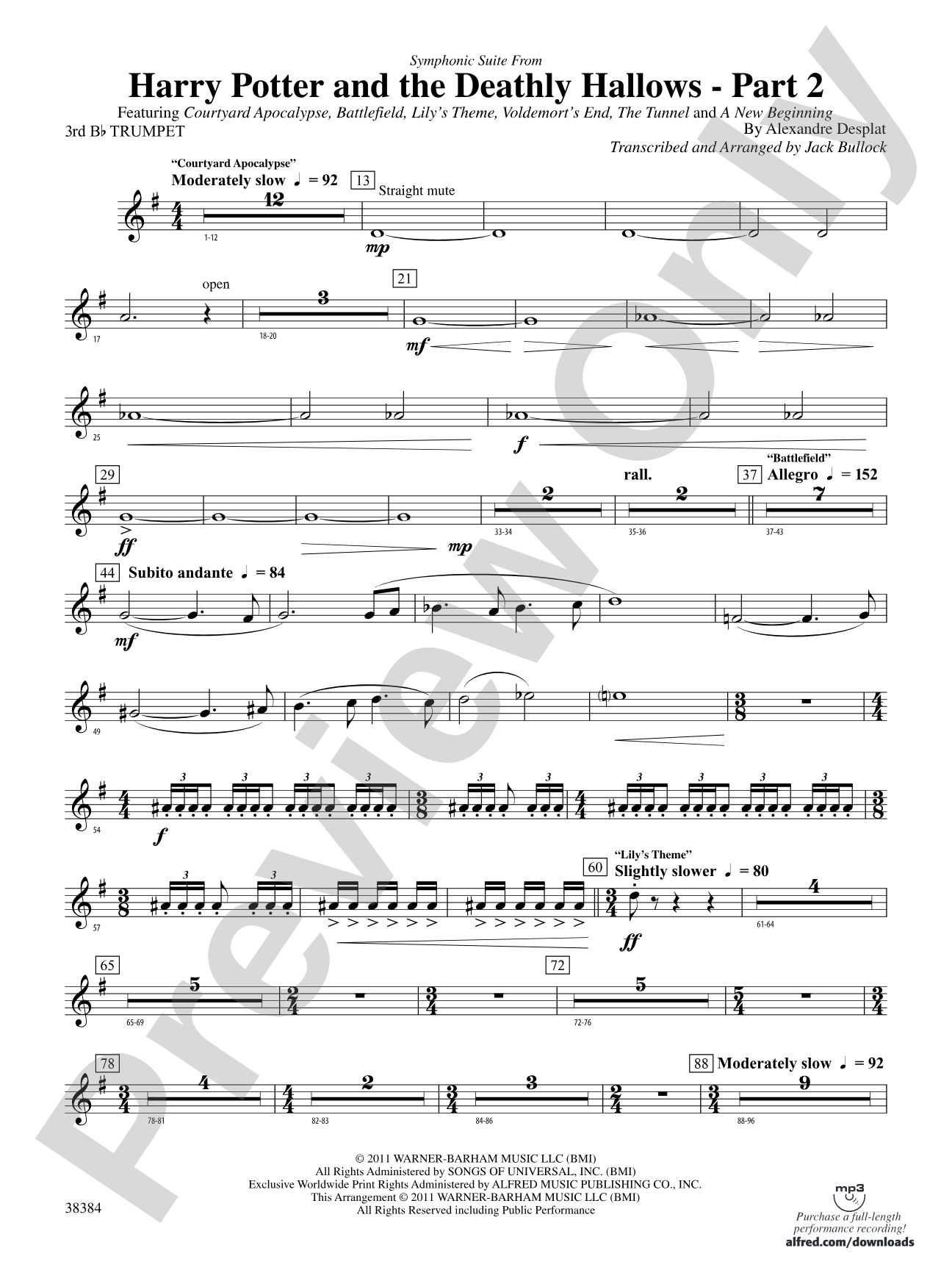

Harry Potter and the Deathly Hallows, Part 2, Symphonic Suite from: 3rd B-flat Trumpet
Featuring: Courtyard Apocalypse / Battlefield / Lily’s Theme / Voldemort’s End / The Tunnel / A New Beginning
By Alexandre Desplat / transcribed and arr. Jack Bullock
Grade: 4 (Medium)
Item: 00-PC-0015804_T3
$3.00
Pickup currently not available
Description
Transcribed directly from Alexandre Desplat's blockbuster film score, Jack Bullock's medley has all of the energy for your symphonic band. This no-holds-barred arrangement features "Courtyard Apocalypse," "Battlefield," "Lilly's Theme," "Voldemort's End," "The Tunnel," and "A New Beginning." The dramatic conclusion to the epic Harry Potter series has been captured musically. A stunning work! (7:00)
For educational usage/non-profit performances only; for professional arrangements, visit our rental library at alfred.com/rental.


For educational usage/non-profit performances only; for professional arrangements, visit our rental library at alfred.com/rental.
Don't just read it, hear it, play along with it, and watch your students grow with it. In MakeMusic Cloud, Harry Potter and the Deathly Hallows, Part 2, Symphonic Suite from: 3rd B-flat Trumpet comes alive with professional accompaniment, adjustable tempo, and built-in practice tools that turn solo practice into real progress.
Open in the Player
Jump straight in and assign it today.
Start Your Free Trial
Open this title and explore the full library in minutes.
Sample Audio
1
Audio File
--:--
0:00
0:00
Sample Video
No sample videos found.
Additional Details
Series:
Pop Symphonic Band
Publisher:
Alfred Music
Page Count:
252
SKU:
00-PC-0015804_T3
More about this title
About the Composer: Alexandre Desplat
Alexandre Desplat has become one of the most sought-after film composers of his generation, earning acclaim for his work on the Harry Potter series and the Fantastic Beasts franchise. His orchestral writing combines dramatic intensity with emotional clarity, making his scores immediately recognizable and deeply engaging for both listeners and performers.
Desplat's compositional approach relies on memorable thematic material and sophisticated harmonic language that translates remarkably well to band and orchestra arrangements. His scores have introduced millions of students to orchestral music through films, and transcriptions of his work have become staples in concert band and orchestra programs worldwide.
Why we love this
Jack Bullock's arrangement captures the cinematic sweep and dramatic arc of the final battle sequence without losing the character themes that made the film score unforgettable. This medley gives your band a chance to play genuinely exciting, emotionally substantial music that your audience will recognize instantly. The pacing and orchestration choices make it feel like a feature-length concert piece rather than a collection of snippets.
What to expect
This suite sweeps you through triumph, chaos, and loss, then settles into quiet reflection before building to a hopeful finish. You'll move from the ominous gathering at the beginning through visceral battle music, pause for a moment of tender remembrance, and finally arrive at resolution. The orchestration feels cinematic throughout, with clear layering that lets each section contribute to the whole.
Who it's for
This arrangement is built for concert bands at the Grade 4 level who want a substantial, recognizable work that showcases their musicianship across a wide emotional and technical range. Directors seeking repertoire with built-in audience appeal will find that students respond enthusiastically to material they already know, while the arrangement's musical demands ensure genuine learning happens.
How to get the most out of it
- Balance the ensemble so that thematic lines (particularly 'Lilly's Theme') sing through the texture without overwhelming the overall harmonic support; use sectional rehearsals to clarify who carries the melody at each moment.
- Establish a clear sense of pulse across the 'Courtyard Apocalypse' and 'Battlefield' sections, where rapid figuration and shifting rhythms can easily fragment if the conductor's beat isn't rock-solid.
- Treat dynamic contrasts as structural markers; the shifts between aggressive and intimate moments require precise ensemble response to maximize the dramatic impact.
- Allow 'A New Beginning' its full lyrical space in the final minutes; resist rushing the resolution, and let the band settle into the final cadence with confidence.
How to use it
Program this as a closing piece on a spring concert where it can command the full attention of the audience and conclude your program with emotional resonance. It also works as a capstone project in the concert band curriculum, offering students an arrangement substantial enough to justify significant rehearsal time and flexible enough to feature multiple sections across the ensemble. Consider pairing it with other film score arrangements or concert band versions of popular music to create a thematically cohesive program.
Skills your students will build
- Sustaining energy across a seven-minute work with multiple tempo and dynamic shifts
- Balancing melodic prominence with harmonic support in dense orchestrations
- Executing rapid articulation and rhythmic figures in contemporary film music idioms
- Responding to dramatic structural pivots (from aggressive to lyrical material and back)
- Ensemble transparency when multiple sections carry related thematic content simultaneously