
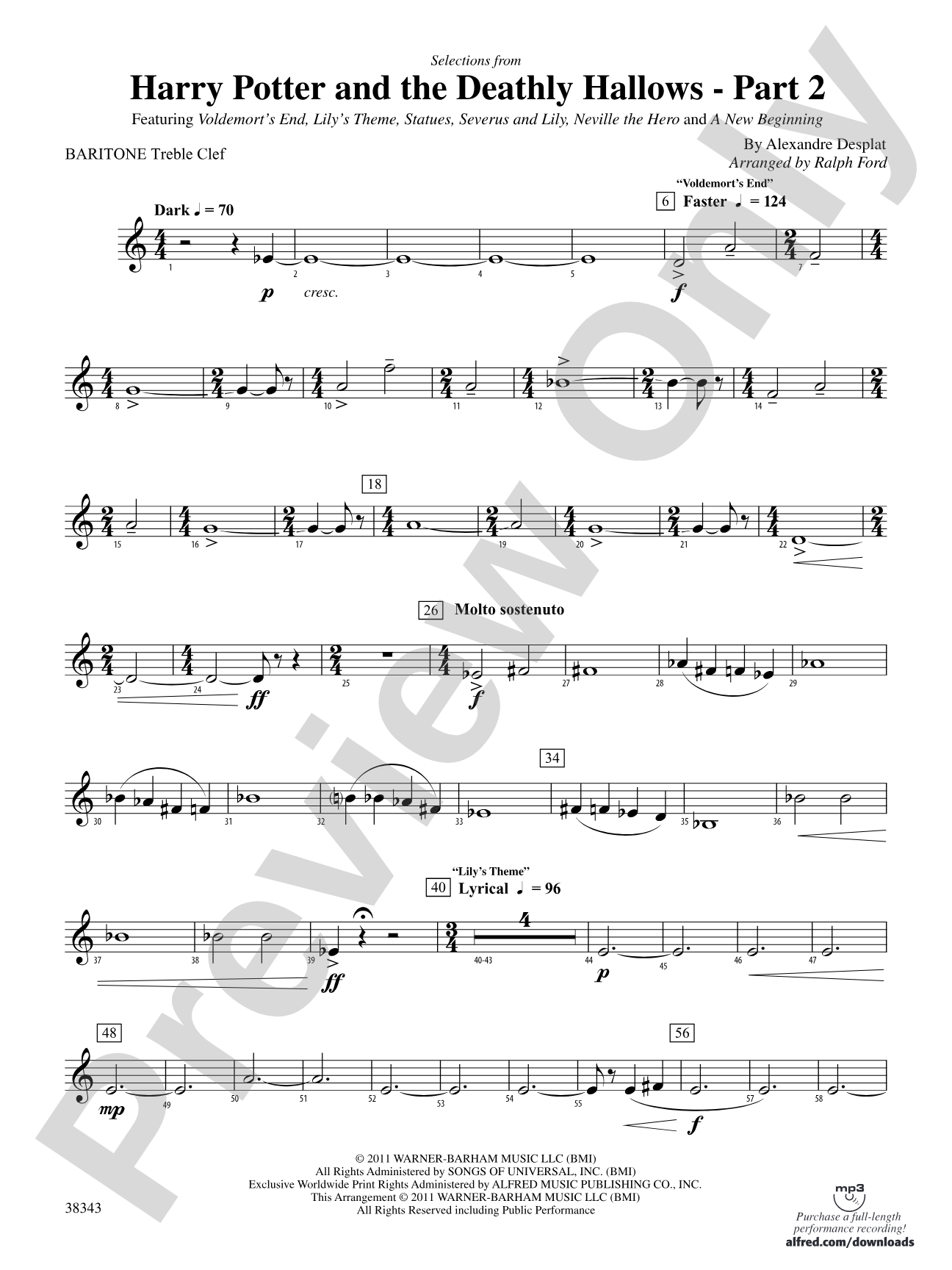

Harry Potter and the Deathly Hallows, Part 2, Selections from: Baritone T.C.
Featuring: Voldemort’s End / Lily’s Theme / Statues / Severus and Lily / Neville the Hero / A New Beginning
Music by Alexandre Desplat / arr. Ralph Ford
Grade: 2 (Easy)
Item: 00-PC-0015798_BTC1
$3.00
Pickup currently not available
Description
The epic film series draws to a dramatic close with an equally dynamic Alexandre Desplat film score. Ralph Ford has captured the imagination in his young band medley direct from the film-score compact disc. The medley includes "Voldemort's End," "Lily's Theme," "Statues," "Severus and Lily," "Neville the Hero," and "A New Beginning." Join the musical celebration with this stunning medley from the final Harry Potter film. (5:30)
For educational usage/non-profit performances only; for professional arrangements, visit our rental library at alfred.com/rental.


For educational usage/non-profit performances only; for professional arrangements, visit our rental library at alfred.com/rental.
Don't just read it, hear it, play along with it, and watch your students grow with it. In MakeMusic Cloud, Harry Potter and the Deathly Hallows, Part 2, Selections from: Baritone T.C. comes alive with professional accompaniment, adjustable tempo, and built-in practice tools that turn solo practice into real progress.
Open in the Player
Jump straight in and assign it today.
Start Your Free Trial
Open this title and explore the full library in minutes.
Sample Audio
1
Audio File
--:--
0:00
0:00
Sample Video
No sample videos found.
Additional Details
Series:
Pop Young Band
Publisher:
Alfred Music
Page Count:
252
SKU:
00-PC-0015798_BTC1
More about this title
About the Composer: Alexandre Desplat
Alexandre Desplat has become one of the most prolific and celebrated film composers of the 21st century, earning multiple Academy Award nominations for his work across major franchise films. His approach to scoring combines orchestral sophistication with accessibility, creating themes that resonate with both casual listeners and musicians studying his craft. Desplat's ability to build emotional depth through memorable melodic lines makes his film scores valuable teaching tools for young ensembles.
Why we love this
Ralph Ford's medley captures the emotional arc of the final Harry Potter film without overwhelming a Grade 2 ensemble. Young musicians get to perform recognizable, meaningful material that carries real dramatic weight, and the arrangement balances accessibility with moments that feel genuinely cinematic. Audiences respond immediately to these themes, making it a programming choice that builds enthusiasm for concert band.
What to expect
The medley moves between intimate, reflective moments and triumphant, energetic passages that mirror the film's emotional journey. Younger musicians will feel the sweep of orchestral storytelling as familiar themes from the movie come alive under their hands. The arrangement respects the source material's dramatic intent while remaining playable for developing ensembles.
Who it's for
Concert band directors working with Grade 2 ensembles who want to program recognizable, emotionally engaging material that doesn't compromise musical substance. Young musicians benefit from playing themes they already know and love, which builds confidence while developing fundamental ensemble skills. This arrangement is ideal for schools seeking appealing concert material that spans the full range of the band.
How to get the most out of it
- Balance the lyrical passages in "Lily's Theme" and "Severus and Lily" by allowing the melody to sing above a supporting harmonic foundation; younger players often rush these emotional moments out of nervousness.
- Mark the tempo shifts between sections in rehearsal so the ensemble understands when energy increases (particularly into "Neville the Hero") versus when reflective phrasing takes precedence.
- Give percussion clear cues for rhythmic punctuation, especially in the more dramatic selections like "Voldemort's End," to maintain ensemble cohesion across ensemble size.
- Record a full run-through early in rehearsals so students hear how their individual parts contribute to the complete sound and narrative arc of the medley.
How to use it
Program this as a substantial centerpiece in a concert celebrating film music or popular culture themes; the 5:30 runtime and structural variety make it a satisfying standalone feature. Pair it with other Grade 2 selections from the Pop Young Band series to create a thematic concert that speaks directly to your students' musical interests. Consider timing the performance for a spring concert when students have built enough technical security to showcase the medley's emotional nuances.
Skills your students will build
- Playing sustained melodic lines with consistent tone and phrasing
- Responding to tempo and dynamic changes across multiple musical sections
- Balancing individual parts within a full ensemble texture
- Reading and performing medley structures that shift between themes
- Maintaining rhythmic precision in both lyrical and energetic passages