
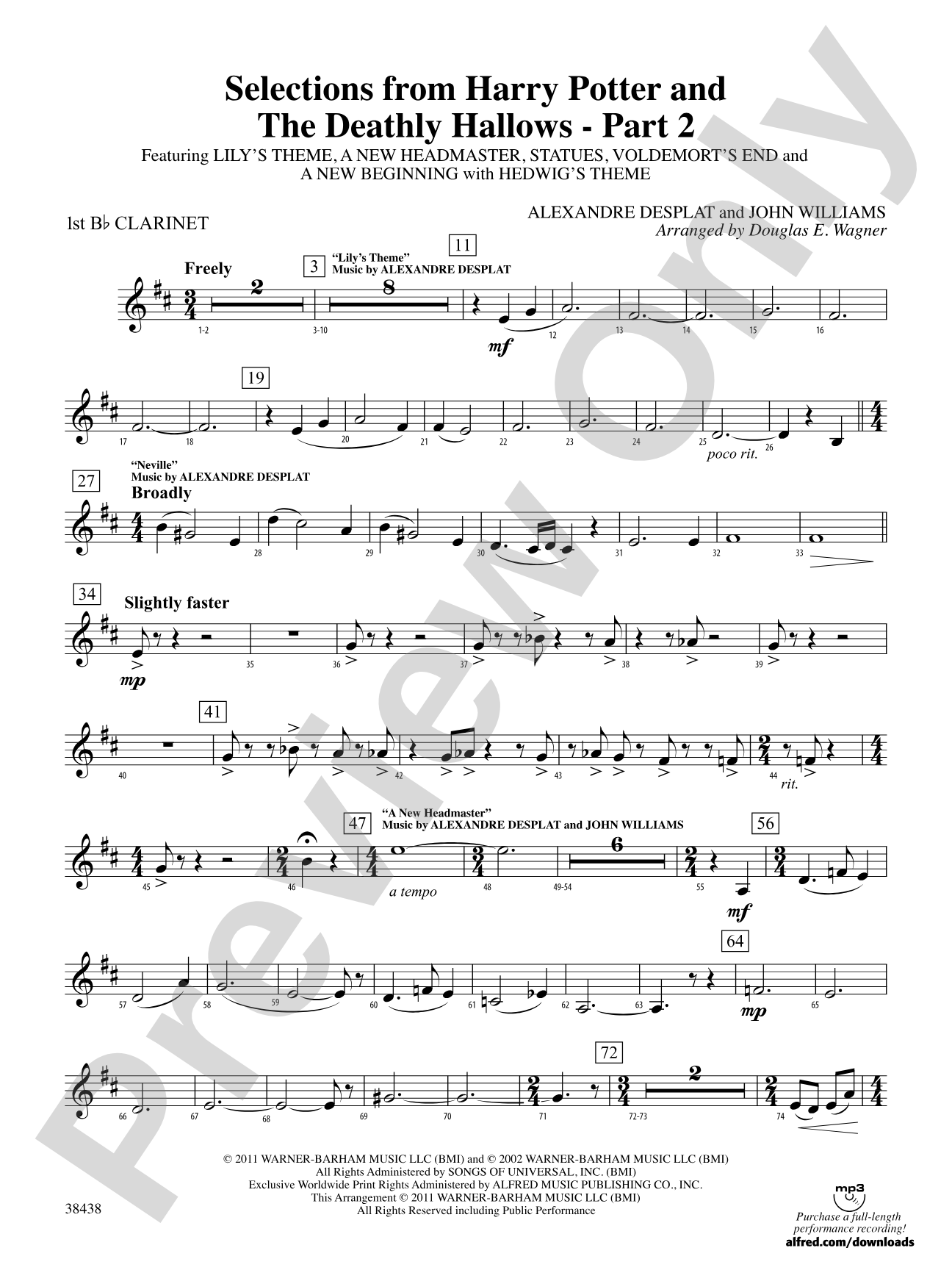

Harry Potter and the Deathly Hallows, Part 2, Selections from: 1st B-flat Clarinet
Featuring: Lily's Theme / A New Headmaster / Statues / Voldemort's End / A New Beginning (with Hedwig's Theme)
By Alexandre Desplat and John Williams / arr. Douglas E. Wagner
Grade: 3
Item: 00-PC-0015806_C1
$5.99
Pickup currently not available
Description
Six key selections from this brilliant score are presented in a solidly scored, emotion-packed arrangement that is designed to flatter your players and please any audience, young or old. Relive the dramatic conclusion to the fabulous Harry Potter saga! Playable by strings alone or any combination of winds.
For educational usage/non-profit performances only; for professional arrangements, visit our rental library at alfred.com/rental.


For educational usage/non-profit performances only; for professional arrangements, visit our rental library at alfred.com/rental.
Don't just read it, hear it, play along with it, and watch your students grow with it. In MakeMusic Cloud, Harry Potter and the Deathly Hallows, Part 2, Selections from: 1st B-flat Clarinet comes alive with professional accompaniment, adjustable tempo, and built-in practice tools that turn solo practice into real progress.
Open in the Player
Jump straight in and assign it today.
Start Your Free Trial
Open this title and explore the full library in minutes.
Sample Audio
1
Audio File
--:--
0:00
0:00
Sample Video
No sample videos found.
Additional Details
Series:
Pop Intermediate String/Full Orchestra
Publisher:
Alfred Music
Page Count:
244
SKU:
00-PC-0015806_C1
More about this title
About the Composer: Alexandre Desplat
Alexandre Desplat has become one of the most sought-after film composers of the 21st century, with a gift for writing music that deepens emotional storytelling without overwhelming dialogue or action. His work on the Harry Potter films established him as a master of orchestral architecture, crafting themes that embed themselves in listeners' memories while serving the needs of directors and editors. Beyond Potter, Desplat has scored major releases for franchises ranging from Marvel to DC, proving his versatility across genres while maintaining a distinctly lyrical voice.
In the classroom and rehearsal hall, Desplat's orchestrations reward young musicians with clear parts, singable lines, and genuine dramatic payoff. His scores demand precision and ensemble awareness from student players while remaining accessible to developing musicians. Teachers value his work because it engages students emotionally with music they already love, raising their investment in technical growth.
Why we love this
Six movements from one of cinema's most beloved scores arrive in an arrangement that respects the original's emotional weight while staying completely playable at Grade 3. The orchestration flexes beautifully whether you field a full ensemble or strings with selective winds, giving you real programming options without sacrificing Desplat's signature grandeur. Student musicians connect instantly with material they recognize, and that connection fuels the kind of focused, engaged rehearsing that translates directly to concert performance.
What to expect
These selections capture the epic sweep and intimate moments of Deathly Hallows Part 2, from soaring heroic themes to passages of quiet reflection and crystalline beauty. The arrangement preserves Desplat's gift for writing memorable melodies and rich harmonies while keeping the orchestration transparent enough that young musicians can hear themselves and understand the architecture beneath.
Who it's for
Conductors leading Grade 3 full orchestras or string ensembles (with optional winds) who want substantial repertoire that engages their musicians emotionally while remaining within technical reach. Directors seeking concert material that appeals to audiences of all ages and connects with students through music they already know and love.
How to get the most out of it
- Balance the melody line carefully in passages where violins and violas carry the theme simultaneously; the upper strings should lead while the violas provide harmonic color rather than compete for prominence.
- Observe tempo relationships between movements, particularly the transition from slower reflective passages into the more energetic selections; slight rubato at movement boundaries helps audiences hear distinct emotional shifts rather than abrupt changes.
- Shape dynamic arcs phrase by phrase rather than hitting marked dynamics statically; even in Grade 3 arrangements, subtle long-line shaping transforms functional playing into storytelling.
- Use the conductor's score to identify which instruments carry primary themes in each movement, then rehearse those parts prominently during sectionals to ensure clarity when the full ensemble plays.
How to use it
Program this as a thematic anchor for a spring concert, particularly one celebrating film music or storytelling through sound; younger audiences will recognize the material immediately, while the serious orchestration shows your ensemble's growth. Alternatively, select individual movements as encores or opener pieces throughout the year to build familiarity and rehearse different technical challenges without the commitment of the full suite.
Skills your students will build
- Balancing independent melodic lines in divisi writing
- Sustaining longer phrases while managing breath or bow control
- Responding to subtle tempo and dynamic shifts within movements
- Playing with stylistic awareness of film scoring conventions
- Ensemble awareness when multiple voice parts carry equal harmonic weight