Hark, the Herald Angels Sing Sheet Music Preview

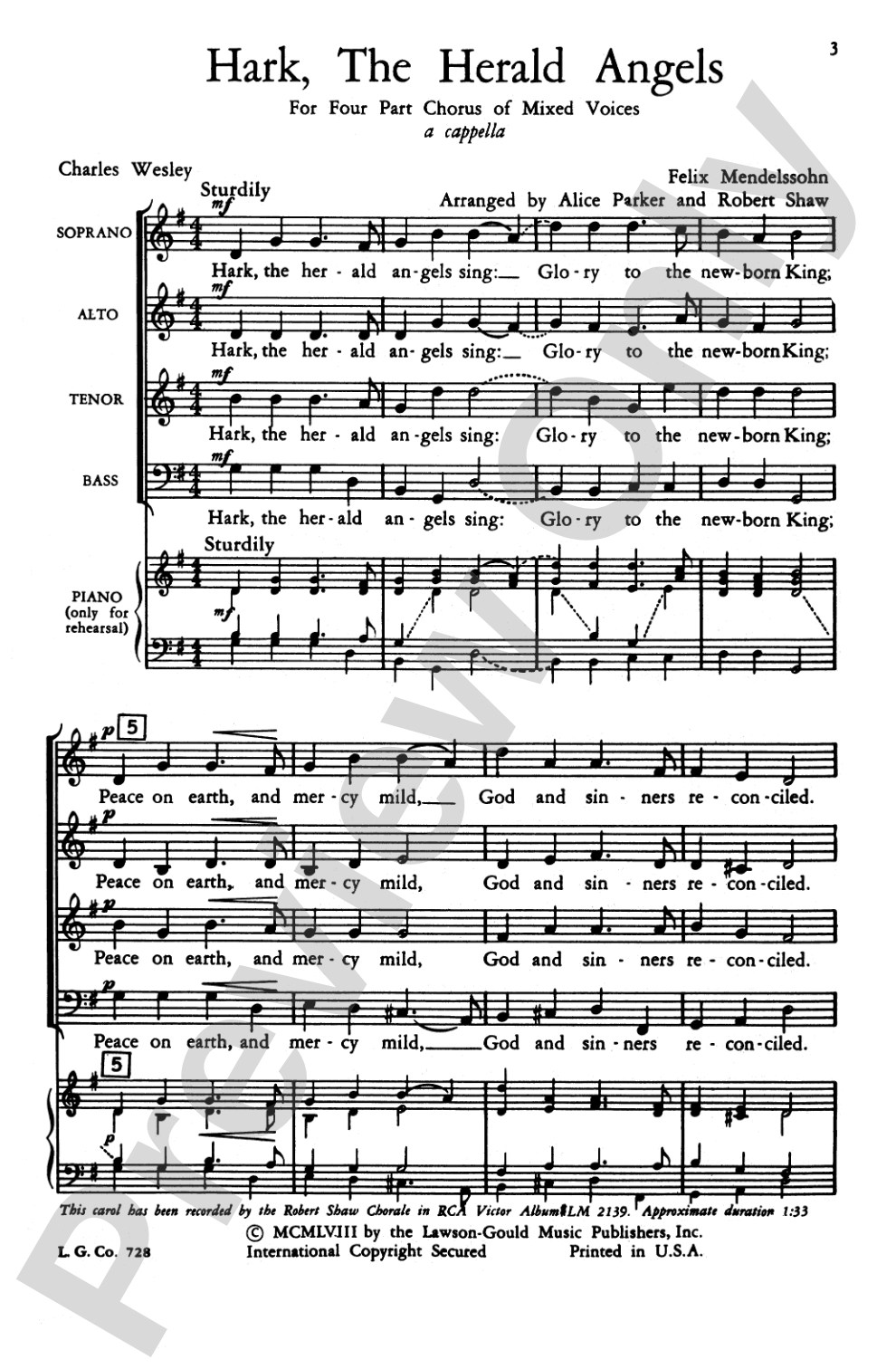
Hark, the Herald Angels Sing: SATB Choral Octavo

By Felix Mendelssohn / arr. Robert Shaw and Alice Parker

Item: 00-PO-0004941

Digital Download
$2.25

Minimum order quantity: 20 copies

Description

Hark, the Herald Angels Sing: SATB Choral Octavo isn't in MakeMusic Cloud just yet...but it could be. Let us know you'd like to see it, and you'll help shape what comes next. In the meantime, start a free trial and dive into thousands of interactive titles your students can play along with today.

Sample Audio
No sample audio found.
Sample Video
Additional Details
Series: Alfred Archive Edition: Robert Shaw Choral Series
Publisher: Alfred Music
Page Count: 8
SKU: 00-PO-0004941

More about this title

About the Composer: Felix Mendelssohn

Felix Mendelssohn (1809-1847) was a German composer of the Romantic era whose gift for melody and structural clarity made him one of the most performed composers in choral and orchestral music. Though best known for works like the Violin Concerto and A Midsummer Night's Dream overture, his choral writing shaped the nineteenth-century choral tradition profoundly. His motets and larger sacred works demonstrate a composer who understood the voice intimately and wrote for singers with respect and imagination.

Mendelssohn's engagement with existing melodies, particularly in sacred contexts, reveals a thoughtful arranger's sensibility. His approach to familiar material shows how a master composer can honor tradition while infusing it with harmonic sophistication and emotional depth. For choirs, his works remain essential not just as performance pieces but as studies in how to balance accessibility with artistic substance.

Why we love this

The Shaw-Parker arrangement transforms this beloved carol through sensitive part-writing that gives every voice authentic musical material rather than purely functional harmony. This octavo sits at that rare intersection where the piece is both singable by competent high school and community choirs and rewarding enough for more advanced ensembles to explore deeper interpretive nuance. Programming this standard carol alongside less familiar sacred repertoire signals to audiences that you're offering them a fresh encounter with a familiar text.

What to expect

The Shaw-Parker treatment brings warmth and structural clarity to this familiar melody. Each section unfolds with a sense of inevitability, the harmonies supporting rather than overshadowing the text. There is reverence here without sentimentality, and dignity without coldness.

Who it's for

This octavo serves both skilled choirs seeking an arrangement with genuine musical substance and intermediate ensembles wanting to program a significant carol with confidence. It works equally well in Christmas concerts, worship services, and holiday celebrations where something beyond a basic arrangement is desired.

How to get the most out of it

  • Shape the melodic line in the soprano part with gentle direction rather than mechanical phrasing; the carol's effectiveness depends on the tune feeling conversational and warm rather than hymnal.
  • Balance the lower voices carefully during harmonic shifts so inner parts aren't swallowed. The arrangement includes beautiful alto and tenor writing that deserves to be heard.
  • Use text to guide tempo relationships between sections. Allow the piece to breathe at phrase endings; resist the impulse to push through for the sake of momentum.
  • Attend to syllabic clarity on repeated text ("Hark" appears multiple times) so each iteration feels intentional rather than automatic.

How to use it

Include this in a Christmas concert's opening or closing section to establish an accessible, joyful foundation before moving into more contemporary or unfamiliar works. It also anchors a mixed-repertoire holiday program, bridging formal concert contexts and community sing-alongs. Consider pairing it with an instrumental prelude (organ or small instrumental group) to frame the performance.

Skills your students will build

  • Four-part voice independence in an arrangement that distributes musical interest across all parts
  • Sensitivity to how familiar texts can be freshly interpreted through thoughtful harmonic reharmonization
  • Diction and phrasing that honor both lyrical content and melodic integrity
  • Listening for balance in SATB texture where inner voices carry significant musical weight

You May Also Like