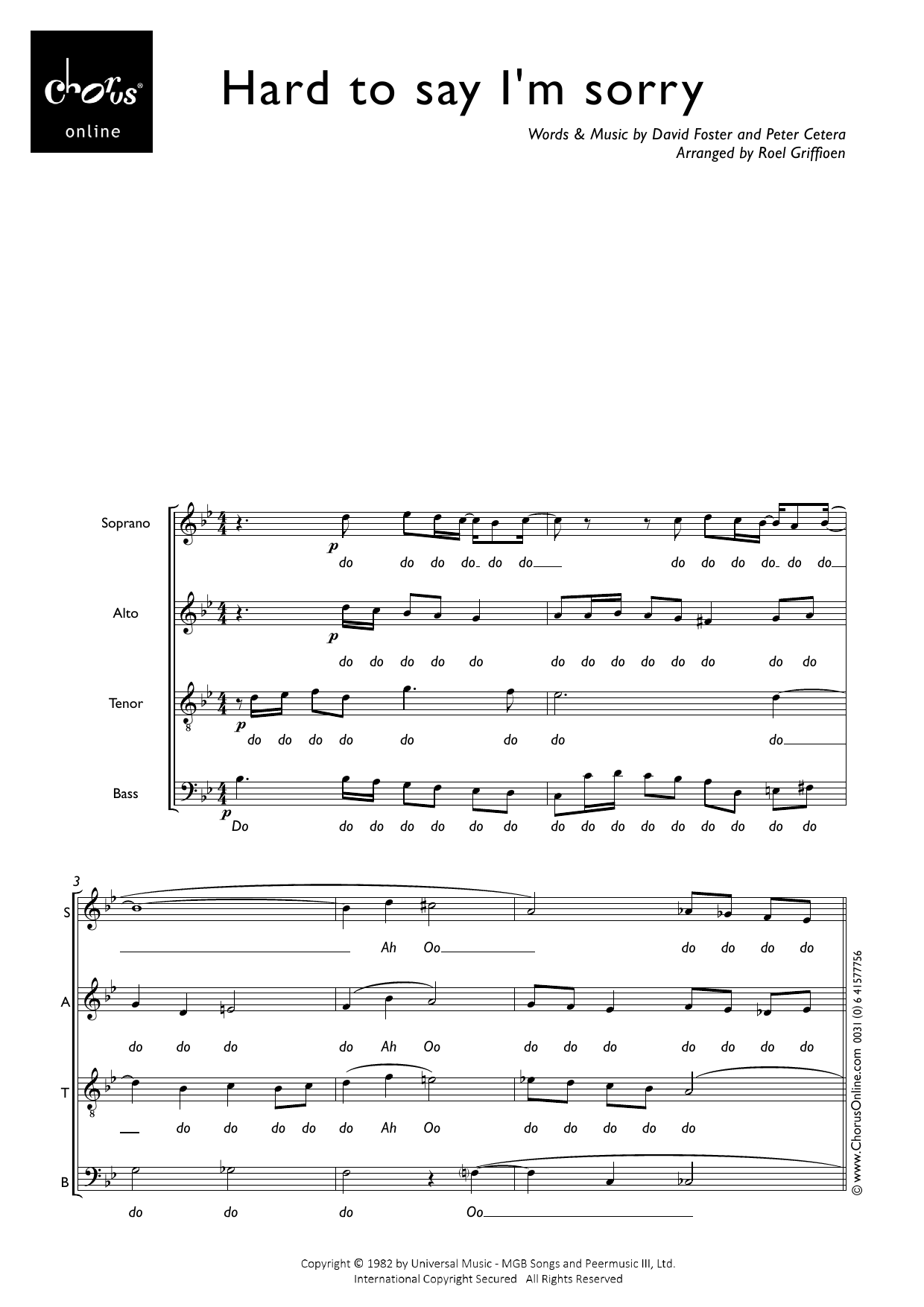
Hard to Say I'm Sorry (arr. Roel Griffioen) Sheet Music Preview

Hard to Say I'm Sorry (arr. Roel Griffioen): SATB Choral Octavo

As performed by Chicago / Arranged by Roel Griffioen

Item: 35-DS00487091

Digital Download
$2.99
Description

Hard to Say I'm Sorry (arr. Roel Griffioen): SATB Choral Octavo isn't in MakeMusic Cloud just yet...but it could be. Let us know you'd like to see it, and you'll help shape what comes next. In the meantime, start a free trial and dive into thousands of interactive titles your students can play along with today.

Sample Audio
No sample audio found.
Sample Video
Additional Details
Publisher: Hal Leonard
Page Count: 9
SKU: 35-DS00487091

More about this title

About the Artist: Chicago

Chicago emerged in the late 1960s as one of America's most successful rock bands, blending horn section sophistication with pop sensibility. Their catalog spans decades of chart hits, and their music has become a staple of popular music education for its accessible melodies, strong harmonic structures, and emotional directness.

Why we love this

This Griffioen arrangement captures the tenderness of the original while giving your SATB ensemble a song they actually want to sing. The pop-rock idiom keeps singers engaged, and the a cappella format means you can perform it anywhere without accompaniment logistics.

What to expect

Honest and vulnerable. The song inhabits that space between pop accessibility and genuine emotion, with a melody that stays with you long after rehearsal ends. Singing it in unison feels like a conversation; singing it in harmony feels like a collective confession.

Who it's for

High school and college choirs looking for accessible pop repertoire that doesn't condescend musically. Directors seeking a contemporary piece that builds blend and balance while maintaining student investment.

How to get the most out of it

  • Nail the opening unison or near-unison passage to establish the intimate, conversational tone before voices separate into harmony.
  • Balance the alto and tenor lines carefully in the homophonic sections; they often carry melodic interest equal to the soprano.
  • Treat dynamic shaping as essential, not optional. The emotional arc depends on careful swells and releases, especially approaching phrase endings.
  • Work the lyrics with intention. This song lives in sincerity, not performance theatricality.

How to use it

Pair it with other soft rock or pop ballads from the 1980s to anchor a thematic concert, or use it as an emotional centerpiece in a program that otherwise leans classical. It also works as a standalone spring or winter concert selection for groups building contemporary repertoire.

Skills your students will build

  • Blending vowels across voice parts in lyrical, sustained passages
  • Maintaining pitch accuracy in a cappella environments without instrumental reference
  • Interpreting dynamic nuance to shape emotional phrasing
  • Balancing independence and unity when lines move in different rhythmic patterns

You May Also Like