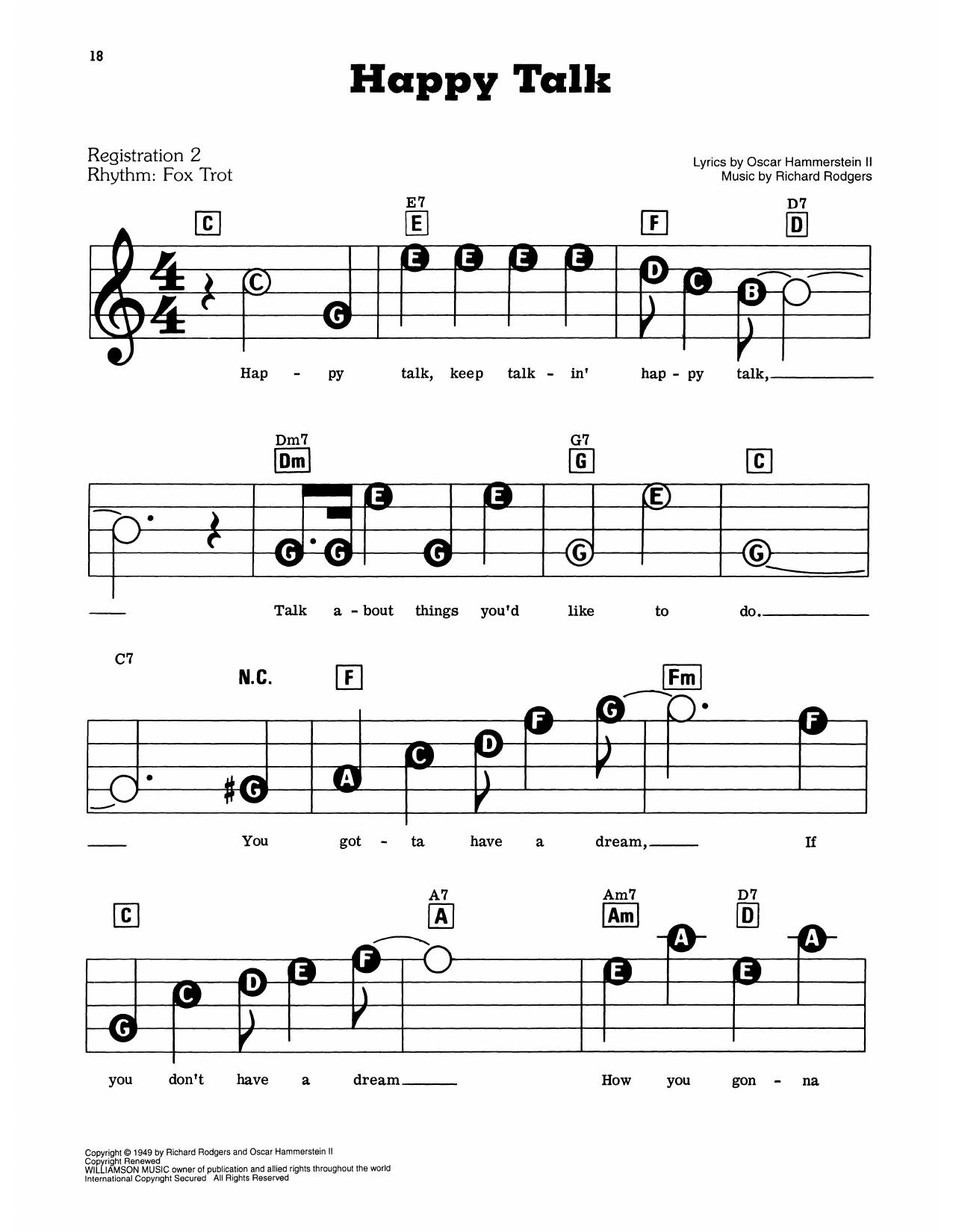
Happy Talk (from South Pacific): E-Z Play Today

By Richard Rodgers / By Oscar Hammerstein II / As performed by Rodgers & Hammerstein

Item: 35-DS01721100

Digital Download
$4.99
Description

Happy Talk (from South Pacific): E-Z Play Today isn't in MakeMusic Cloud just yet...but it could be. Let us know you'd like to see it, and you'll help shape what comes next. In the meantime, start a free trial and dive into thousands of interactive titles your students can play along with today.

Sample Audio
No sample audio found.
Sample Video
Additional Details
Publisher: Hal Leonard
Page Count: 2
SKU: 35-DS01721100

More about this title

About the Composer: Richard Rodgers

Richard Rodgers shaped American musical theater across five decades, creating melodies that balanced sophistication with immediate appeal. His partnership with Oscar Hammerstein II produced some of the 20th century's most enduring scores, including South Pacific, The Sound of Music, and The King and I. Rodgers had an instinctive gift for writing memorable vocal lines that sit naturally in the voice while maintaining harmonic interest and structural elegance.

For pianists and students, Rodgers' work offers a masterclass in melody writing and accompaniment design. His piano arrangements preserve the theatrical warmth of the original while remaining accessible to intermediate players, making his songs ideal for building musicality and understanding how great melodies support storytelling.

Why we love this

This arrangement captures the optimistic energy of the original without demanding virtuosic technique. The two-page length makes it manageable for students building their Broadway repertoire, while the harmonic vocabulary and melodic contour reward careful phrasing and offer plenty of room for individual interpretation.

What to expect

Pure, unburdened optimism. The melody floats above gentle harmonies in a way that feels both intimate and timeless, inviting the player to explore what makes a simple tune unforgettable. There's a lightness here that belies the craft underneath.

Who it's for

This arrangement works well for intermediate pianists exploring the Broadway canon, as well as for students accompanying singers in audition or recital. It also suits music theory classes studying golden-age song form and voice-leading in tonal music.

How to get the most out of it

  • Support the lyrical melody by keeping accompaniment patterns light and conversational; let the right hand lead the musical conversation rather than dominating it.
  • Shape phrases around the text even when playing instrumentally. Notice where the original lyrics breathe, and use those moments to reset rhythmic energy.
  • Lean into the lifted, cheerful character by maintaining rhythmic buoyancy in the supporting figures; avoid making the accompaniment sound heavy or overly dramatic.
  • Balance pedal judiciously to maintain harmonic clarity while creating warmth in the sustained chords typical of this style.

How to use it

Include this in a Broadway cabaret evening or a standards-focused concert program where it pairs naturally with other Rodgers songs. It also works as a charming interlude in a piano recital, offering audiences a moment of genuine warmth between more demanding classical works.

Skills your students will build

  • Phrasing vocal melody lines idiomatically within a keyboard texture
  • Managing light, rhythmic accompaniment patterns that support rather than overshadow the melody
  • Interpreting and realizing chord symbols in a jazz-influenced harmonic context
  • Understanding song form and structural repetition in American musical theater
  • Balancing melody and accompaniment at the piano

You May Also Like