Happy In Shadows Sheet Music Preview

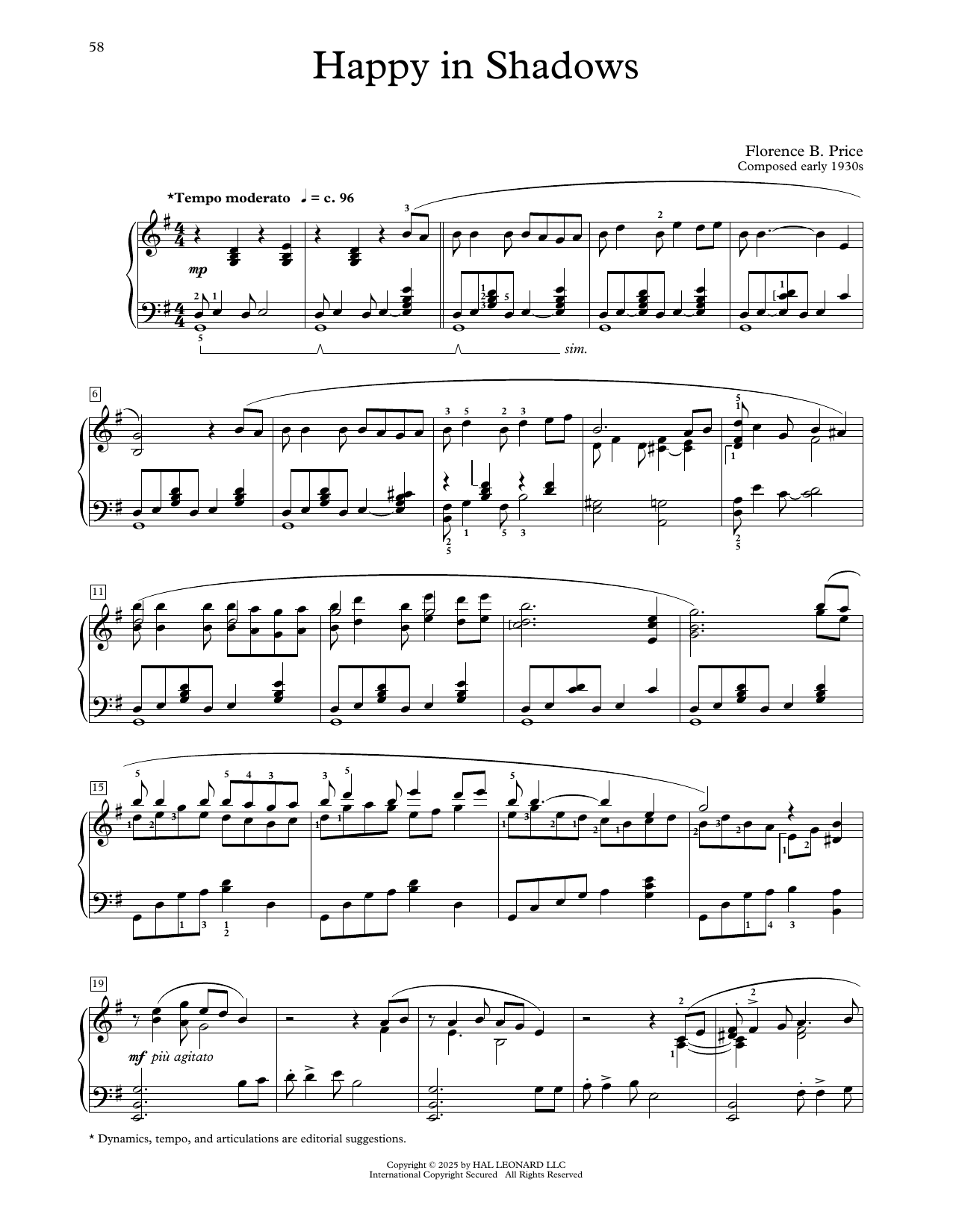
Happy In Shadows: Educational Piano

By Florence Price / Edited by Michael Clark

Item: 35-DS01576383

Digital Download
$4.99
Description

Discover MakeMusic Cloud: thousands of interactive titles your students can play along with today.

Sample Audio
No sample audio found.
Sample Video
Additional Details
Publisher: Hal Leonard
Page Count: 2
SKU: 35-DS01576383

More about this title

About the Composer: Florence Price

Florence Price (1887-1953) was the first Black woman to have a symphony performed by a major American orchestra. A prolific composer working across orchestral, chamber, and solo keyboard works, Price drew from African American spirituals, folk traditions, and European classical forms to create a distinctive voice that challenged racial barriers in concert music. Her piano works demonstrate her gift for lyrical melody and sophisticated harmonic language, making them invaluable resources for students exploring the breadth of American classical music.

Price's educational piano pieces remain underrepresented in curricula despite their musical merit and accessibility. Including her work in student repertoire acknowledges both historical omission and the quality of her compositional craft. Teachers who program her music open students' ears to an essential figure in American concert music.

Why we love this

This is a chance to center a significant American composer whose work belongs in the standard student repertoire. Price's melodic writing sings naturally under the fingers, and the piece's modest technical demands mean students can focus on expressive detail rather than struggling through difficulty. Adding her work to your curriculum demonstrates that canonical piano literature extends far beyond the European canon.

What to expect

Quiet contemplation infused with dignity. The piece inhabits a reflective space without sentimentality, finding lightness and grace even in its somber moments. The writing suggests introspection unfolding with natural phrasing and understated eloquence.

Who it's for

Intermediate piano students ready for pieces with genuine artistic substance. This works well for students in grades 5-8 or early high school who are developing interpretive skills and can handle two-page scores with moderate technical demands.

How to get the most out of it

  • Shape the melodic line with subtle dynamic breathing; Price's phrases reward singers' attention to phrasing, not just pianists' finger technique.
  • Balance texture carefully so the accompaniment supports without overshadowing the melody. Lighter touch in the left hand allows the right-hand line to float.
  • Let the harmonic movement breathe. Price's chords often shift gradually, so avoid rushing transitions between sonorities.

How to use it

Feature this as part of a recital or concert exploring American women composers, or use it as a bridge piece between classical standards and lesser-known twentieth-century repertoire. Its two-page length makes it ideal for filling a slot on a student showcase without demanding excessive practice time.

Skills your students will build

  • Playing with legato pedaling in romantic harmonic contexts
  • Balancing melody against accompaniment texture
  • Shaping phrases through dynamic nuance rather than tempo change
  • Reading and interpreting early twentieth-century American piano notation

You May Also Like