
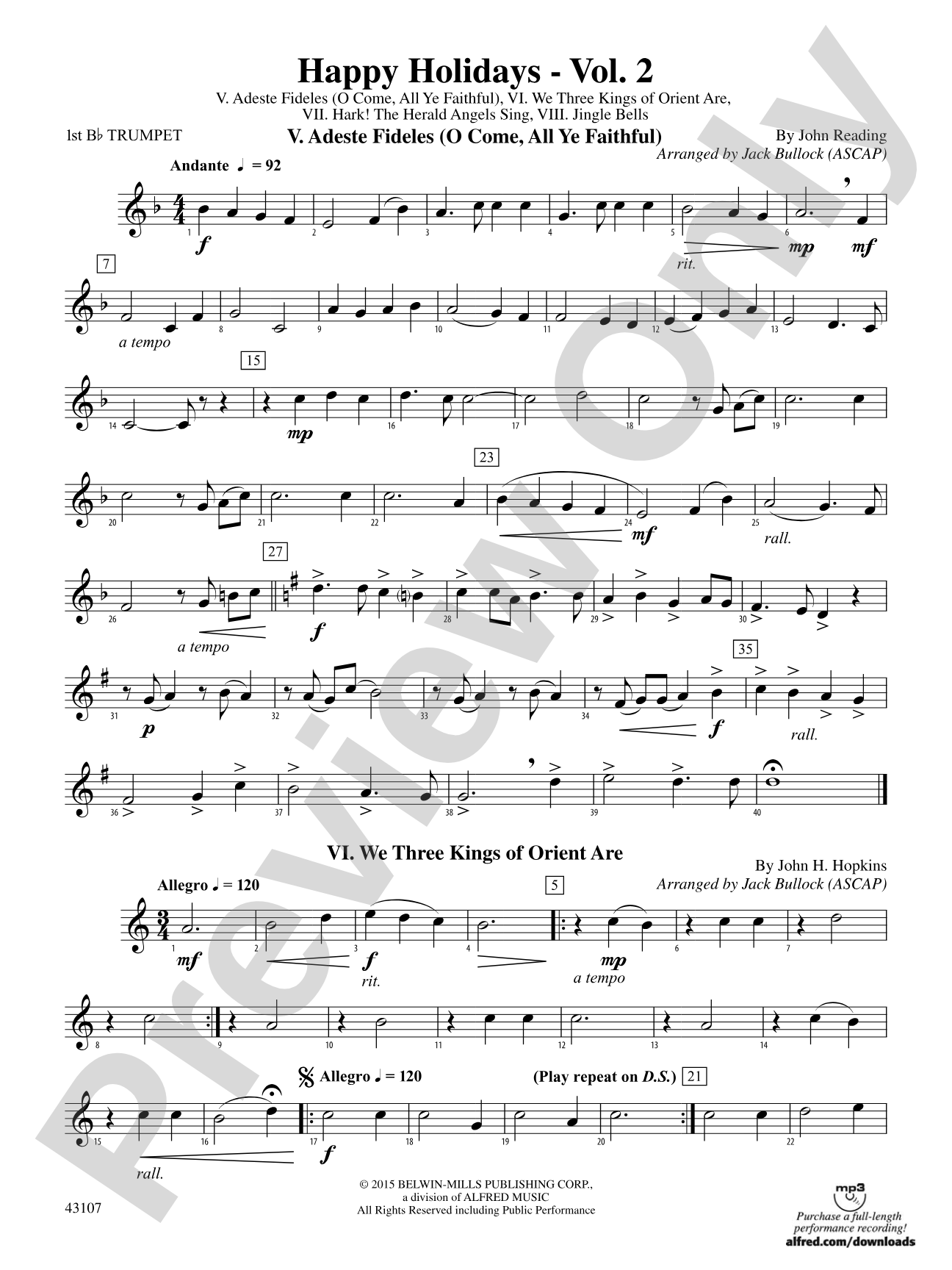

Happy Holidays---Vol. 2: 1st B-flat Trumpet
V. Adeste Fideles, VI. We Three Kings of Orient Are, VII. Hark! The Herald Angels Sing, VIII. Jingle Bells
Various / arr. Jack Bullock
Grade: 2.5 (Easy to Medium Easy)
Item: 00-PC-0016758_T1
$3.00
Pickup currently not available
Description
By popular demand due to their extensive flexibility, Happy Holidays---Vol. Two is now available in this ingenious setting that can be used year after year. Suitable for both middle school and high school performances, and presented in a multipurpose format, you can choose to have a quintet (brass, woodwind, or both) perform in the lobby of the concert hall prior to the band concert or at a reception after the concert. Or choose to have the entire band perform it during the concert! Tremendous versatility permits preparation in small groups saving rehearsal time. This new version includes: "Adeste Fideles," "We Three Kings of Orient Are," "Hark! The Herald Angels Sing," and "Jingle Bells." (6:45) Also available, Happy Holidays---Vol. 1 (00-42178).


Don't just read it, hear it, play along with it, and watch your students grow with it. In MakeMusic Cloud, Happy Holidays---Vol. 2: 1st B-flat Trumpet comes alive with professional accompaniment, adjustable tempo, and built-in practice tools that turn solo practice into real progress.
Open in the Player
Jump straight in and assign it today.
Start Your Free Trial
Open this title and explore the full library in minutes.
Sample Audio
1
Audio File
--:--
0:00
0:00
Sample Video
No sample videos found.
Additional Details
Series:
Belwin Young Band
Publisher:
Alfred Music
Page Count:
240
SKU:
00-PC-0016758_T1
More about this title
About the Arranger: Jack Bullock

Jack Bullock has established himself across multiple roles in music: as a trumpet performer with the Miami Philharmonic Orchestra and Miami Opera Company, as an educator who spent two decades teaching instrumental music in school settings and seven years as assistant band director at Ithaca College's School of Music, and as a prolific composer and arranger with over 600 publications to his name. His work spans concert band, orchestra, jazz ensemble, and marching band literature, and he served as chair of Ithaca College's Music Education Department while also co-authoring the Belwin 21st Century Band Method and contributing arrangements to Alfred Music's Music Expressions curriculum.
Bullock's education includes undergraduate, graduate, and doctoral degrees in Music Education, with trumpet study under Harry Glantz, James Ode, and Craig McHenry. He has been an ASCAP member since 1980 and has conducted clinics and workshops throughout the United States, Canada, and England. His recognition includes listings in Marquis Who's Who in the Media and Communications and Who's Who in Entertainment.
Why we love this
Bullock designed this collection specifically for the real constraints of school music programs: you can field a small ensemble for pre-concert or post-concert performances, saving full-band rehearsal time while still delivering polished holiday music. The flexibility to scale from a quintet to full band without compromising the arrangement makes this a season-spanning resource that pays dividends year after year with minimal new prep work.
What to expect
These four familiar carols receive straightforward, accessible treatment that respects their melodic character while anchoring them in clear harmonic progressions. The Grade 2.5 difficulty level keeps the writing supportive and readable; the 6 minutes 45 seconds of music unfolds with the warmth and directness you'd expect from holiday standards.
Who it's for
Middle school and high school concert bands seeking flexible holiday programming that accommodates multiple performance venues and ensemble sizes. Directors managing tight rehearsal schedules will appreciate the option to develop small group repertoire separately from full-band material without sacrificing musical substance.
How to get the most out of it
- Balance the small ensemble parts carefully when performing as a quintet; the thinned orchestration exposes any intonation inconsistencies more readily than the full band setting.
- Use the full score to identify where parts double across the small group configurations, which helps singers understand voice leading even when only a subset of the band performs.
- Consider rotating which instruments carry the melody in repeated sections; students benefit from the pedagogical clarity of hearing different timbral combinations of the same harmonic material.
How to use it
Perform the quintet version in your lobby or reception space while the full band preps backstage, then close the concert with the complete arrangement featuring your entire ensemble. Alternatively, the small group format works well as a standalone prelude during your winter concert preamble, building goodwill before launching into longer symphonic works.
Skills your students will build
- Reading a conductor score while managing individual parts
- Balancing melody and harmony in small ensemble contexts
- Maintaining intonation and blend across different instrumental combinations
- Adapting to multiple performance formats of the same arrangement