
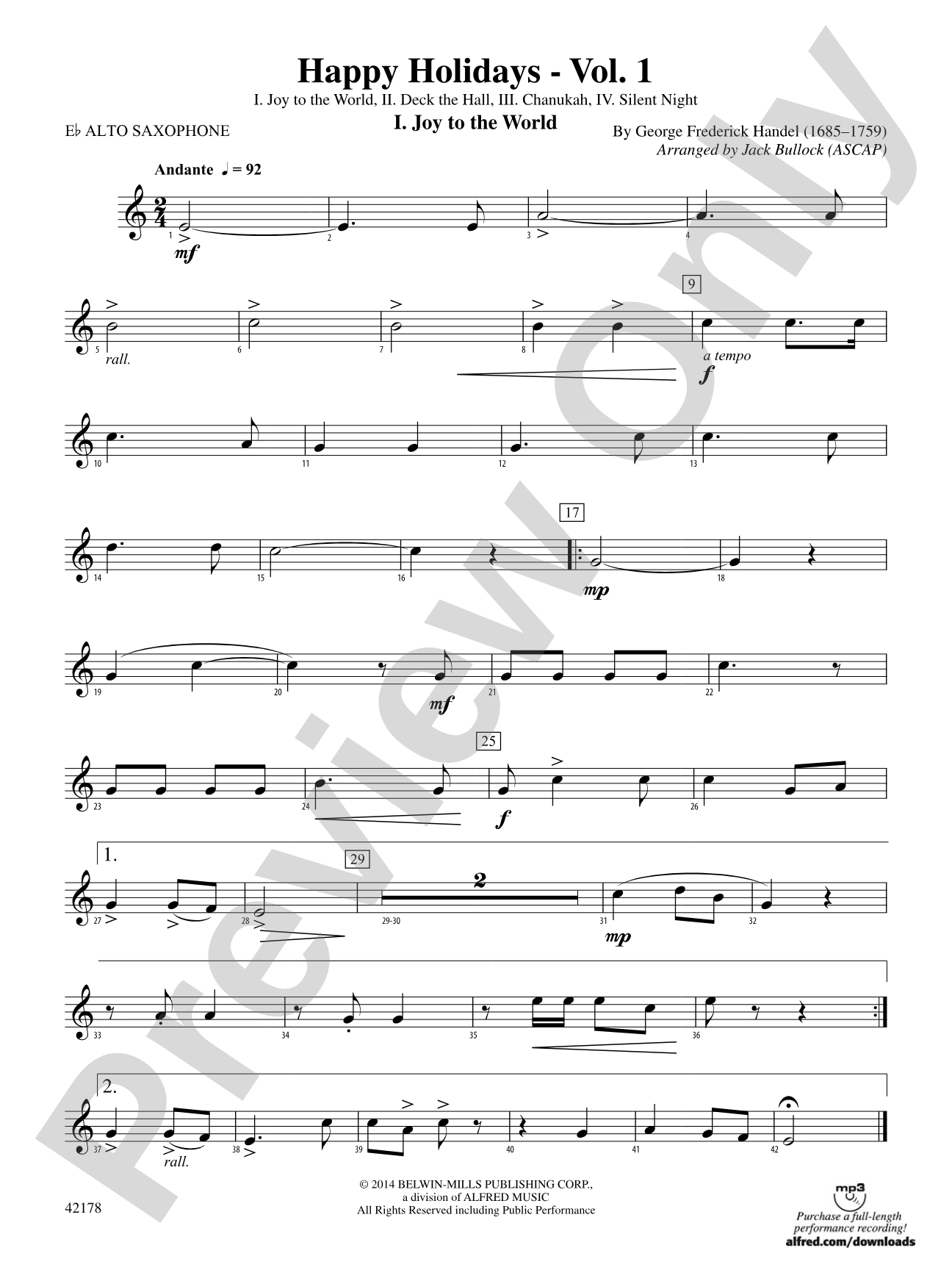

Happy Holidays---Vol. 1: E-flat Alto Saxophone
I. Joy to the World, II. Deck the Hall, III. Chanukah, IV. Silent Night
Arr. Jack Bullock
Grade: 2.5 (Easy to Medium Easy)
Item: 00-PC-0016550_AX1
$3.00
Pickup currently not available
Description
Bring variety to your holiday concerts with this setting that can be used year-after-year with different smaller ensembles. Suitable for both middle school and high school performances and presented in a multipurpose format you can choose to perform with brass or woodwind choirs. (5:30)


Don't just read it, hear it, play along with it, and watch your students grow with it. In MakeMusic Cloud, Happy Holidays---Vol. 1: E-flat Alto Saxophone comes alive with professional accompaniment, adjustable tempo, and built-in practice tools that turn solo practice into real progress.
Open in the Player
Jump straight in and assign it today.
Start Your Free Trial
Open this title and explore the full library in minutes.
Sample Audio
1
Audio File
--:--
0:00
0:00
Sample Video
No sample videos found.
Additional Details
Series:
Belwin Young Band
Publisher:
Alfred Music
Page Count:
240
SKU:
00-PC-0016550_AX1
More about this title
About the Arranger: Jack Bullock

Jack Bullock brings deep expertise across performance, composition, and education. A trumpeter trained under Harry Glantz, James Ode, and Craig McHenry, he performed with the Miami Philharmonic Orchestra and Miami Opera Company before establishing himself as a prolific arranger and composer. His catalog exceeds 600 publications spanning concert band, orchestra, jazz ensemble, and marching band.
Bullock spent 20 years teaching instrumental music in public schools and served as assistant band director at Ithaca College's School of Music, where he also chaired the Music Education Department. He co-authored the Belwin 21st Century Band Method and contributed arrangements to Music Expressions, Alfred Music's comprehensive school music curriculum. His work has earned recognition through ASCAP membership since 1980 and multiple listings in Who's Who publications.
Why we love this
Bullock designed this collection specifically for the realities of holiday scheduling. The multipurpose format lets you field brass choirs one year and woodwind choirs the next, stretching your investment across seasons and configurations without relearning the same material. At Grade 2.5, the writing is accessible enough for middle school yet musically substantial enough to satisfy high school audiences.
What to expect
The arrangements honor the emotional familiarity of holiday standards while offering fresh textures through strategic voicing. Bullock's Grade 2.5 orchestration leaves room for genuine musicality without taxing younger players, creating performances that feel polished and intentional rather than rushed or thin.
Who it's for
Middle school and high school band directors seeking flexible, repeatable holiday programming that works with different ensemble sizes. If you field both brass and woodwind choirs or want to rotate which students get featured each December, this collection solves the problem of building a repertoire that serves multiple configurations.
How to get the most out of it
- Balance the melodic line clearly when rotating between brass and woodwind voicings; these changes demand intentional blend work so transitions feel seamless rather than exposed.
- Establish a steady tempo early in rehearsal and maintain it throughout; the 5:30 runtime rewards consistent pulse, especially if you're pairing multiple selections from the collection in one program.
- Shape phrase endings with slight rubato and dynamic release to bring warmth to familiar holiday melodies.
- Mark your score to show which parts sit out for each configuration (brass choir versus woodwind choir) so transitions are silent and professional.
How to use it
Use individual selections as concert openers or closers to frame your winter program around established holiday material, or string multiple pieces together as a thematic suite if your concert structure allows. The variety of sacred and secular titles lets you build a program that reflects your school's values and audience expectations. Because the arrangement works year after year with different smaller ensembles, you can rotate it into your annual concert cycle every few years without the burden of learning entirely new scores.
Skills your students will build
- Balancing melodic content across changing instrumental combinations
- Maintaining consistent pulse within a longer multimovement setting
- Reading parts within restricted instrumental configurations (brass or woodwind only)
- Shaping familiar melodies with appropriate phrasing and dynamic control
- Transitioning smoothly between sections when personnel changes occur