Happy Birthday to You: Bassoon Sheet Music Preview

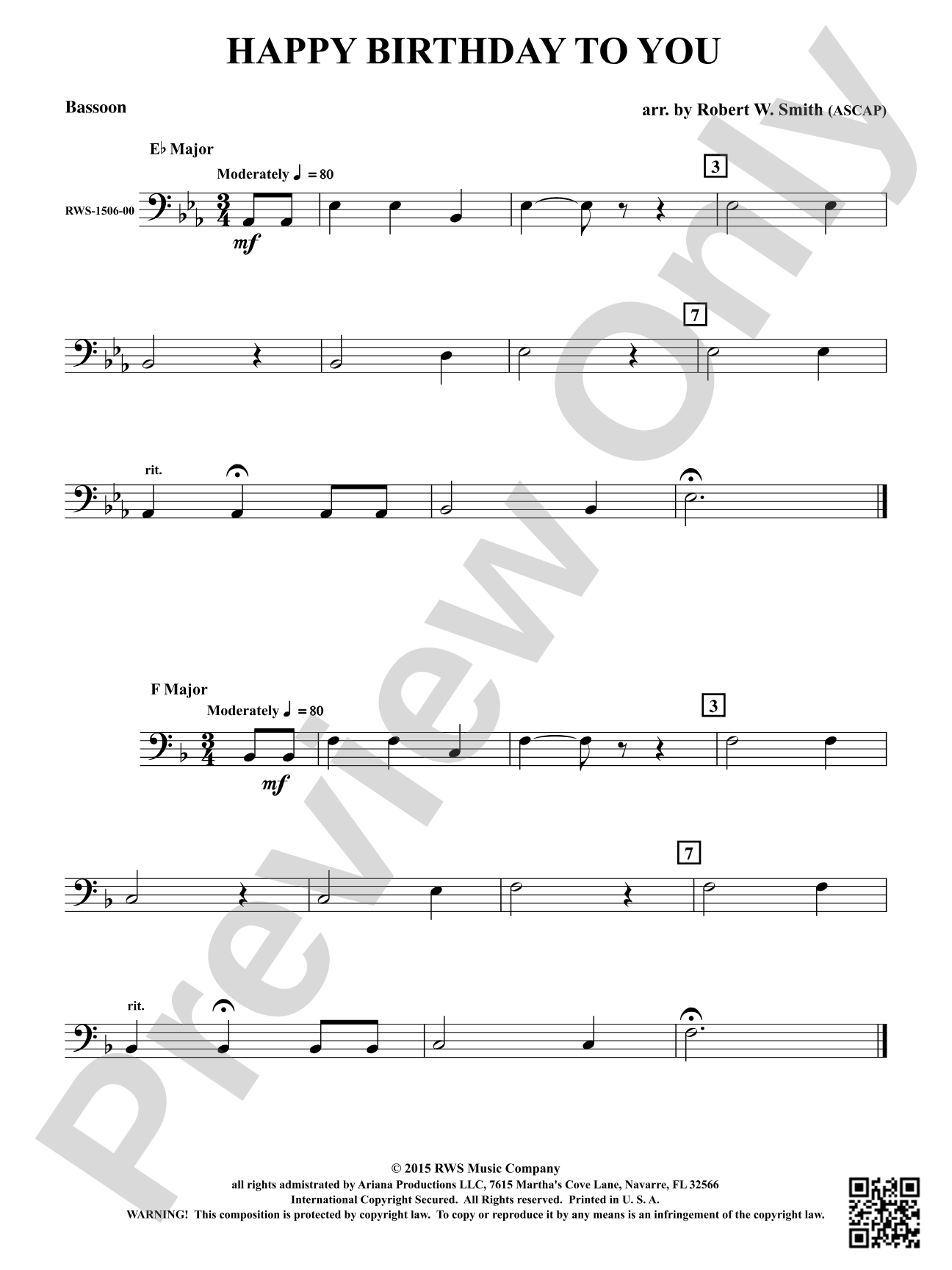
Happy Birthday to You: Bassoon

Arranged by Robert W. Smith

Grade: 2

Item: 98-PC-RWS1506_B1

Digital Download
$3.99
Description
Composed by Patty and Mildred Hill in 1893, "Happy Birthday To You" is considered the most recognized song in the English language. This developing band arrangement is written as a sing-along for use at any occasion. It includes two separate arrangements (Eb Major and F Major) providing multiple performance options.

Original Item#: RWS-1506-00

Happy Birthday to You: Bassoon isn't in MakeMusic Cloud just yet...but it could be. Let us know you'd like to see it, and you'll help shape what comes next. In the meantime, start a free trial and dive into thousands of interactive titles your students can play along with today.

Sample Audio
0:00
0:00
Sample Video
Additional Details
Series: RWS - Developing Band
Publisher: RWS Music Company
SKU: 98-PC-RWS1506_B1

More about this title

About the Arranger: Robert W. Smith

Robert W. Smith

Robert W. Smith has established himself as a defining voice in concert band and orchestral composition, with more than 400 works published through Alfred Music and other major publishers. His training at Troy State University and the University of Miami provided the foundation for a career spanning four decades, during which his original compositions and arrangements have been performed across North America, Europe, Australia, and Asia.

Beyond the concert hall, Smith's music has reached audiences through television broadcasts, ceremonial events, and major sporting venues. His works for developing ensembles, including The Tempest and numerous Grade 2 and 3 pieces, have become cornerstones of school band repertoire. As a guest conductor and clinician, he continues to shape the sound and standards of programs nationwide.

Why we love this

Smith's arrangement transforms the world's most universally recognized melody into a practical, joyful vehicle for young bands. The inclusion of two keys (Eb Major and F Major) gives directors flexibility to suit their ensemble's current range and abilities, while the sing-along texture invites audiences into the performance rather than positioning the band as distant performers. At Grade 2, this is both accessible and genuinely musical.

What to expect

Celebratory and welcoming. The arrangement honors the tune's infectious simplicity while adding gentle harmonic color beneath it. There's an ease to the writing that lets young musicians play with confidence, and the sing-along quality creates an immediate bridge between band and audience.

Who it's for

Band directors looking for an arrangement that works at any school event, pep assembly, or concert where audience participation adds warmth and connection. Grade 2 programs will find this accessible without feeling simplistic, and mixed-ability ensembles benefit from the straightforward harmonic language.

How to get the most out of it

  • Balance the melody generously in the first trumpet or clarinet line so the familiar tune shines clearly; young audiences connect instantly when they can hear what they're singing.
  • Use the key choice strategically: select F Major if your lower brass section is still building confidence, or Eb Major if your upper woodwinds benefit from playing in a comfortable register.
  • Shape the phrasing with gentle dynamic contours rather than playing the entire arrangement at one dynamic level; this gives the piece character and keeps the audience engaged across multiple hearings.

How to use it

Open a pops concert or spring celebration with this piece to establish a warm, joyful tone immediately. Use it at school assemblies or community events where the goal is connection over technical display. The brevity and accessibility also make it ideal for students' first public performances of the season.

Skills your students will build

  • Balancing melody and harmony within a section
  • Maintaining steady pulse while supporting a singable top line
  • Reading and performing in both Eb Major and F Major
  • Responding to audience context and adjusting performance energy accordingly

You May Also Like