Happy Birthday, Ludwig: Flute Sheet Music Preview

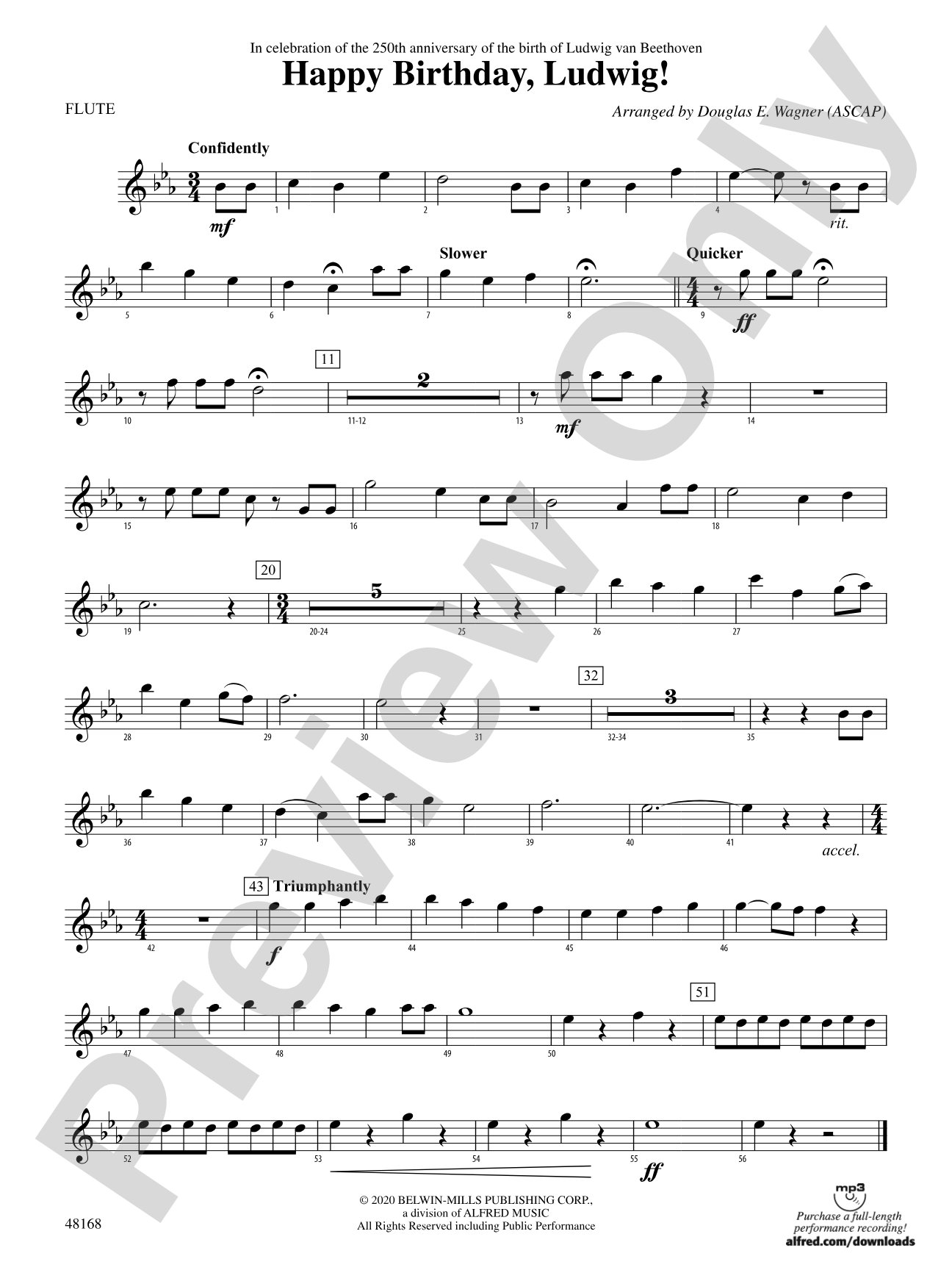
Happy Birthday, Ludwig: Flute

In Celebration of the 250th Anniversary of the Birth of Ludwig van Beethoven

By Ludwig van Beethoven / arr. Douglas E. Wagner

Grade: 1 (Easy)

Item: 00-PC-0018581_F1

Digital Download
$3.00
Description
A celebration of the 250th anniversary of the birth of iconic composer Ludwig van Beethoven. This cleverly inspired arrangement stylistically intertwines strains from three of his most popular works with the traditional "Happy Birthday to You." Intuitive fermatas and familiar meter changes provide teaching opportunities, and the initial statement of "Happy Birthday" is ideal to keep in the folders should a planned or impromptu rendition be needed. A quarter millennium of popularity! (2:15) This title is available in MakeMusic Cloud.

Don't just read it, hear it, play along with it, and watch your students grow with it. In MakeMusic Cloud, Happy Birthday, Ludwig: Flute comes alive with professional accompaniment, adjustable tempo, and built-in practice tools that turn solo practice into real progress.

Sample Audio
0:00
0:00
Sample Video
Additional Details
Series: Belwin Beginning Band
Publisher: Alfred Music
Page Count: 132
SKU: 00-PC-0018581_F1

More about this title

About the Composer: Douglas E Wagner

Douglas E Wagner

Douglas E. Wagner grew up in Chicago and earned both undergraduate and graduate degrees in music from Butler University. He spent three decades as a high school music director and administrator before dedicating himself fully to composing and arranging.

Since 1973, Wagner has published more than 3,500 compositions across virtually every ensemble type: concert band, orchestra, choir, handbell ensemble, organ, piano, and voice. His works have reached audiences through concert performances, radio broadcasts, and television programs in the United States and internationally, with over seventeen million copies in circulation. He lives in Indianapolis with his wife, Sandy.

Why we love this

Wagner transforms a familiar birthday song into a genuine teaching moment by weaving in Beethoven's actual thematic material, giving your band a reason to listen closely to how melodies fit together. The Grade 1 accessibility means even your developing ensembles can execute fermatas and meter shifts without stumbling, leaving cognitive space for understanding the structural choices at play.

What to expect

Celebratory and clever, this arrangement wraps beloved Beethoven melodies around a tune every audience member knows, creating moments of recognition and delight. The interplay between familiar strains keeps energy forward while fermatas and meter shifts signal a band that understands nuance.

Who it's for

Beginning and intermediate concert bands ready to tackle light pedagogical content without sacrificing musicality. Directors seeking a crowd-pleasing opener or closer that doubles as a lesson in thematic integration and structural variety.

How to get the most out of it

  • Balance the thematic quotations by letting each Beethoven reference emerge clearly before the ensemble moves to the next section; resist the urge to rush through transitions.
  • Mark fermata releases in rehearsal with a visible preparatory gesture so the band releases together rather than trailing off.
  • Keep the arrangement's character joyful but not frantic; steady pulse through familiar meter changes helps the audience follow Beethoven's fingerprints in the texture.

How to use it

Place this at the top of a concert to establish an inviting tone, or use it as an encore that acknowledges Beethoven's enduring presence in musical life. The two-minute-fifteen-second duration makes it ideal padding between substantial works, and having the initial 'Happy Birthday' statement available separately means you're always ready should a birthday surprise arise.

Skills your students will build

  • Recognizing and playing multiple melodic themes within one composition
  • Executing fermatas with rhythmic precision and unified releases
  • Reading mixed meters (including transitions between different time signatures)
  • Balancing thematic material across the ensemble so quotations emerge without obscuring the main line

You May Also Like