
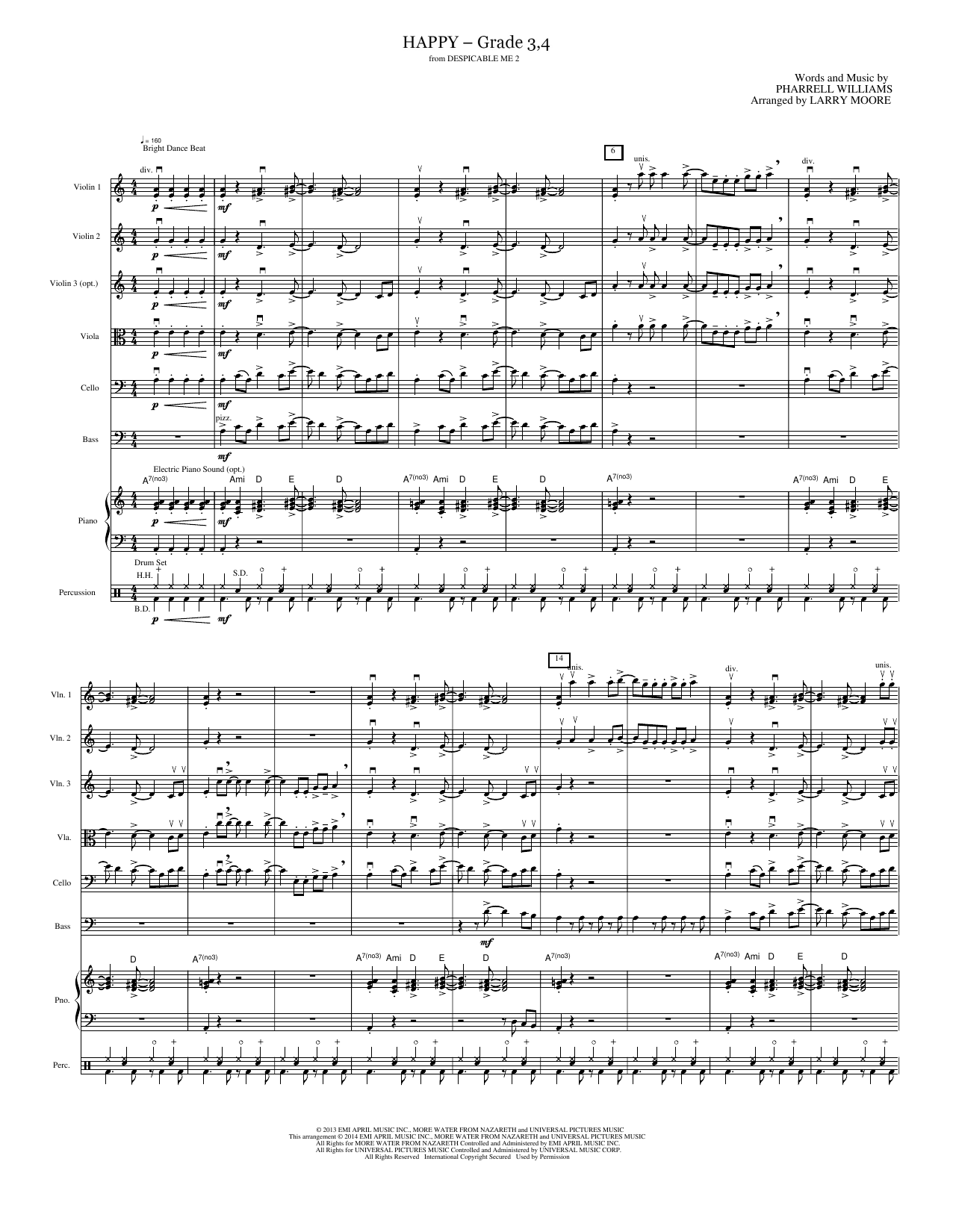

Happy: String Orchestra Conductor Score & Parts
By Pharrell Williams / As performed by Pharrell / Arranged by Larry Moore
Grade: 3-4
Item: 35-PK00426800
$50.00
Pickup currently not available
Parts Added to Cart!
Description
Happy


Happy: String Orchestra Conductor Score & Parts isn't in MakeMusic Cloud just yet...but it could be. Let us know you'd like to see it, and you'll help shape what comes next. In the meantime, start a free trial and dive into thousands of interactive titles your students can play along with today.
Request This Title
Tell us you want it.
Start Your Free Trial
Explore everything that's ready to play right now.
Sample Audio
No sample audio found.
Sample Video
No sample videos found.
Additional Details
Publisher:
Hal Leonard
SKU:
35-PK00426800
More about this title
About the Composer: Pharrell Williams
Pharrell Williams stands as one of contemporary music's most versatile creators, with a career spanning production, songwriting, and performance across hip-hop, pop, and R&B. His work with The Neptunes and N.E.R.D. established him as an innovative force in popular music, while his solo output demonstrates an ability to craft infectious melodies that resonate across demographics. In the classroom, his compositions offer students accessible entry points into contemporary songwriting and arrangement, bridging the gap between concert music and the music students hear in their daily lives.
Williams' prolific output as a songwriter and producer has made him one of the most commercially successful musicians of the 21st century. His gift for crafting songs with genuine emotional warmth beneath their surface appeal makes his work valuable for music educators seeking to engage students with material that feels current and relevant without sacrificing musical substance.
Why we love this
Larry Moore's string arrangement captures the essential optimism of the original while giving students real countermelodic and harmonic material to sink their teeth into. At grades 3 to 4, it sits in that sweet spot where the writing is accessible enough for developing players but contains enough textural interest to keep rehearsals from feeling rote. Directors consistently find that programming contemporary pop hits alongside traditional repertoire energizes ensemble culture without compromising musicianship standards.
What to expect
Bright and propulsive, with the forward momentum of the original intact. The orchestration carries warmth and accessibility, inviting audiences in immediately while the string writing allows musicians to experience how color and texture build energy in ensemble music. There's an infectious quality here that makes rehearsals feel purposeful rather than obligatory.
Who it's for
String orchestras in grades 3 to 4 seeking repertoire that connects with student culture while maintaining legitimate musical challenges. Directors building programs that include contemporary material alongside the standard classical canon will find this arrangement useful for concert variety and student engagement.
How to get the most out of it
- Establish the groove early in sectional rehearsals by having students tap the rhythmic pulse on their instruments before adding pitch, especially in passages where the strings lock into syncopated figures.
- Balance the melodic line carefully between first and second violins; the arrangement likely distributes the main theme across sections, so clarity comes from matching tone quality rather than volume.
- Reference a recording of the original song during the first read-through, but move away from it quickly. Students will naturally want to replicate the production sound, and your job is to help them find what the string orchestra version can do that the recording cannot.
- Pay attention to tuning in the lower register during cello and bass passages. The arrangement's pop sensibility sometimes calls for fuller sonorities that expose intonation issues if not addressed directly.
How to use it
Consider placing this on a concert that mixes classical and contemporary works, where it can serve as a tonal bridge between heavier pieces. The arrangement works particularly well on family concerts or young people's concerts where you want to affirm the musical tastes students bring to the rehearsal room. It's also an excellent vehicle for demonstrating to students how professional orchestrations take familiar material and reimagine it for new instrumental combinations.
Skills your students will build
- Reading mixed rhythmic figurations including eighth-note syncopation patterns
- Achieving vertical ensemble alignment across distributed melodies
- Balancing homophonic and contrapuntal textures within a single piece
- Interpreting articulation and dynamic markings that shape contemporary arranging styles
- Maintaining rhythmic precision in grooved, repetitive sections